AI-Assisted Web App Development
Introduction to AI-Assisted Coding
Your New Coding Partner
Imagine you're coding, and instead of working alone, you have an expert partner who suggests the next line of code, finishes your functions, and even spots potential bugs before you do. That's the core idea behind AI-assisted coding.
It’s more than just the simple autocomplete that developers have used for years. Modern AI coding assistants are powered by large language models (LLMs) trained on billions of lines of code from public repositories. They understand context, patterns, and programming languages on a deep level.
Think of it as a sophisticated pair programmer. You're still in charge, but the AI provides real-time suggestions, making the process faster and smoother.
This technology has evolved rapidly. Early tools offered basic suggestions. Now, they can generate entire code blocks from a simple comment written in plain English, translate code from one language to another, and explain complex snippets. The release of tools like GitHub Copilot in 2021 marked a major turning point, bringing this powerful capability to developers everywhere.
The Benefits of AI Collaboration
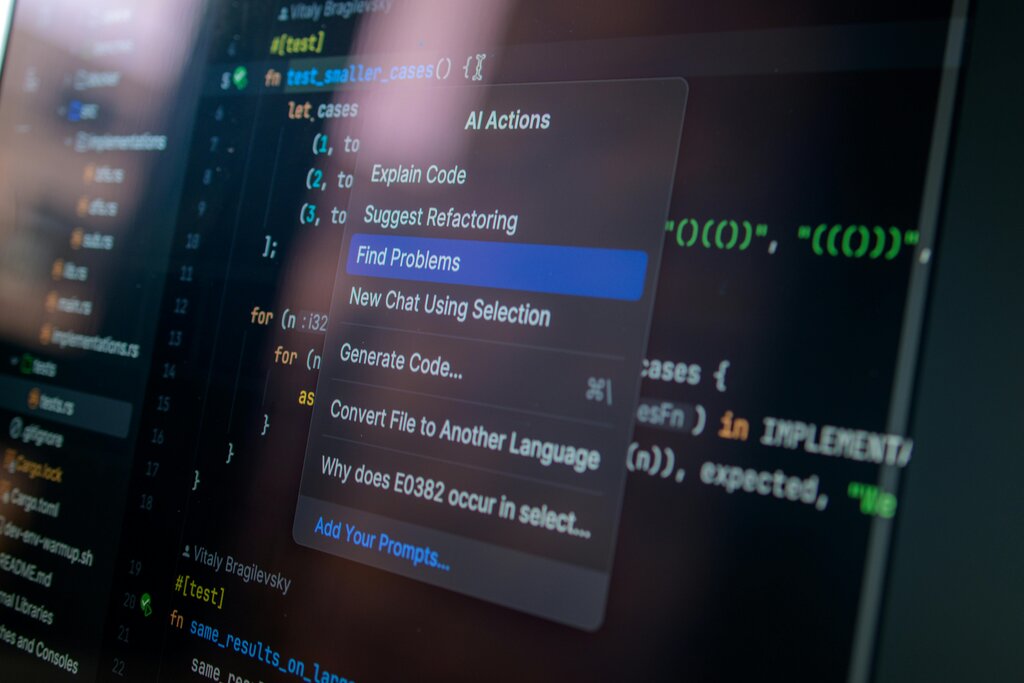
Integrating AI into the coding workflow offers some significant advantages. The most immediate is a boost in productivity. AI assistants excel at writing boilerplate code—the repetitive, standard chunks of code needed in almost every project. This frees up developers to focus their mental energy on more complex, creative problem-solving.
AI also acts as a vigilant reviewer, catching common errors and suggesting improvements on the fly. This can lead to cleaner, more reliable code and reduce the time spent on debugging later. For those learning to code, these tools are invaluable. They can serve as a patient tutor, providing examples and breaking down difficult concepts, which can make programming more accessible to newcomers.
AI code generation tools are transforming software development, especially for novice and non-software developers, by enabling them to write code and build applications faster and with little to no human intervention.
Navigating the Risks
While the benefits are compelling, AI-assisted coding isn't without its challenges. One of the biggest concerns is security. Because AI models learn from vast amounts of public code, they can sometimes reproduce snippets that contain security vulnerabilities. A developer who accepts AI-generated code without careful review might unknowingly introduce a flaw into their application.
There's also the issue of correctness. AI can occasionally "hallucinate" and produce code that looks plausible but is buggy, inefficient, or completely non-functional. The developer is always the final authority and must test and verify everything the AI writes.
Over-reliance is another risk. If developers lean too heavily on AI, their own fundamental coding skills could atrophy. The goal is to use AI as a tool for enhancement, not a crutch.
Properly incorporating AI into development requires an engineer-in-the-loop approach: balancing automation with continuous human oversight, securing sensitive data, and reducing potential risks like AI hallucinations and prompt injections.
A Look at the Toolbox
The market for AI coding tools is growing quickly, with several key players offering a range of features. These tools often integrate directly into popular code editors like Visual Studio Code, making them a seamless part of the development workflow. While we won't dive into the specifics of each one, it's helpful to know the names of a few major platforms.
| Tool | Primary Function |
|---|---|
| GitHub Copilot | Code completion and generation from natural language prompts |
| Amazon CodeWhisperer | Real-time code suggestions and security scanning |
| Tabnine | AI code completion that can be personalized on specific codebases |
| Replit Ghostwriter | An AI-powered suite for explaining, editing, and generating code |
Each tool has its own strengths, but they all share the same goal: to augment the developer's abilities and streamline the process of turning ideas into functional software.
What is the primary technology that powers modern AI coding assistants?
Which of the following is a key productivity benefit of using an AI coding assistant?