AI-Assisted Backend Development
Introduction to Backend Development
Beyond the Screen
Think of a website like a restaurant. The part you see—the tables, the menus, the decor—is the frontend. It’s what you interact with directly. But the real work happens in the kitchen, a place you never see. That’s the backend.
The backend is the engine of a web application. It’s a combination of servers, databases, and code that works behind the scenes. Its job is to manage the data and logic that make the application run. When you log into an account, post a photo, or buy something online, the backend is doing the heavy lifting. It authenticates your credentials, saves your data, and processes your transactions.
Back-end development focuses on the server-side logic and functionality that powers a website or application.
Essentially, the backend ensures that all the features on the frontend have the information and power they need to work correctly. Without it, a website would just be a static, unchangeable page.
The Client-Server Handshake
Web applications operate on a model called the client-server architecture. It’s a simple but powerful concept involving two key players.
-
The Client: This is the device you're using to browse the web, like your laptop or smartphone, along with the web browser (like Chrome or Safari). The client's job is to send requests for information.
-
The Server: This is a powerful computer, or a network of computers, where the website's code and data are stored. The server's job is to listen for requests from clients and send back responses.
Every time you interact with a website, you are kicking off a conversation between a client and a server. This constant back-and-forth is what makes the web dynamic and interactive.
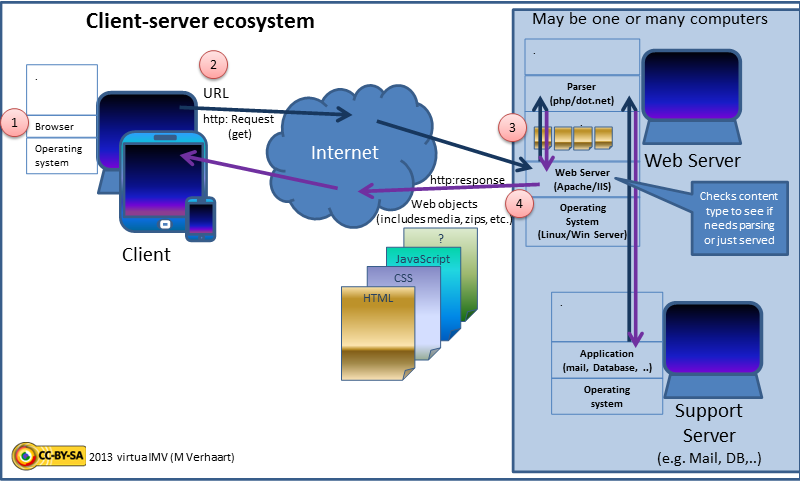
Requests and Responses
So what actually happens during this client-server handshake? Let's break down the request-response cycle.
When you type a web address into your browser and hit Enter, you're sending an HTTP (Hypertext Transfer Protocol) request to a specific server. This request isn't just a simple
Hey, give me the homepage!
It’s a structured message that includes the type of request (like GET to retrieve data or POST to send data), the address of the resource you want, and other details.
The server receives this request and processes it. This is where server-side programming comes in. The code running on the server figures out what the client wants. Does it need to fetch user data from a database? Does it need to process a payment? Based on the request, the server-side code performs the necessary actions.
Once the work is done, the server sends an HTTP response back to the client. This response includes a status code (like 200 OK for success or 404 Not Found for an error) and the content the client asked for, usually in the form of HTML, CSS, and JavaScript files that the browser can render into a webpage.
This cycle happens incredibly fast, often in milliseconds, for almost every interaction you have online.
Using the analogy of a website as a restaurant, what part represents the backend?
In the client-server model, what is the primary role of the client?
That's the core idea of the backend. It's the hidden, powerful machinery that handles logic and data, working with the frontend to deliver a complete web experience.