AI as Your Cognitive Collaborator
Introduction to AI
What Is Artificial Intelligence?
At its core, Artificial Intelligence (AI) is about creating computer systems that can perform tasks that typically require human intelligence. This includes things like learning from experience, solving problems, understanding language, and recognizing objects in an image.
Think of it less as building a synthetic human brain and more as teaching a machine to recognize patterns and make decisions based on data. We provide the computer with vast amounts of information, and it learns to identify connections and make predictions. It's the technology that powers everything from your email's spam filter to the recommendation engine that suggests your next favorite movie.
Artificial Intelligence
noun
A field of computer science dedicated to creating systems capable of performing tasks that normally require human intelligence, such as visual perception, speech recognition, decision-making, and translation between languages.
A Quick Trip Through Time
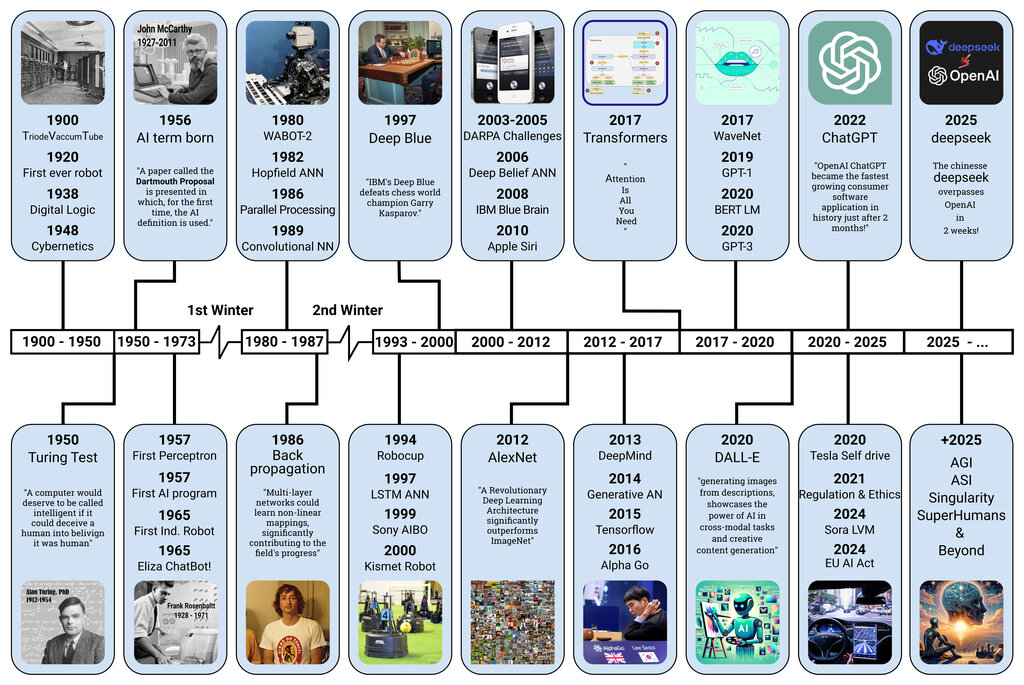
The idea of intelligent machines has been around for centuries, but the actual field of AI officially began in the summer of 1956. A group of scientists at Dartmouth College organized a workshop to explore the concept of thinking machines, and the term "Artificial Intelligence" was born.
The journey since then has been a series of peaks and valleys. Early excitement led to ambitious predictions, but the limits of computing power and data availability led to periods of slowed progress, often called "AI winters." However, in recent decades, the explosion of data and massive increases in computational power have fueled a resurgence, leading to the breakthroughs we see today.
The Building Blocks of AI
AI isn't a single technology; it's a broad field with many branches. Three of the most important concepts to understand are Machine Learning, Neural Networks, and Natural Language Processing. They are often nested within each other, each a more specialized version of the last.
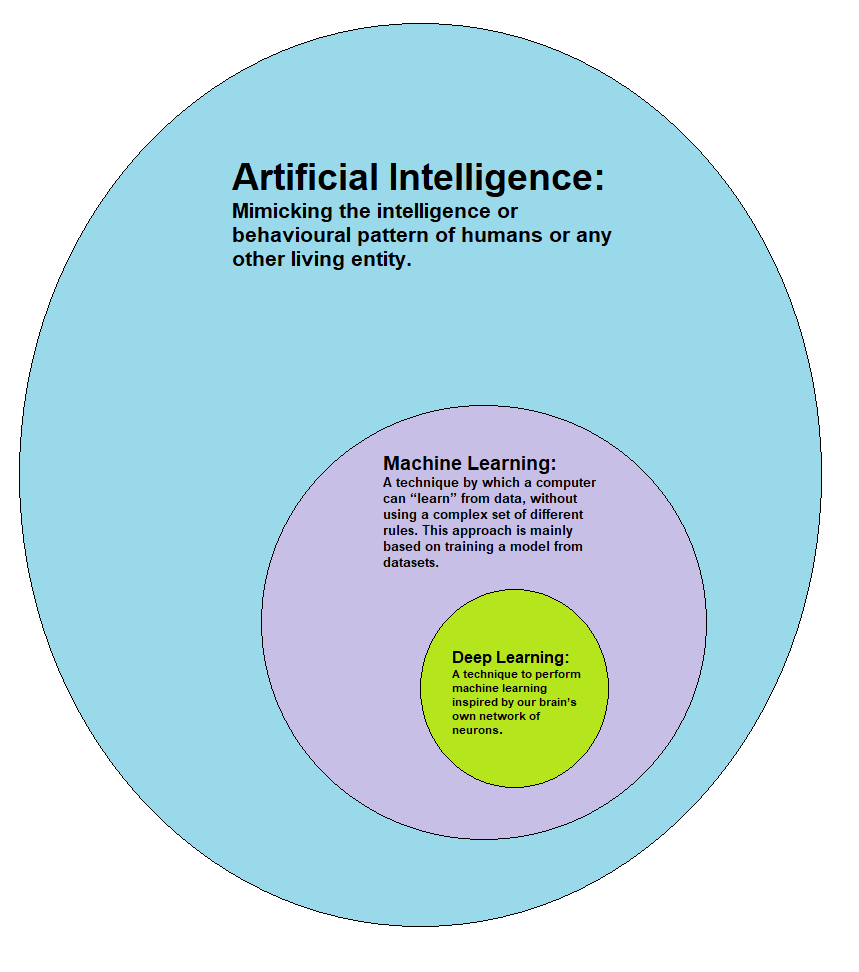
Machine Learning (ML) is a core part of modern AI. Instead of programming a computer with explicit rules for a task, we give it a large dataset and let it learn the rules for itself. For example, to build a spam detector, you don't write rules like "if the email contains the word 'free,' it's spam." Instead, you feed the system thousands of examples of spam and non-spam emails, and it learns to identify the patterns that distinguish them.
Essentially, Machine Learning is the process of teaching a computer to make predictions or decisions without being explicitly programmed to do so.
Neural Networks are a type of machine learning model inspired by the structure of the human brain. They are made up of layers of interconnected "neurons" that process information. Each neuron receives inputs, processes them, and passes the result to the next layer. This structure is particularly good at recognizing complex patterns in data, making neural networks the powerhouse behind tasks like image recognition and speech-to-text.
Finally, Natural Language Processing (NLP) is a branch of AI that helps computers understand, interpret, and generate human language. Whenever you use a voice assistant like Siri or Google Assistant, see a translation on a website, or get your writing checked by a grammar tool, you're interacting with NLP. It's the bridge that allows us to communicate with machines in our own language.
Two Flavors of AI
When people talk about AI, they are usually referring to one of two types: Narrow AI or General AI.
| Type | Description | Example |
|---|---|---|
| Narrow AI | Designed to perform a single specific task. | A chess-playing computer, a facial recognition system, or a self-driving car. |
| General AI | A hypothetical AI with human-like intelligence. | A machine that could learn and perform any intellectual task that a human can. |
All the AI we use today is Narrow AI. It can be incredibly powerful and outperform humans at its specific task, but it can't operate outside its programming. A chess program can't write a poem, and a self-driving car can't diagnose a disease.
Artificial General Intelligence (AGI) is the kind of AI you often see in science fiction. It's a machine with the ability to understand, learn, and apply its intelligence to solve any problem, just like a human being. AGI is still a long-term goal for researchers and remains purely theoretical for now. Understanding this distinction is key to cutting through the hype and seeing AI for the powerful, specialized tool it is today.
Ready to check your understanding? This quiz will cover the fundamental concepts of AI we've discussed.
What is the primary goal of Artificial Intelligence (AI)?
The type of AI we interact with daily, such as a spam filter or a movie recommendation engine, is known as ______.
By understanding these core ideas, you've built a solid foundation for exploring the fascinating world of Artificial Intelligence.