AI Application Development Fundamentals
Introduction to Artificial Intelligence
What Is Artificial Intelligence?
At its core, artificial intelligence is about making machines smart. It's a broad field of computer science focused on building systems that can perform tasks that normally require human intelligence. This includes things like learning from experience, understanding language, recognizing objects, solving problems, and making decisions.
Think of it this way: AI gives a computer the ability to think and learn, rather than just follow a rigid set of pre-programmed instructions.
The goal isn't necessarily to create a machine that thinks exactly like a human. Instead, it's about creating tools that can process information and complete tasks in intelligent ways, often far more efficiently than we can. From the spam filter in your email to the navigation app on your phone, you're likely interacting with AI every single day.
A Quick Trip Through Time
The dream of intelligent machines has been around for centuries, but the formal study of AI began in the mid-20th century. The term "artificial intelligence" was first coined at a workshop at Dartmouth College in 1956. Early researchers were incredibly optimistic, believing that a machine as intelligent as a human being was just a few decades away.
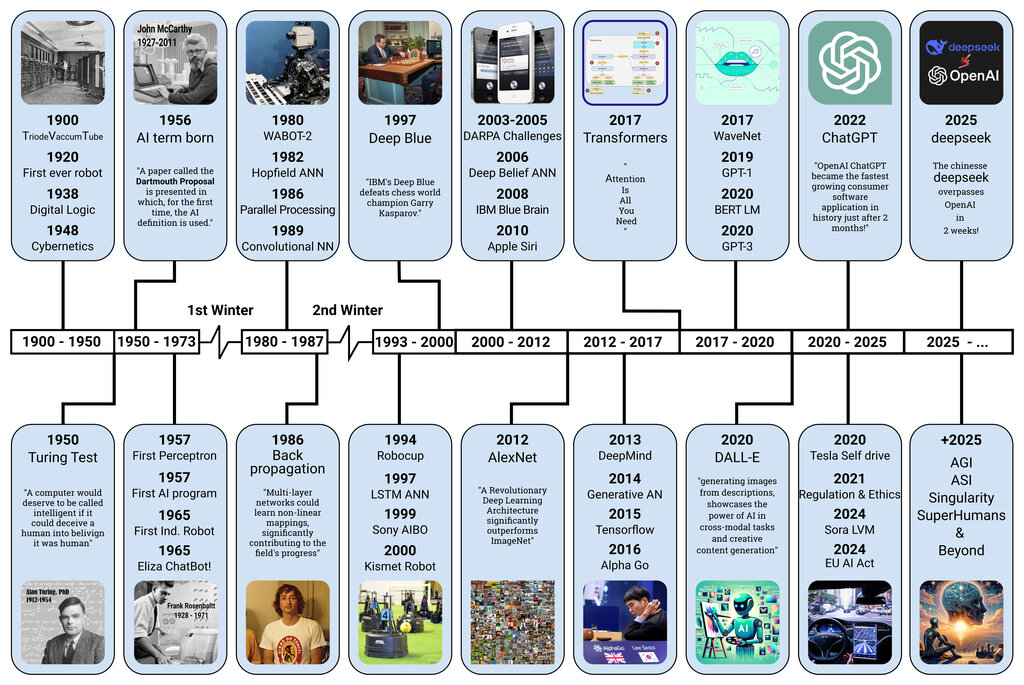
Progress came in waves. There were periods of excitement and huge funding, followed by "AI winters" where progress stalled and interest waned. But breakthroughs in computing power and the availability of massive amounts of data eventually fueled a resurgence. Developments like IBM's Deep Blue defeating a world chess champion in 1997 and the rise of powerful learning models in the 2010s brought AI out of the lab and into our daily lives.
The AI Family Tree
The term AI is often used as a catch-all, but it's actually a large umbrella covering many different subfields. The most important ones to know are Machine Learning and Deep Learning. It's helpful to think of them as nested concepts, where each is a specialized part of the one before it.
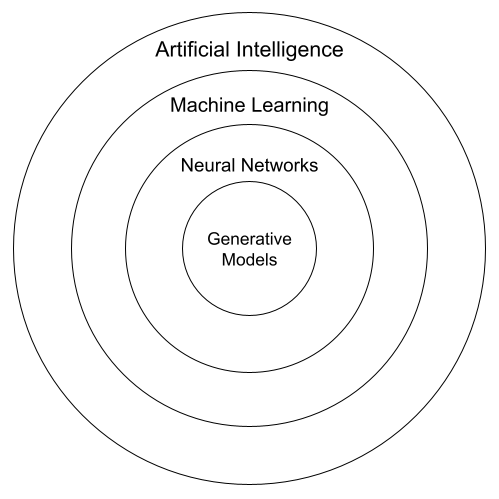
Machine Learning (ML) is a subfield of AI. Instead of being explicitly programmed to perform a task, a machine learning system is trained on large amounts of data. It learns to recognize patterns in that data and then uses those patterns to make predictions or decisions about new, unseen data.
Deep Learning is a subfield of machine learning. It uses complex, multi-layered structures called neural networks, which are loosely inspired by the human brain. Deep learning is particularly good at finding intricate patterns in very large datasets, making it the powerhouse behind many recent AI advances, like image recognition and natural language processing.
Another key area is Natural Language Processing (NLP), a branch of AI that focuses on enabling computers to understand, interpret, and generate human language. NLP is what allows you to talk to a voice assistant, translate text from one language to another, or get a summary of a long article.
AI in the Real World
AI isn't just a futuristic concept; it's a practical tool that's transforming industries all around us.
| Industry | AI Application |
|---|---|
| Healthcare | Analyzing medical images like X-rays and MRIs to detect diseases earlier and more accurately than the human eye. |
| Finance | Identifying fraudulent transactions in real-time by spotting unusual patterns in spending behavior. |
| Transportation | Powering the systems in self-driving cars to perceive the environment and navigate safely. |
| Entertainment | Recommending movies, shows, and music based on your viewing and listening history. |
These applications are just the beginning. From optimizing supply chains in retail to creating personalized learning plans in education, AI is being used to solve complex problems and create new opportunities across nearly every sector of the economy.
Now, let's test your understanding of these core concepts.
What is the primary goal of artificial intelligence?
Which statement best describes the relationship between AI, Machine Learning (ML), and Deep Learning?