AI Application Backend Development
Backend Development Basics
The Engine Room
Every application has two sides: the part you see and the part you don't. The part you interact with—the buttons, the text, the layout—is the frontend. But behind the scenes, there's a whole world of servers, databases, and application logic that makes everything work. This is the backend, the engine that powers the application.
A backend developer is like the chief engineer. Their job isn't about colors or fonts; it's about building and maintaining the core of the application. They are responsible for a few key areas:
- Server-Side Logic: Writing the code that processes requests from the frontend. For example, when you sign up for an account, backend code validates your information, creates your user profile, and saves it.
- Database Management: Storing, organizing, and retrieving all the application's data. This includes everything from user profiles to product inventories. They ensure data is safe, secure, and accessible.
- APIs (Application Programming Interfaces): Creating the communication channels that allow the frontend to talk to the backend. The API defines how the two sides exchange information.
Essentially, if the frontend is the car's dashboard and steering wheel, the backend is the engine, transmission, and fuel system—all the complex machinery that makes the car go.
Building the Blueprint
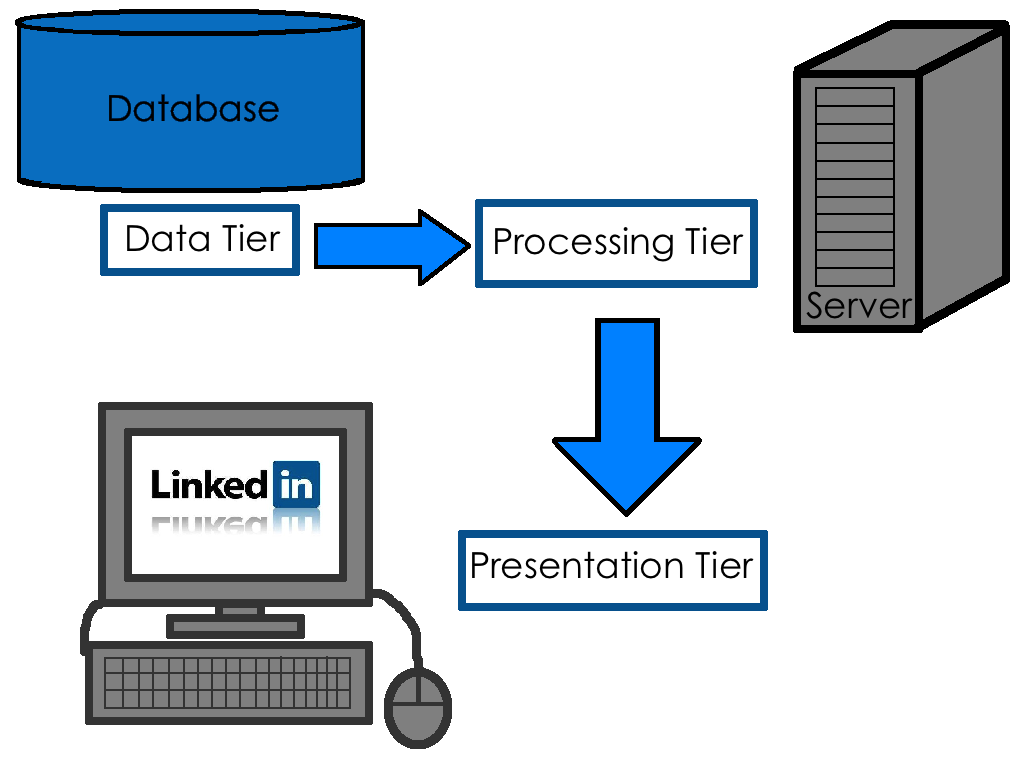
Backend systems aren't just a random collection of files and databases. They're built using a structured plan, or architecture, to ensure they are efficient, scalable, and easy to maintain. One of the most common and straightforward architectures is the three-tier model.
Let's break down these layers:
-
Presentation Tier: This is the frontend—the user interface. It's what the user sees and interacts with in their browser or mobile app. Its main job is to display data and collect user input.
-
Application Tier: This is the heart of the backend. It contains the application's logic, processing user requests from the presentation tier. If a user wants to see their purchase history, this tier fetches that data from the data tier, formats it, and sends it back to the presentation tier to be displayed.
-
Data Tier: This is where the information lives. It consists of databases and other storage systems that hold all the data the application needs. The application tier is the only layer that communicates directly with the data tier, which helps keep the data secure and organized.
This separation makes the system modular. You can update the user interface (presentation tier) without having to change the core logic (application tier), or switch your database (data tier) with minimal disruption to the rest of the app.
Tools of the Trade
Backend developers use a variety of languages, databases, and tools to build these systems. The choice of tools often depends on the project's specific needs, like the amount of data to be handled or the performance required.
API
noun
Stands for Application Programming Interface. It's a set of rules and protocols that allows different software applications to communicate with each other.
An API acts as a waiter in a restaurant. The frontend (the customer) gives an order (a request for data) to the API (the waiter). The API takes that request to the backend (the kitchen), which prepares the data (the food). The API then brings the data back to the frontend.
When it comes to programming languages, there are many options. Python is popular for its simplicity and powerful libraries, especially in AI and data science. Node.js allows developers to use JavaScript on the backend, which can be efficient for teams that also use it on the frontend. Java is a longtime favorite for large, enterprise-level applications because of its stability and performance.
For storing data, developers typically choose between two main types of databases: SQL and NoSQL.
| Feature | SQL (Relational) | NoSQL (Non-Relational) |
|---|---|---|
| Data Structure | Structured data in tables with predefined schemas (rows and columns) | Unstructured or semi-structured data (documents, key-value pairs) |
| Schema | Rigid, defined in advance | Flexible, dynamic schema |
| Scalability | Vertically (increase power of a single server) | Horizontally (add more servers) |
| Example | PostgreSQL, MySQL | MongoDB, Cassandra |
SQL databases are like organized spreadsheets and are great for data that has clear, consistent relationships. NoSQL databases are more like filing cabinets where each document can have a different structure, making them ideal for large amounts of varied data.
Understanding these core components—the roles, the architecture, and the tools—is the first step to building the powerful and reliable backend systems that drive modern applications.