AI and the Evolving Workplace
Introduction to Organizational Psychology
The Psychology of the Workplace
Organizational psychology is the study of how people behave at work. It's that simple. Professionals in this field, often called I/O (Industrial-Organizational) psychologists, look at everything from what makes employees happy and productive to how teams can work better together. The goal is to apply psychological principles to solve problems in the workplace and improve the quality of life for everyone involved.
Think of an organization as a complex ecosystem. It has individuals, groups, and leaders, all interacting with each other. I/O psychology tries to understand these interactions. It explores questions like: Why are some people more motivated than others? What makes a good leader? How does the overall 'vibe' or culture of a company affect its success? By answering these questions, we can make work more efficient, engaging, and fulfilling.
What Drives Us at Work
Motivation is the force that drives our behavior. At work, it's what gets us to finish a project, help a colleague, or even just show up on time. Understanding what motivates people is a huge part of organizational psychology. One of the most famous theories is Maslow's Hierarchy of Needs.
Abraham Maslow suggested that our needs are arranged in a pyramid. At the bottom are the most basic needs, like food, water, and safety. You can't focus on much else until these are met. In a work context, this translates to having a stable job and a safe working environment. Once those are secure, we can move up the pyramid to social needs (like belonging to a team), esteem needs (recognition and respect), and finally, self-actualization (reaching our full potential).
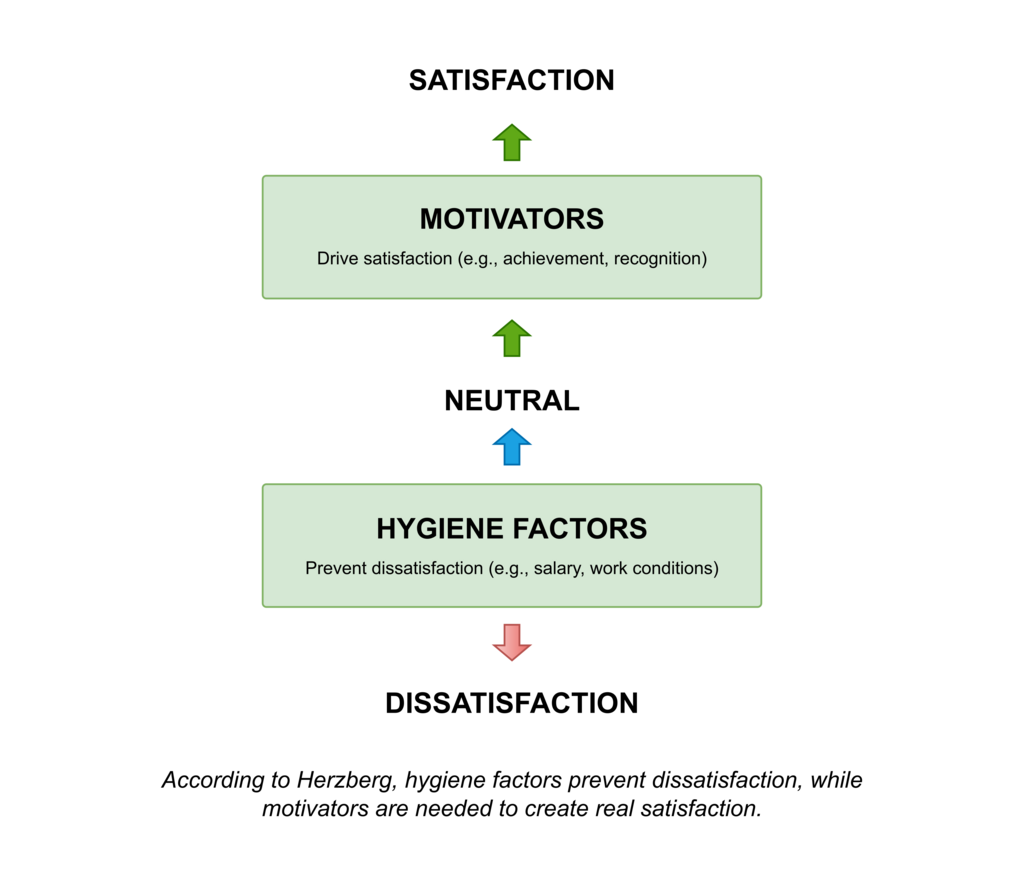
Another important perspective is Frederick Herzberg's Two-Factor Theory. He argued that the things that make people dissatisfied at work are different from the things that make them satisfied.
He called the first category "Hygiene Factors." These are things like salary, work conditions, and company policies. If these are bad, people will be unhappy. But even if they're great, they won't necessarily make people motivated. They just prevent dissatisfaction.
The second category is "Motivators." These are things like challenging work, recognition, responsibility, and personal growth. According to Herzberg, these are the factors that truly drive job satisfaction and push people to perform their best.
Leadership and Teamwork
A leader's style can shape the entire experience of a team. Some leaders are autocratic, making decisions on their own. Others are democratic, involving the team in the decision-making process. Then there are laissez-faire leaders, who give their team a lot of freedom. There isn't one "best" style; the most effective approach often depends on the team, the task, and the situation.
But leadership is only part of the equation. How a team works together is just as crucial. A simple way to understand team effectiveness is the Input-Process-Output (IPO) model. This model suggests that a team's success (output) is a result of its internal workings (process), which are influenced by the resources and context it starts with (input).
Inputs: These are the ingredients. Think of team member skills, resources like time and money, and the nature of the task.
Process: This is how the ingredients are mixed. It includes communication, coordination, conflict resolution, and decision-making.
Outputs: This is the final dish. It includes performance (did they achieve the goal?), team member satisfaction, and the team's ability to work together in the future.
The Unspoken Rules
Every workplace has a distinct personality, often called its organizational culture. This culture is the collection of shared values, beliefs, and assumptions that guide how people behave. It's the "way we do things around here." Culture can be seen in the office layout, the communication style, the company's rituals, and the stories people tell.
A strong, positive culture can be a powerful asset. When employees feel aligned with the company's values, they're more likely to be engaged, collaborative, and committed. On the other hand, a toxic or weak culture can lead to low morale, high turnover, and poor performance. Culture isn't just a fluffy concept; it has a direct impact on the bottom line.
Now, let's test your understanding of these core concepts.
According to Herzberg's Two-Factor Theory, which of the following is considered a 'Hygiene Factor'?
A manager who involves their team in the decision-making process is demonstrating which leadership style?
Understanding these foundations of organizational psychology gives us a framework for analyzing any workplace. By looking at motivation, leadership, team dynamics, and culture, we can start to see why some organizations thrive while others struggle.