AI and the Environment
Introduction to AI
What is Artificial Intelligence?
Artificial intelligence, or AI, is the science of making machines that can think, learn, and solve problems like humans do. It's not about creating conscious robots from movies. Instead, it's about building systems that can perform tasks that typically require human intelligence, such as understanding language, recognizing images, or making decisions based on data.
Think of it this way: You don't program an AI with every single rule. You give it a goal and the ability to learn, and it figures out the best way to achieve that goal on its own.
This ability to learn from experience is what makes AI so powerful. It allows a computer to spot patterns in vast amounts of data that would be impossible for a person to see. The core idea is to simulate human intelligence in machines, enabling them to adapt and improve over time.
A Brief History
The dream of intelligent machines is ancient, but the scientific field of AI is relatively new. It officially began in the summer of 1956 at a workshop at Dartmouth College, where the term "artificial intelligence" was coined. Early pioneers were optimistic, believing a machine as intelligent as a human was just a few decades away.
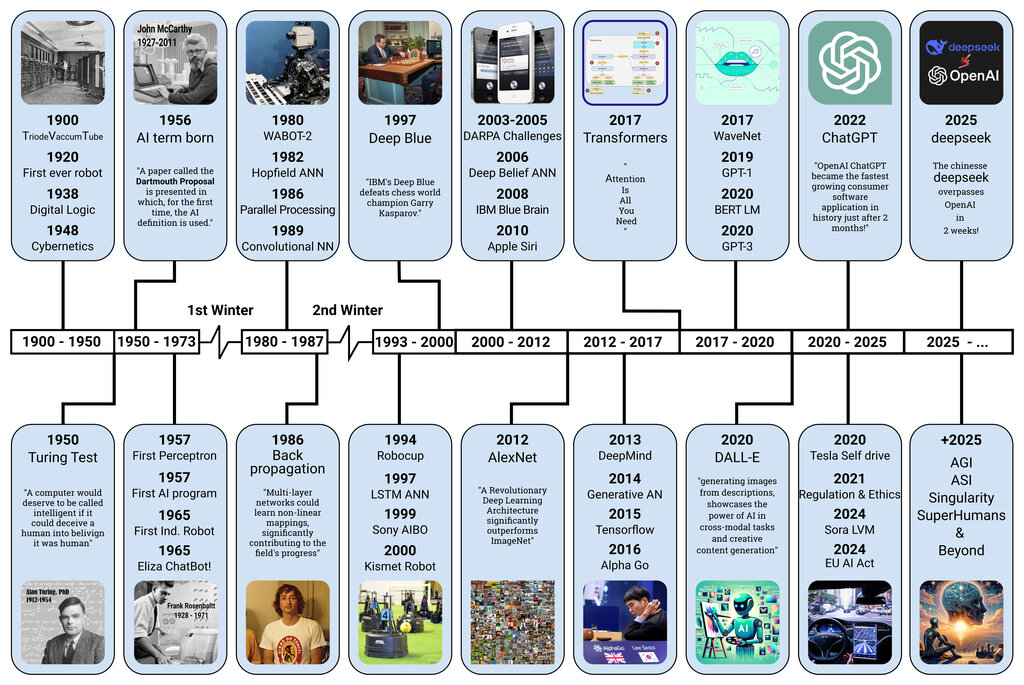
Progress wasn't always a straight line. The field went through periods of high funding and excitement, followed by "AI winters" where progress stalled and funding dried up. However, the last two decades have seen an explosion in AI development. This is thanks to two key factors: the availability of massive amounts of data (big data) and the development of powerful computers that can process it all quickly.
Narrow vs. General AI
Not all AI is created equal. Today, AI systems are categorized into two main types based on their capabilities: Narrow AI and General AI.
Artificial Narrow Intelligence (ANI)
noun
Also known as Weak AI, this is AI that is designed and trained for one specific task. It operates within a limited, pre-defined range and cannot perform beyond its designated function.
You interact with Narrow AI every day. Your phone's voice assistant, the recommendation engine on a streaming service, and even the software that detects credit card fraud are all examples of ANI. They are incredibly good at their specific jobs but can't do anything else. A chess-playing AI can't write a poem, and a spam filter can't drive a car.
Artificial General Intelligence (AGI)
noun
Also known as Strong AI, this is a theoretical form of AI where a machine would have an intelligence equal to humans. It would have a self-aware consciousness and the ability to solve problems, learn, and plan for the future.
AGI is the kind of AI you see in movies, like HAL 9000 from 2001: A Space Odyssey. It's a machine that can understand and learn any intellectual task that a human being can. It's important to remember that AGI does not exist yet; it remains a goal for researchers.
| Feature | Narrow AI (ANI) | General AI (AGI) |
|---|---|---|
| Scope | Performs a single task | Can perform any intellectual task a human can |
| Awareness | No consciousness or self-awareness | Self-aware and conscious (theoretical) |
| Examples | Voice assistants, image recognition | Fictional characters (e.g., The Terminator) |
| Status | Widely used today | Does not yet exist |
The Engines of AI
So how do we get machines to learn and solve problems? Two of the most important concepts that power modern AI are Machine Learning and Neural Networks.
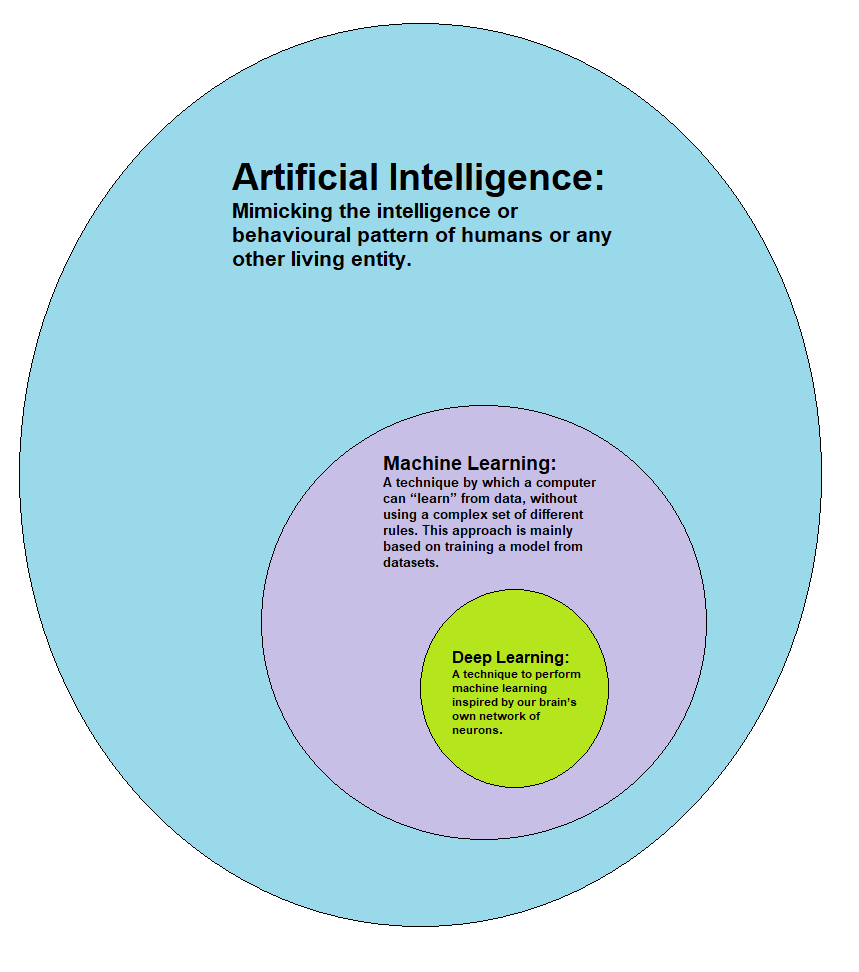
Machine Learning (ML) is a subfield of AI. Instead of writing explicit instructions for a computer, ML algorithms allow the computer to learn from data. You show it thousands of pictures of cats, and it learns to recognize a cat. You give it historical sales data, and it learns to predict future sales. It's all about identifying patterns.
Neural Networks are a type of machine learning model inspired by the structure of the human brain. They are made up of layers of interconnected nodes, or "neurons." Each neuron receives input, processes it, and passes an output to the next layer.
When a neural network has many layers, it's called a "deep neural network," and the technique is known as Deep Learning. This depth allows the network to learn very complex patterns, which is why it's behind many of today's most advanced AI applications, like self-driving cars and advanced language translation.
Now that you understand the basic terms and history, it's time to review.
Let's check your understanding of these core concepts.
What is the primary goal of Artificial Intelligence as a scientific field?
The recent explosion in AI development is largely due to the availability of powerful computers and what other key factor?
These fundamental ideas—from the basic definition of AI to the complex structures of neural networks—are the building blocks for everything that follows. Understanding them is the first step to understanding how AI works and its role in the world.