AI and Manus
Introduction to AI
What Is Artificial Intelligence?
At its core, artificial intelligence (AI) is the science of making machines smart. It's a broad field of computer science focused on building systems that can perform tasks that typically require human intelligence. This includes things like learning from experience, solving problems, understanding language, and recognizing patterns in the world around us.
This introduction to this special issue discusses artificial intelligence (AI), commonly defined as “a system’s ability to interpret external data correctly, to learn from such data, and to use those learnings to achieve specific goals and tasks through flexible adaptation.”
Think of it less as creating a conscious robot and more as developing a powerful tool. AI systems analyze huge amounts of data to find shortcuts (algorithms) for achieving specific goals, whether that's recommending your next movie or helping doctors diagnose diseases.
A Brief History of AI
The dream of intelligent machines has been around for centuries, but the actual field of AI began in the 1950s. A handful of computer scientists believed that a machine could be made to think, and in 1956, they gathered for a workshop at Dartmouth College. It was here that the term "artificial intelligence" was officially coined.
The early years were filled with excitement. Researchers developed programs that could solve algebra problems, prove theorems, and speak simple English. But the initial optimism soon hit a wall. The computers of the time weren't powerful enough, and the problems turned out to be much harder than expected. This led to periods known as "AI winters," when funding dried up and progress slowed.
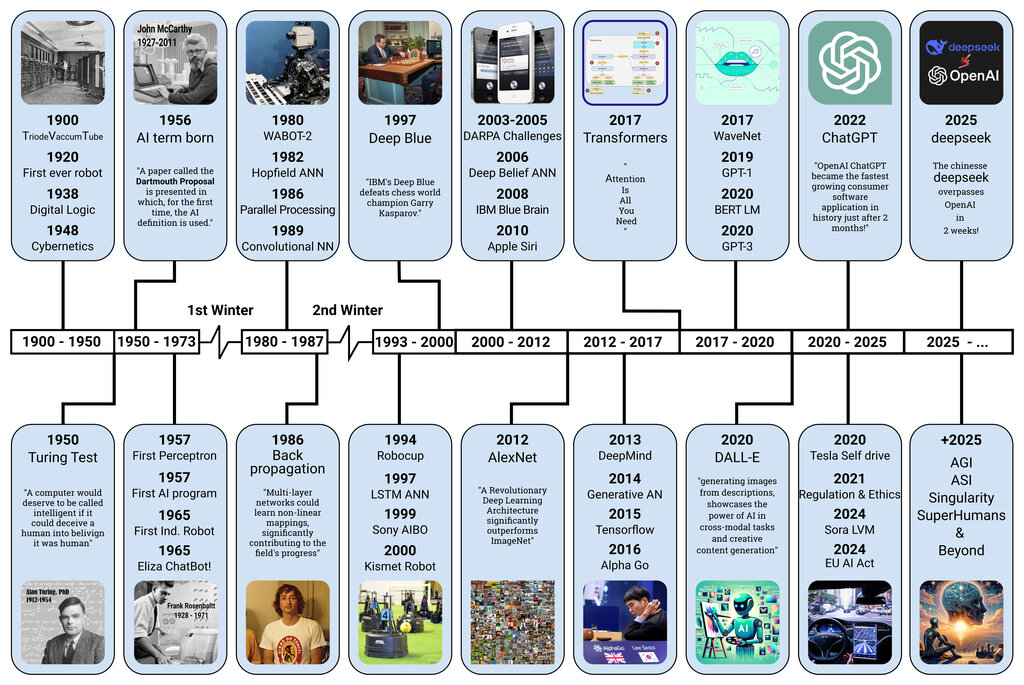
Things began to change in the 1990s and 2000s. A combination of faster computers, larger datasets, and smarter algorithms led to a renaissance. In 1997, IBM's Deep Blue computer defeated world chess champion Garry Kasparov, a major milestone. This was followed by the rise of machine learning and, more recently, deep learning, which power many of the AI applications we use every day.
Three Kinds of AI
Not all AI is created equal. We can categorize it into three main types based on its capabilities. Understanding these distinctions is key to understanding where AI is today and where it might be headed.
| Type | Capability | Status |
|---|---|---|
| Artificial Narrow Intelligence (ANI) | Performs a specific task | Exists today |
| Artificial General Intelligence (AGI) | Performs any intellectual task a human can | Theoretical |
| Artificial Superintelligence (ASI) | Surpasses human intelligence in all areas | Hypothetical |
Artificial Narrow Intelligence (ANI) is the only type of AI we have successfully created so far. It's designed to perform a single task very well. Your spam filter, a navigation app, a voice assistant like Siri or Alexa—these are all examples of ANI. They are incredibly useful for their specific purpose but can't operate outside of it. A chess-playing AI can't write a poem, and a self-driving car can't suggest a recipe for dinner.
Artificial General Intelligence (AGI) is the next step, and it's what many people think of when they hear "AI." This is an AI with the ability to understand, learn, and apply its intelligence to solve any problem, much like a human being. It would be able to reason, plan, and think abstractly. AGI is a major goal of AI research, but a true AGI system does not yet exist.
Artificial Superintelligence (ASI) is a hypothetical future stage where AI surpasses human intelligence across virtually every field, from scientific creativity to general wisdom. The capabilities of such an AI are difficult to predict, but it represents the ultimate potential of artificial intelligence.
For now, all the AI influencing our world is narrow AI. But the rapid progress in this area is what fuels the research and discussion about what AGI and ASI might one day become.