AI and Machine Learning Fundamentals
Introduction to AI
What Is Artificial Intelligence?
Artificial intelligence, or AI, is the science of making machines that can think and learn like humans. It’s a field of computer science focused on creating systems that can perform tasks that typically require human intelligence. This isn't just about crunching numbers faster; it's about simulating core human abilities.
The main goals of AI are to enable machines to reason through problems, learn from experience, and perceive the world around them.
Imagine teaching a computer to play chess. You wouldn't just give it a list of every possible move. Instead, you'd want it to understand the rules, recognize patterns, and develop strategies based on the opponent's actions. That ability to reason, adapt, and solve problems is the essence of AI.
The Three Types of AI
When we talk about AI, we're not talking about a single entity. The field is often broken down into three categories based on a machine's capabilities. These categories help us understand where the technology is today and where it might be headed.
Artificial Narrow Intelligence
noun
AI that is specialized for one specific task. It operates within a limited context and cannot perform tasks outside its designated scope.
Also known as "Weak AI," this is the only type of artificial intelligence we have successfully created so far. Every AI you interact with today, from voice assistants to recommendation engines, is a form of ANI. It might seem incredibly smart, but it's operating within a pre-defined, narrow range. A chess-playing AI can't write a poem, and a language translation app can't diagnose a medical condition.
Artificial General Intelligence
noun
A type of AI that possesses the ability to understand, learn, and apply its intelligence to solve any problem that a human being can.
AGI, or "Strong AI," is the next frontier. It represents the kind of adaptable, flexible intelligence we see in humans. An AGI system could learn to do anything a human can, from performing scientific research to understanding social cues. This level of AI does not yet exist and remains a major goal for researchers.
Artificial Superintelligence
noun
A hypothetical form of AI that would possess intelligence far surpassing that of the brightest and most gifted human minds.
This is the most speculative category. An ASI would not just mimic human intelligence; it would exceed it in every domain, including scientific creativity, general wisdom, and social skills. The development of ASI is purely theoretical and is a popular subject in both science fiction and philosophical debates about technology's future.
A Brief History of AI
The idea of intelligent machines has been around for centuries, but the formal field of AI research began in the mid-20th century. In 1956, a group of researchers held a workshop at Dartmouth College, where the term "artificial intelligence" was officially coined. This event marked the birth of AI as an academic discipline.
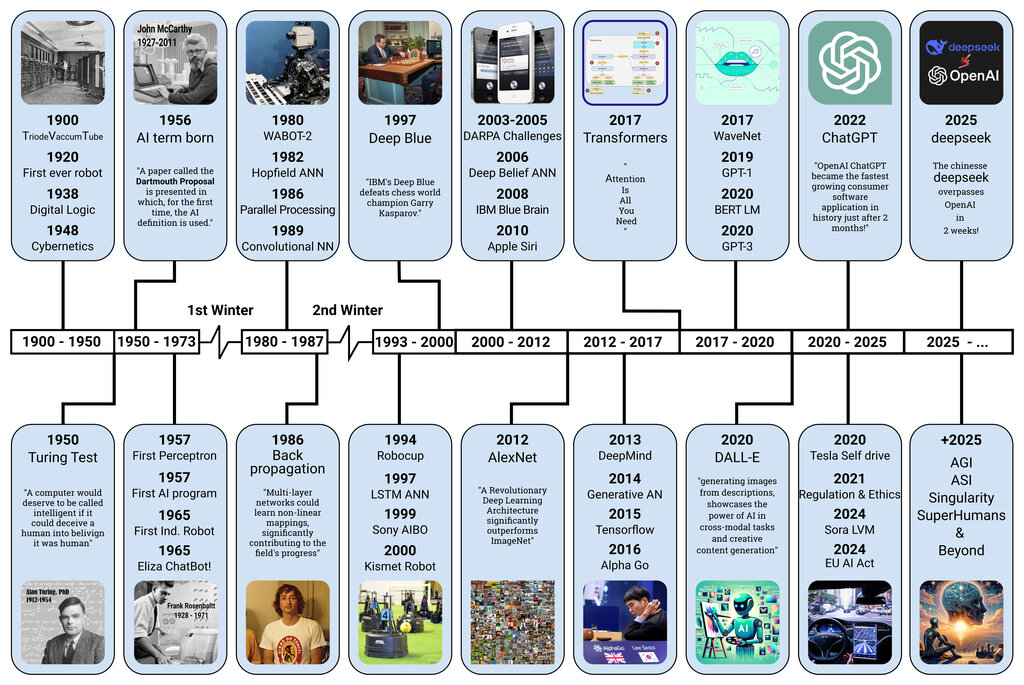
The early years were filled with optimism. Researchers developed programs that could solve algebra problems and prove theorems in logic. However, the initial excitement was followed by a period known as the "AI winter" in the 1970s and 80s. Progress slowed as the complexity of creating true intelligence became apparent and funding dried up.
A resurgence began in the 1990s and has accelerated dramatically in the 21st century, fueled by the availability of vast amounts of data and massive increases in computing power. This combination allowed for new approaches that have led to the powerful AI systems we see today.
Why AI Matters Now
The significance of AI in modern technology is hard to overstate. It has moved from a niche academic field to a driving force of innovation. AI is not just a single technology but a foundational layer that is enhancing countless other systems and processes.
It allows us to find patterns in complex data that would be impossible for humans to detect, from medical imaging to climate modeling. It powers automation that makes industries more efficient and creates new possibilities for scientific discovery. Understanding the basics of AI is becoming essential for navigating a world that is increasingly shaped by intelligent machines.
What is the primary goal of the field of artificial intelligence?
The AI that powers your smartphone's voice assistant or a recommendation engine is an example of which type of AI?
This foundational knowledge sets the stage for exploring the more complex mechanisms and applications that make AI such a transformative field.