AI and Human Potential
Introduction to Artificial Intelligence
What Is Artificial Intelligence?
At its core, Artificial Intelligence is about creating machines that can think or act intelligently. The goal is to build systems that can perform tasks that normally require human intelligence, like learning, reasoning, problem-solving, and understanding language.
Artificial Intelligence
noun
A field of computer science dedicated to creating systems that can perform tasks that typically require human intelligence. This includes abilities like learning from data, recognizing patterns, and making decisions.
Think of it this way: when you teach a child to recognize a cat, you show them pictures and point out key features—whiskers, pointy ears, a long tail. After seeing enough examples, the child learns to identify cats they've never seen before. AI, particularly a subfield called machine learning, works in a similar way. It learns patterns from vast amounts of data to make predictions or decisions.
A Quick Trip Through Time
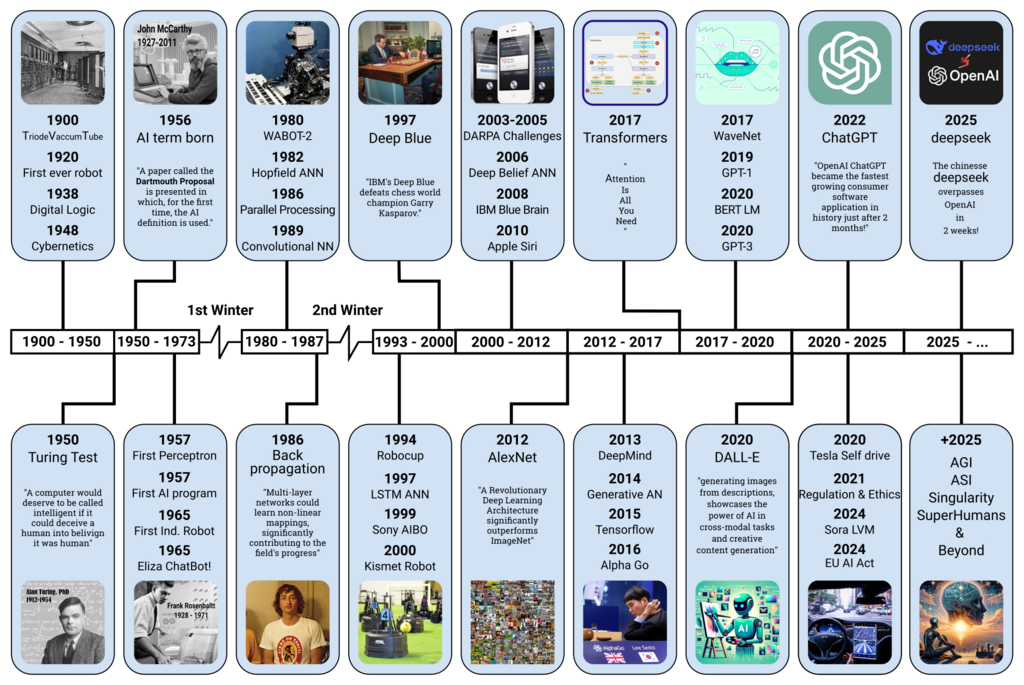
The dream of creating intelligent machines isn't new. It dates back to ancient myths about automatons and mechanical beings. But the modern field of AI officially kicked off in the summer of 1956 at a workshop at Dartmouth College. It was there that the term "artificial intelligence" was first coined.
The early days were filled with optimism. Researchers created programs that could solve algebra problems and prove theorems. But progress stalled. The complexity of creating true intelligence was far greater than imagined, leading to periods known as "AI winters," when funding and interest dried up.
Things began to change dramatically in the 21st century. Two key ingredients became widely available: massive amounts of data from the internet and powerful computers capable of processing it all. This combination fueled the deep learning revolution, leading to the AI boom we see today.
The Three Types of AI
Not all AI is created equal. When we talk about AI, we're usually talking about one of three distinct categories, based on its capabilities.
| Type | Description | Current Status |
|---|---|---|
| Artificial Narrow Intelligence (ANI) | Specializes in one specific task. | All current AI is ANI. |
| Artificial General Intelligence (AGI) | Possesses human-like intelligence and can learn any task. | Hypothetical. |
| Artificial Superintelligence (ASI) | Surpasses human intelligence in every domain. | Hypothetical. |
Artificial Narrow Intelligence (ANI) is the only type of AI we have achieved so far. It's designed to perform a single, specific task very well. Your GPS, a spam filter, a chess-playing computer, or a movie recommendation engine are all examples of ANI. They are incredibly powerful in their specialized area, but they can't operate outside of it. A chess program can't suggest a movie for you.
Artificial General Intelligence (AGI) is the next step, and it remains the stuff of science fiction for now. An AGI would be a machine with the ability to understand, learn, and apply its intelligence to solve any problem, much like a human being. It could switch seamlessly between writing a poem, composing music, and solving a complex physics equation.
Artificial Superintelligence (ASI) is a hypothetical future AI that wouldn't just mimic human intelligence but would far surpass it. An ASI would be smarter than the most brilliant human minds in virtually every field, from scientific creativity to general wisdom.
Capabilities and Limitations
Today's AI is a powerful tool. It excels at finding patterns in enormous datasets, which makes it great for tasks like identifying diseases in medical scans or detecting fraudulent transactions. It can generate text, images, and code with remarkable fluency. These systems can process information at a scale and speed that is impossible for humans.
However, AI has significant limitations. Current systems lack true understanding or common sense. They don't grasp context the way we do. An AI can translate a sentence, but it doesn't know what the words mean. It learns from the data it's trained on, which means if the data is biased, the AI will be biased too.
AI is also not creative or conscious in a human sense. It can combine existing patterns in novel ways, but it doesn't have original thoughts, feelings, or self-awareness. It's a sophisticated pattern-matching machine, not a thinking being.
The power of today's AI lies in its ability to handle specific, well-defined tasks at scale. Its weakness is its lack of general understanding and common sense.
Knowing these fundamentals—what AI is, where it came from, and what it can (and can't) do right now—is the first step to understanding its role in our world.
What is the fundamental goal of Artificial Intelligence?
The term "artificial intelligence" was first coined at a workshop in 1956 held at which institution?