AI and Foundational LLMs Explained
Introduction to Artificial Intelligence
What Is Artificial Intelligence?
Artificial intelligence is about making computers smart. It’s a field of computer science dedicated to creating systems that can perform tasks that normally require human intelligence. This includes things like learning from experience, solving problems, understanding language, and recognizing objects in an image.
This introduction to this special issue discusses artificial intelligence (AI), commonly defined as “a system’s ability to interpret external data correctly, to learn from such data, and to use those learnings to achieve specific goals and tasks through flexible adaptation.”
Think of it not as a single technology, but as a broad umbrella covering many different methods and approaches. At its heart, AI is about giving machines the ability to think and adapt. Instead of just following a rigid set of pre-programmed instructions, an AI system can analyze new information and change its behavior accordingly.
How AI Thinks
So how does a machine “think”? AI systems are generally built on three core principles: learning, reasoning, and self-correction. They work together in a continuous cycle.
Learning: This is the process of acquiring information and rules for using it. For an AI, this information is data. By processing vast amounts of data, the system can identify patterns. For example, by analyzing thousands of cat photos, an AI learns to recognize the features of a cat, just like a toddler does.
Reasoning: Once it has learned, the AI uses its rules and patterns to make decisions or predictions. It's like a detective using clues (the data) to solve a mystery. If the AI has learned what a cat looks like, it can then reason whether a new, unseen image contains a cat.
Self-correction: This is where the AI refines its abilities. If the AI incorrectly identifies a raccoon as a cat, it gets feedback. This feedback helps it adjust its internal rules, making it less likely to repeat the same mistake. Over time, this process of trial and error makes the AI more accurate and reliable.
A Brief History of AI
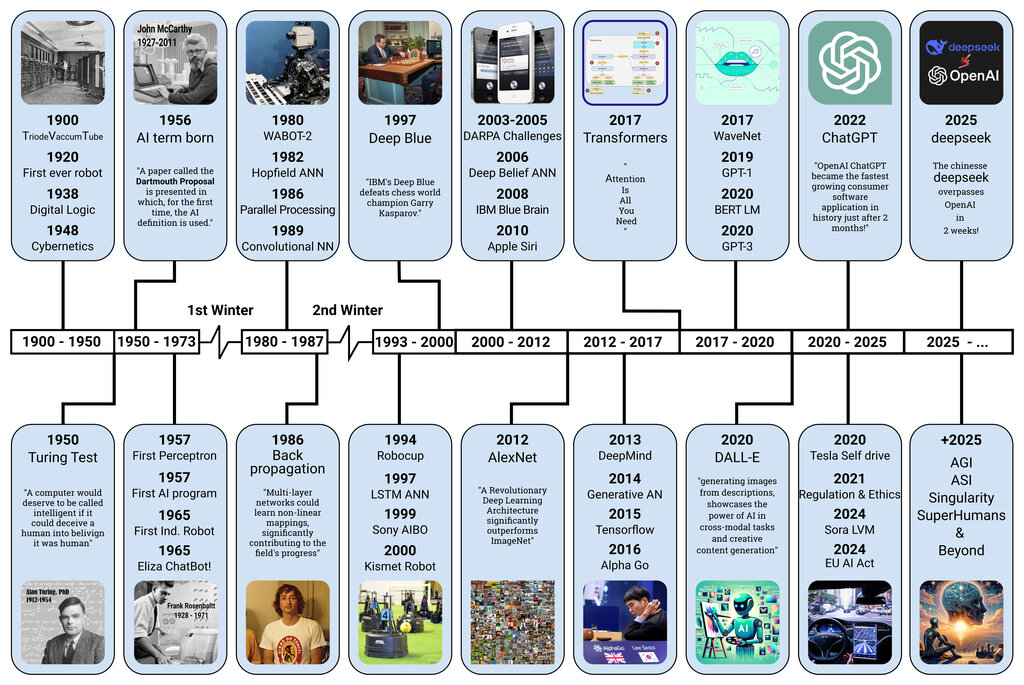
The idea of intelligent machines has been around for centuries, but the modern field of AI officially began in the summer of 1956 at a workshop at Dartmouth College. This event brought together the founding fathers of the field and coined the term "artificial intelligence."
The following decades saw waves of excitement and disappointment. Early enthusiasm led to predictions that human-level AI was just around the corner. But when progress stalled due to limited computing power and data, funding dried up, leading to periods known as "AI winters."
A major turning point was the rise of machine learning in the 1980s and 90s, shifting the focus from programming explicit rules to allowing systems to learn from data. This culminated in high-profile successes, like IBM's Deep Blue computer defeating world chess champion Garry Kasparov in 1997. In the 21st century, the availability of massive datasets and powerful computers has fueled the deep learning revolution, leading to the powerful AI tools we see today.
Two Kinds of AI
When people talk about AI, they are usually referring to one of two broad categories: narrow AI and general AI.
Narrow AI
noun
Also known as Weak AI, this is artificial intelligence that is focused on one specific task.
Every AI application you interact with today is a form of narrow AI. Your phone's voice assistant, the recommendation engine on a streaming service, and even complex systems like self-driving cars are all designed for a limited set of tasks. They can perform their specific function incredibly well, often better than a human, but they can't operate outside of their programming.
A chess-playing AI can beat any human, but it can't tell you if a picture shows a cat or a dog. It's an expert in one domain and knows nothing about any other.
The other type, Artificial General Intelligence (AGI), is what you often see in science fiction. AGI, or Strong AI, refers to a machine with the ability to understand, learn, and apply its intelligence to solve any problem, much like a human being. This kind of flexible, adaptable intelligence doesn't exist yet and is still a long-term goal for many researchers.
| Feature | Narrow AI (ANI) | General AI (AGI) |
|---|---|---|
| Scope | Performs a single, specific task | Can handle any intellectual task a human can |
| Learning | Limited to its specific domain | Can transfer knowledge between domains |
| Current State | All current AI is narrow AI | Hypothetical, does not exist yet |
| Example | Facial recognition, language translation | A robot that could be a doctor, chef, or mechanic |
Now that you've got the basics down, let's review the key terms we've covered.
Ready to check your understanding?
What is the fundamental goal of artificial intelligence?
An AI system analyzes thousands of medical scans to learn how to identify tumors. When it incorrectly flags a healthy area, it receives feedback and adjusts its internal rules to avoid that mistake in the future. Which core AI principle is best demonstrated by this adjustment process?
Understanding these fundamental concepts is the first step. AI is a powerful tool built on simple principles of learning from data, reasoning to make decisions, and correcting its mistakes over time.