AI and Automation for Marketing and Beyond
Agentic Architecture Fundamentals
Beyond the Chatbox
Most interactions with AI feel like a conversation. You type a prompt, a large language model (LLM) responds, and the exchange ends. This is useful for drafting an email or summarising a report, but it's a passive process. The AI only works when you're actively giving it commands.
Agentic AI flips this script. Instead of a one-off command, you give an agent a goal. It then works autonomously, using tools and reasoning to achieve the objective without you needing to guide every step. It’s the difference between asking a junior employee to write a single social media post versus asking them to manage the entire social media calendar for a week. One is a task; the other is a responsibility.
Unlike traditional generative AI, which responds reactively to prompts, agentic AI proactively orchestrates processes, such as autonomously managing complex tasks or making real-time decisions.
This shift moves AI from being a dashboard that shows you data to an active player that executes tasks based on that data. It doesn't just predict which customers are likely to churn; it can reach out to them with a personalised offer to stay. This is the core of moving from manual tinkering to autonomous execution.
Agents vs. Automations
It's easy to confuse AI agents with standard automation tools. Both can perform tasks without human intervention. The key difference lies in how they handle decisions.
Standard automations are deterministic. They follow rigid, predefined rules. Think of an "if-this-then-that" workflow: if a new customer signs up, then send a welcome email. It's a straight line from trigger to action, with no room for interpretation. These systems are reliable for simple, repetitive tasks but break down when faced with ambiguity.
Agentic workflows, on the other hand, are dynamic. They use an LLM to reason and make decisions at critical points. Instead of a fixed rule, the agent evaluates the situation and chooses the best path forward. This allows them to handle complex, unpredictable scenarios that would paralyse a simple automation.
For example, a deterministic workflow might automatically post a new blog article to all social media channels. An agentic workflow would first analyse the blog post's content, decide which channels are most appropriate (e.g., LinkedIn for a technical article, Instagram for a visual one), and then tailor the message for each platform's audience and format. The goal is the same—promote the article—but the execution is intelligent and adaptive.
The Agentic Loop
So how does an agent actually work? Most follow a simple but powerful cycle often called the —short for Reason and Act. This loop enables an agent to tackle complex goals that require multiple steps.
- Observe: The agent assesses the current situation and gathers necessary information. This could involve reading an email, checking a customer's profile in a CRM, or searching the web.
- Reason: Based on its observations and the overall goal, the LLM at its core decides on the next logical step. It formulates a plan or a single action to move closer to the objective.
- Act: The agent executes the chosen action. This means using a specific tool, like sending an email through a Gmail API, updating a record in a database, or posting to social media.
The agent repeats this loop—Observe, Reason, Act—until the goal is achieved. This iterative process allows it to correct its course, handle unexpected issues, and break down a large, ambiguous goal into a series of small, manageable tasks.
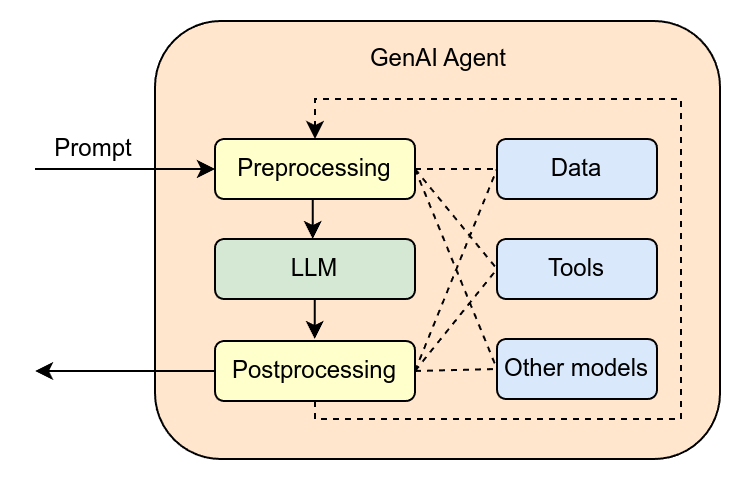
The magic is in the 'Act' phase. An agent is only as capable as the tools it can use. A general chatbot can only talk. A marketing agent might have tools to access Google Analytics, your company's CRM, and a social media scheduling platform. Giving an LLM access to these tools is what transforms it from a text generator into an autonomous worker.
Finding Your 80/20
The first step toward implementing agentic AI is not about technology; it's about observation. Your goal is to find the high-leverage manual tasks that are ripe for automation. This is the classic 80/20 rule: identify the 20% of repetitive decisions and tasks that consume 80% of your team's operational time.
Start by looking for workflows that involve rules, but also require a bit of human judgment. These are often the bottlenecks in a business.
Good candidates for agentic automation often look like this: "We usually do X, but sometimes, if Y is true, we do Z instead." That "sometimes" is where an LLM can replace a human decision.
For example, consider lead qualification. A salesperson might look at a new lead and check their company size, job title, and recent website activity to decide if they're a good fit. This process is mostly rule-based but requires judgment. An AI agent can be given the same goal ('Qualify this lead') and the tools to look up that information. It can then reason through the data and make the same decision, freeing up the salesperson to focus on building relationships with qualified prospects.
Finally, think in terms of roles, not just tasks. Instead of building a generic chatbot, design agents with specific job titles. You could have a 'Content Promotion Agent', a 'Customer Onboarding Agent', or a 'Lead Nurturing Agent'. This role-based design gives the agent a clear context and a defined set of goals and tools, making it far more effective than a jack-of-all-trades model.
What is the primary difference between a standard Large Language Model (LLM) interaction and using an AI agent?
A workflow is set up to automatically send a generic 'thank you' email to every customer who makes a purchase. This is an example of standard automation, not an agentic workflow.
By understanding these core concepts, you can start to see your business not as a series of manual tasks, but as a system that can be gradually upgraded with autonomous agents, freeing you to focus on strategy and growth.