AI Algorithms Explained for Young Learners
Introduction to Machine Learning
What is Machine Learning?
Machine learning gives computers the ability to learn from data without being explicitly programmed for every single task. Instead of writing step-by-step instructions, developers create algorithms that allow a machine to find patterns and make predictions on its own.
Think about your email's spam filter. It wasn't programmed with a list of every possible spam email. Instead, it was trained on a massive number of emails, learning to recognize the characteristics of junk mail—like certain keywords, strange formatting, or suspicious links. Over time, it gets better at spotting spam and keeping your inbox clean.
Algorithm
noun
A set of rules or instructions given to a computer to solve a problem or perform a task.
This process of learning from examples is at the core of machine learning. The goal is to create a model—a mathematical representation of the patterns found in the data—that can make accurate decisions or predictions about new, unseen data. There are two main ways a machine can learn.
Learning with a Teacher
The first approach is called supervised learning. It's like a student learning with a teacher and a textbook full of examples and correct answers. You provide the machine learning algorithm with a dataset where each piece of data is labeled with the right outcome.
For example, to teach a machine to identify photos of cats, you would feed it thousands of images, each one labeled "cat" or "not a cat." The algorithm studies these examples, learning the features associated with a cat, like pointy ears, whiskers, and feline eyes. After training, you can give it a new, unlabeled picture of a cat, and it should be able to correctly identify it.
Supervised learning is used for two main types of tasks: classification (assigning a category, like 'cat' or 'spam') and regression (predicting a continuous value, like the price of a house).
The line in the chart above is the model. It has learned a rule: everything below the line is one class, and everything above is another. This is the essence of supervised learning—finding the boundary that separates different outcomes based on labeled examples.
Learning on Its Own
The other primary method is unsupervised learning. Here, there's no teacher and no answer key. The algorithm is given a dataset without any labels and is asked to find hidden structures or patterns on its own.
Imagine giving a machine a box of mixed fruit and asking it to sort them. Without knowing the names of the fruits, it might start grouping them by color, size, or shape. It would create its own categories: round red things here, long yellow things there, and small green things over there. It discovers the patterns without being told what to look for.
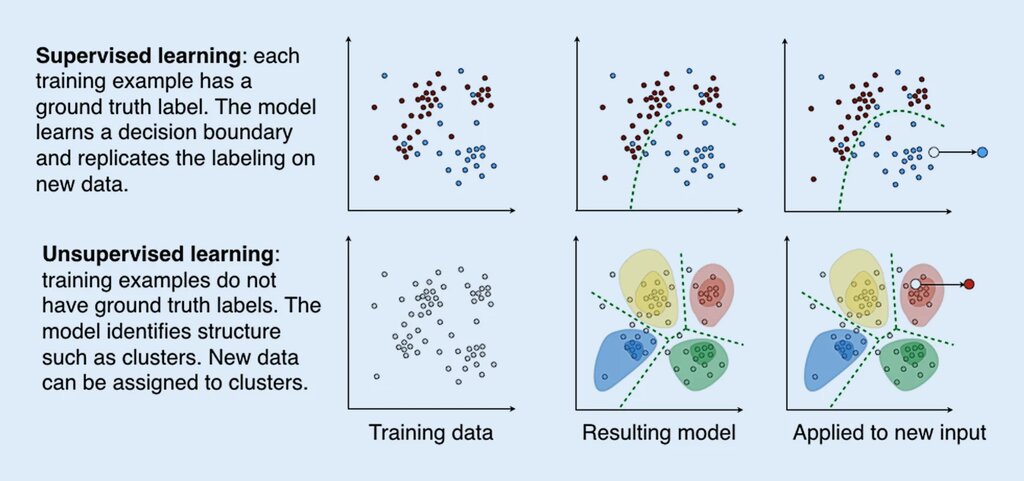
This type of learning is often used for clustering, which involves grouping similar data points together. A common application is customer segmentation, where a business might use an unsupervised algorithm to group customers based on their purchasing habits. The company doesn't pre-define the groups; the algorithm discovers them. This could reveal valuable insights, like a group of customers who only buy on weekends or another that prefers discounted items.
By understanding these two fundamental approaches, you have the foundation for exploring the world of machine learning. Whether a machine is guided by a "teacher" or discovers patterns on its own, its ability to learn from data is what makes it so powerful.
Ready to check your understanding?
What is the primary characteristic of supervised learning?
A business wants to group its customers into different segments based on their purchasing habits, but it doesn't have any predefined categories for these groups. Which type of machine learning would be most suitable for this task?
These basic concepts are the building blocks for more advanced topics in artificial intelligence, enabling everything from voice assistants to medical diagnoses.