AI Agents vs Agentic AI Explained
Introduction to AI Agents
What Are AI Agents?
Think of an AI agent as a smart, autonomous assistant that lives inside a computer. You give it a goal, and it works on its own to figure out the steps to achieve it. It's more than just a simple program that follows a rigid script. An AI agent can perceive its digital environment, make decisions, and take actions to get things done.
agent
noun
An entity that perceives its environment through sensors and acts upon that environment through actuators to achieve a goal.
At its core, an agent is designed for autonomy. Instead of waiting for you to tell it every single thing to do, it takes your main objective—like “book me a flight to Boston for next Tuesday”—and breaks it down into smaller, manageable tasks. It operates within a set of rules and has access to specific tools to complete its work.
The Core Components
Every AI agent is built from a few key parts that work together. This modular design makes them flexible and powerful. The three main components are the brain, the sensors, and the tools.
1. The Brain: The central processing unit of the agent is usually a Large Language Model (LLM). This is what gives the agent its reasoning and language-understanding abilities. The LLM interprets the user's goals, breaks them down into steps, and decides which tools to use.
2. Perception (Sensors): This is how the agent takes in information about its environment. For a software agent, the environment is digital. Its sensors aren't eyes and ears but tools that read text, access databases, or receive data from APIs. This is the agent's input.
3. Action (Tools/Actuators): Once the brain decides on a course of action, it needs a way to execute it. Tools, also known as actuators, are the agent's hands. They allow it to interact with its environment by sending an email, running a search query, writing code, or calling another API.
How an Agent Operates
An AI agent typically works in a continuous loop: it perceives the current situation, thinks about what to do next, and then acts. This is often called the perceive-think-act cycle.
Let's trace a simple example. A customer support agent is tasked with handling refund requests.
- Perceive: The agent receives an email: "Hi, I'd like to cancel my order (ID: 98765) and get a refund."
- Think: The LLM brain analyzes the text. It understands the goal (cancel order and refund) and extracts the key data (Order ID: 98765). It then formulates a plan: first, check the order status; second, verify if it's eligible for cancellation based on company policy; third, initiate the refund if eligible.
- Act: The agent uses its tools. It calls the company's internal API to look up order 98765. It finds the order hasn't shipped yet and is eligible. It uses another tool to cancel the order in the system and trigger a refund. Finally, it uses an email tool to send a confirmation to the customer.
This loop continues until the agent has successfully completed its goal. If it hits a snag—for instance, if the order had already shipped—it would perceive this new information, think of a different plan (like initiating a return process instead), and act accordingly.
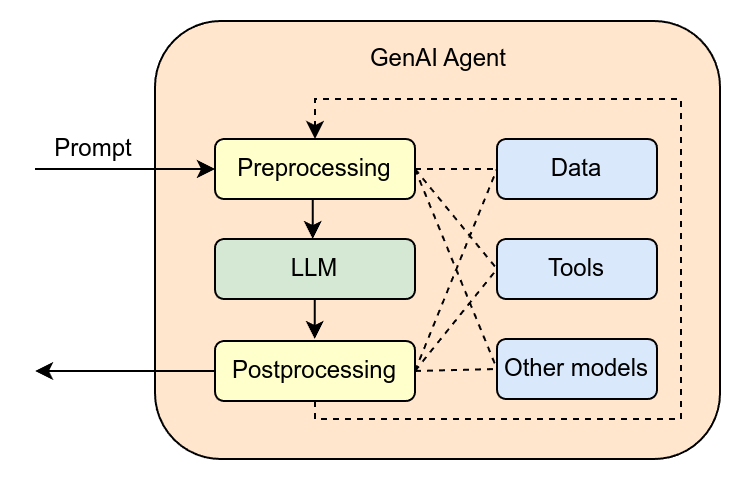
This architecture makes agents incredibly useful for automating complex workflows. They can handle tasks that require multiple steps and interactions with different software systems, all without direct human intervention for each step. From managing your calendar to analyzing sales data, agents can serve as powerful tools for personal productivity and business operations.
What is the primary characteristic that distinguishes an AI agent from a simple program?
Which component of an AI agent is responsible for interpreting the user's goals and deciding on the steps to take?
Now that you've learned the basics of AI agents, you can see how they act as a bridge between a simple instruction and a completed, multi-step task.