AI Agents for Rapid Bidding
Introduction to AI Agents
What Is an AI Agent?
Think of an artificial intelligence (AI) agent as an autonomous entity that works on your behalf inside a computer. It's designed to perceive its environment, make decisions, and take actions to achieve a specific goal, all without direct human command for every step.
At its core, an AI agent is anything that can be viewed as perceiving its environment through sensors and acting upon that environment through actuators.
For a software agent, the "environment" might be a database, a website, or a stream of user requests. Its "sensors" aren't eyes or ears, but rather tools like APIs that read data. Its "actuators" aren't hands, but the ability to send messages, execute commands, or update information.
This whole process forms a continuous loop: perceive, decide, act. The agent observes a situation, figures out what to do next based on its goals and programming, and then does it. This cycle repeats, allowing the agent to react to changes and work towards its objective.
A Spectrum of Agents
Not all agents are created equal. Their complexity and capabilities vary widely depending on their design and purpose. We can categorize them based on how they make decisions.
| Agent Type | How It Works | Simple Example |
|---|---|---|
| Simple Reflex Agent | Reacts to current perceptions only. (If X, then do Y). | A thermostat turning on heat when it gets cold. |
| Model-Based Agent | Maintains an internal state or "model" of the world. | A self-driving car tracking the location of other cars. |
| Goal-Based Agent | Acts to achieve explicit goals. | A GPS navigating to a specific destination. |
| Utility-Based Agent | Aims for the best outcome when goals conflict. | An airline pricing system maximizing profit. |
| Learning Agent | Improves its performance over time through experience. | A spam filter that gets better at identifying junk mail. |
As you move down the table, each agent type builds on the last. A simple reflex agent is purely reactive. A model-based agent has a sense of memory, allowing it to understand situations that unfold over time. Goal-based agents can plan ahead, considering sequences of actions to reach a desired state. Utility-based agents take this a step further by weighing the pros and cons of different outcomes, choosing the one that offers the highest "utility," or happiness.
Finally, learning agents are the most adaptable. They can start with limited knowledge and get smarter by analyzing their own performance, making them incredibly powerful for complex, changing environments.
Principles of Rational Design
When designing an AI agent, the central principle is rationality. This doesn't mean the agent has consciousness or human-like reason. It simply means the agent is designed to do the right thing at the right time.
Rational Agent
noun
An agent that acts to achieve the best expected outcome, given the information available to it.
What counts as the "best outcome" is determined by a performance measure. This is the metric used to judge the agent's success. For a vacuum cleaner agent, the performance measure might be the amount of dirt cleaned up in an hour. For a stock-trading agent, it would be the profit generated.
Crucially, a rational agent is not omniscient. It can't know the future. It makes the best possible choice based on its current perceptions and any past knowledge it has stored. This distinction is important; an agent can be perfectly rational but still fail to achieve its goal if the environment is unpredictable or its information is incomplete.
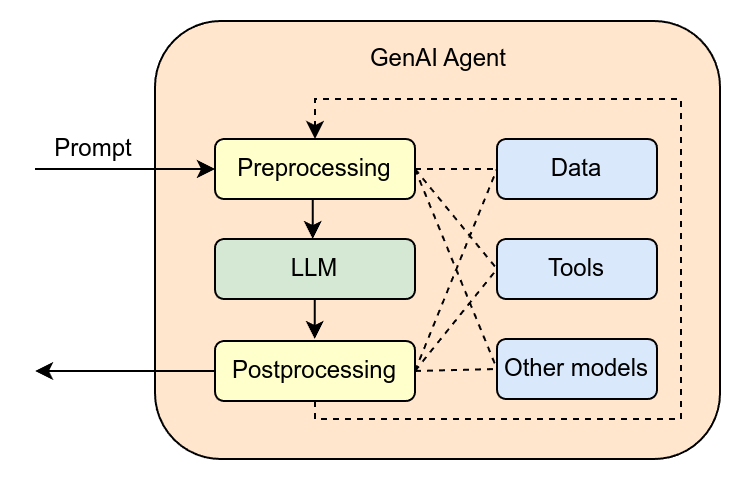
The design of any agent, from a simple thermostat to a complex trading bot, revolves around this cycle of perception, decision, and action, all guided by the principle of achieving the best possible outcome.