AI Agents for Enterprise B2B GTM
Introduction to AI Agents
More Than Just a Chatbot
We often think of AI as something we talk to, like a chatbot that answers questions. But an AI agent is different. It’s a program that can perceive its environment, make decisions, and take actions on its own to achieve a specific goal. Think of it less like a conversation partner and more like an autonomous employee.
Agent
noun
In artificial intelligence, an agent is anything that can be viewed as perceiving its environment through sensors and acting upon that environment through actuators.
This definition is broad. A simple thermostat fits the description, but so does a sophisticated AI that manages a company's entire supply chain. What they have in common is a basic loop: sense, think, act. The agent takes in information (senses), processes it (thinks), and then does something in its digital or physical environment (acts).
How Agents Evolved
Early AI agents in business were simple, rule-based systems. They were good at automating repetitive tasks, like sorting emails or processing invoices. If an email contained the word "invoice," a rule would tell the agent to file it in the accounting folder. This was a form of automation, but it wasn't very smart. It couldn't handle exceptions or learn from new information.
Over time, these systems became more sophisticated. With the rise of machine learning, agents could be trained on vast amounts of data. Instead of relying on rigid rules, they could learn to recognize patterns. This led to more advanced agents that could do things like detect fraudulent transactions or predict which customers were likely to churn.
Today, powered by large language models (LLMs), agents have taken another leap. They can now understand natural language, reason through complex problems, and interact with multiple software systems to complete tasks. They've moved from just automating tasks to orchestrating entire workflows.
The key shift is from task automation to goal achievement. You don't tell a modern agent exactly what to do; you tell it what you want to accomplish.
Reactive vs. Proactive
Not all agents behave the same way. We can group them into two main categories: reactive and proactive.
A reactive agent responds directly to what it perceives in the environment. It follows a set of pre-programmed rules. For example, if a customer's message contains the word "help," a reactive support bot might automatically send a link to the FAQ page. It doesn't plan ahead; it just reacts to the present situation.
A proactive agent, on the other hand, is goal-driven. It doesn't just react to its environment; it takes initiative to achieve its objectives. A proactive sales agent might notice that a client's usage of a product has dropped. Instead of waiting for the client to complain, it could proactively schedule a check-in meeting, analyze the client's account for potential issues, and prepare a report for the human sales representative. It looks ahead and acts to influence future events.
| Agent Type | Behavior | Example |
|---|---|---|
| Reactive | Responds to current stimuli | Spam filter moving a flagged email |
| Proactive | Takes initiative to achieve goals | AI assistant scheduling a follow-up meeting |
Connecting the Dots
For an AI agent to be useful in a business, it can't operate in a vacuum. It needs to connect with the tools the business already uses. This is known as integration with enterprise systems.
An agent might need to pull customer data from a CRM (Customer Relationship Management) system like Salesforce, check inventory levels in an ERP (Enterprise Resource Planning) system, and then send a marketing email through a platform like Mailchimp. By connecting to these different systems through APIs (Application Programming Interfaces), the agent can gather information and take actions across the entire business ecosystem.
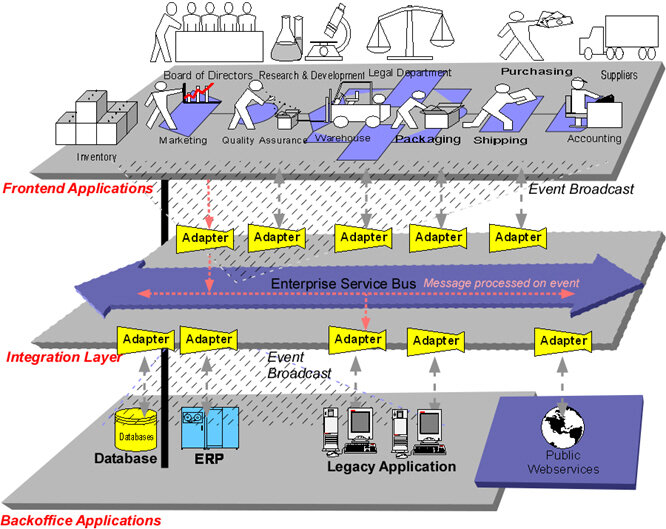
This integration is what gives agents their real power. They become the connective tissue between different software platforms, automating processes that would otherwise require a person to manually jump from one application to another.
Crucially, these agents also have the ability to retain context. When you interact with a simple chatbot, it often forgets everything you said a minute ago. A sophisticated AI agent, however, can maintain memory across interactions. It remembers your past conversations, your preferences, and the history of its own actions. This allows for much more natural and effective collaboration. The agent understands the full picture, not just the immediate request.
What is the fundamental three-step loop that describes how an AI agent operates?
An AI system monitors a company's inventory. When it detects that stock for a popular item is low, it automatically drafts a purchase order for the supply chain manager to approve. This is an example of a proactive agent.
These foundational concepts of what an agent is, how it works, and how it connects to business systems are the building blocks for understanding their role in more complex strategies.