AI Agents Explained
Introduction to AI Agents
What Are AI Agents?
At its core, an AI agent is a system that can observe its surroundings, make decisions, and take actions to achieve a specific goal. Think of it as an autonomous entity that can perceive, think, and act on its own.
Perceive → Think → Act
A simple example is a smart thermostat. It perceives the room's temperature, thinks about whether it matches your desired setting, and acts by turning the heat or air conditioning on or off. A self-driving car is a much more complex agent. It perceives road conditions, traffic, and signs; thinks about the best course of action; and acts by steering, accelerating, or braking.
Two key characteristics define AI agents:
- Autonomy: Agents operate without direct human control. They can make their own choices to pursue their objectives.
- Adaptability: They can react to changes in their environment. A truly advanced agent can also learn from its experiences to improve its performance over time.
Types of Agents
AI agents aren't all the same. They range from simple reactive machines to complex systems that can plan and make nuanced decisions. We can group them into a few main categories based on their intelligence and capabilities.
Let's break these down.
Simple Reflex Agents are the most basic type. They react to what they perceive right now, following a simple "if-then" rule. For example, if the room is dark, then turn on the light. They have no memory of the past.
Model-Based Agents are a step up. They maintain an internal "model" or representation of the world. This allows them to handle situations where the current perception isn't enough. A self-driving car needs to know about cars that might be in its blind spot, even if its cameras can't see them at that exact moment. That's its internal model at work.
Goal-Based Agents think about the future. They don't just react; they have a specific goal to achieve and will choose actions that lead them closer to it. A GPS navigator is a goal-based agent. Its goal is your destination, and it plans a sequence of turns to get you there.
Utility-Based Agents are the most sophisticated. They are useful when there are multiple ways to achieve a goal. A utility-based agent tries to maximize its own "utility"—a measure of success or happiness. A flight-booking agent might have the goal of getting you to Paris, but a utility-based one would weigh factors like price, flight duration, and number of layovers to find the best option for you, not just any option.
| Agent Type | How it Decides | Example |
|---|---|---|
| Simple Reflex | Based on current perception | Automatic vacuum bumps into a wall and turns |
| Model-Based | Uses an internal world model | A poker-playing bot tracking cards already played |
| Goal-Based | Plans to achieve a specific goal | A chess AI planning moves to checkmate the king |
| Utility-Based | Chooses the best outcome | A delivery drone calculating the most fuel-efficient route |
A Brief History
The idea of agents has been around since the early days of AI. The first agents were simple, rule-based systems. Imagine an enemy in an old video game that just moves back and forth along a set path. It's following a simple set of programmed rules, making it a basic reflex agent.
As computing power grew and we collected more data, agents became smarter. Researchers developed techniques that allowed agents to learn from experience. Instead of just following hard-coded rules, they could adapt their behavior. This shift from rule-based systems to learning-based systems is a major theme in the history of AI.
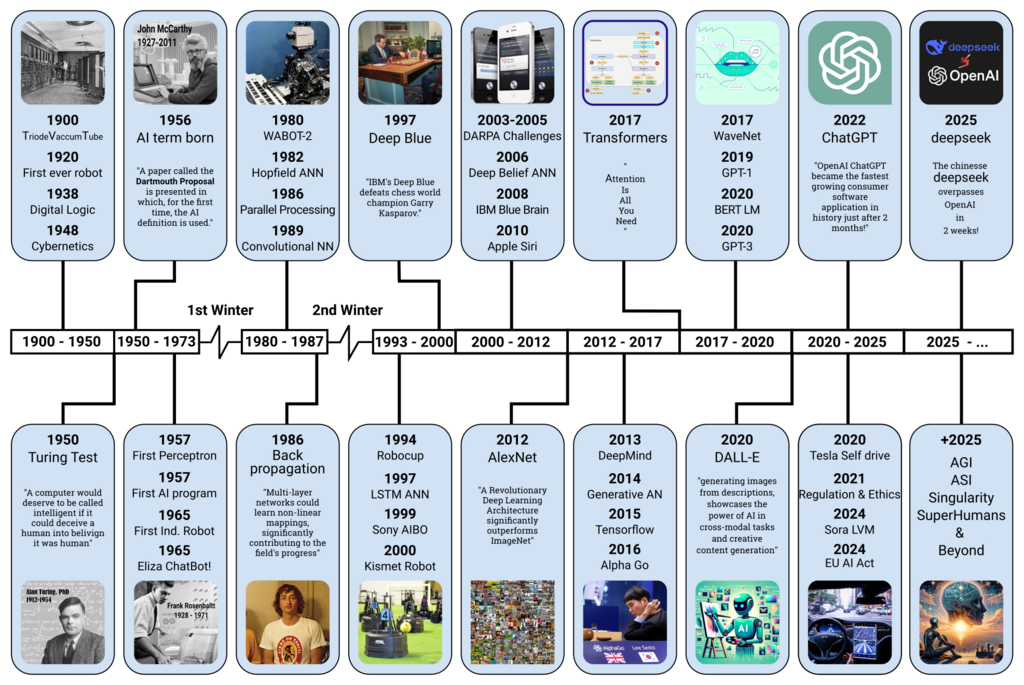
Today's most advanced agents, powered by large language models (LLMs), can understand complex instructions, use different software tools, and perform multi-step tasks that were unimaginable just a decade ago. They've evolved from simple rule-followers to complex, adaptive problem-solvers.
At its most fundamental level, what is an AI agent?
A smoke detector senses smoke and immediately triggers an alarm. Which type of agent does this best represent?
This foundational understanding of what agents are, their different types, and how they've evolved sets the stage for exploring how they're built and used in the real world.