AI Agents Explained
Introduction to AI Agents
What Is an AI Agent?
Think about a simple thermostat. It has a goal: keep the room at a specific temperature. It senses the current temperature, compares it to the target, and then acts by turning the heat or air conditioning on or off. In a nutshell, that's what an AI agent does, just on a much more complex scale.
An AI agent can be broadly defined as a system that perceives its environment, processes data, and takes actions to achieve specific goals.
An agent is anything that can be viewed as perceiving its environment through sensors and acting upon that environment through actuators. It's an autonomous entity that works towards achieving its objectives. From a spam filter in your email to a sophisticated robot exploring another planet, the core concept remains the same: sense, decide, and act.
The Building Blocks
Every AI agent is defined by its relationship with its surroundings. This interaction is made possible by a few key components.
Environment
noun
The world or system in which the agent operates. This could be a physical space, a virtual game, or even a dataset like your email inbox.
The agent receives information about its environment using sensors. For a self-driving car, sensors would include cameras, GPS, and lidar. For a stock-trading bot, the sensors are data feeds providing real-time market prices.
Once the agent decides on a course of action, it uses actuators to interact with its environment. The car’s actuators are its steering wheel, accelerator, and brakes. The trading bot’s actuators execute buy or sell orders.
| Agent | Environment | Sensors | Actuators |
|---|---|---|---|
| Self-Driving Car | Roads, traffic, pedestrians | Cameras, GPS, lidar | Steering, accelerator, brakes |
| Spam Filter | Email server, user feedback | Incoming email content, sender data | Mark as spam, move to inbox |
| Roomba | Floor, furniture, obstacles | Infrared sensors, bump sensors | Wheels, vacuum, brushes |
The Perception-Action Loop
An agent's life is a continuous cycle of perceiving and acting. It doesn't just sense once and act once. Instead, it's constantly updating its understanding of the environment and adjusting its actions accordingly. This is known as the perception-action loop.
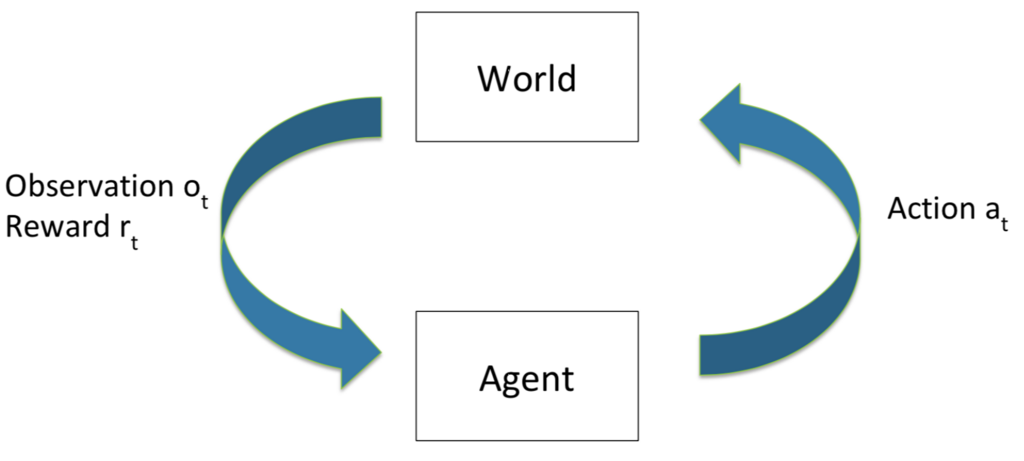
First, the agent uses its sensors to gather information—an observation of the environment's current state. Then, based on its programming and goals, it decides what action to take. The action is performed by the actuators, which in turn changes the state of the environment. The agent then perceives this new state, and the cycle begins again.
This loop is the foundation of all autonomous behavior. Whether the goal is cleaning a floor or winning a complex game, the agent always follows the same fundamental process: sense, think, act.
Now that we've covered the basics of what an AI agent is and how it interacts with its environment, let's test your understanding.
What is the core function of an AI agent?
For a smart thermostat, the thermometer that measures the room's temperature is an example of a(n) ________.