AI Agents Explained
Introduction to AI Agents
What Are AI Agents?
An AI agent is a program that can act on its own to achieve a specific goal. Think of it like a smart assistant. You give it a task, and it figures out the steps to get it done without you guiding it at every turn.
At its core, an agent perceives its environment, makes a decision, and then takes an action. The “environment” could be anything from the internet, a database, or even the physical world, if the agent is connected to sensors and robotics. The agent uses sensors to perceive its environment and actuators to perform actions.
Agents in AI are autonomous entities that perceive their environment, process information, and take actions to achieve specific goals.
A simple example is a thermostat. It senses the room's temperature (perception), decides if it's too hot or cold based on its setting (decision-making), and turns the heat or AC on or off (action). More complex agents can perform tasks like booking a flight, managing your calendar, or even controlling a self-driving car.
The Four Key Traits
Not every piece of software is an agent. True AI agents are defined by a few key characteristics that set them apart.
| Characteristic | Description |
|---|---|
| Autonomy | Agents operate without direct human control. They have control over their own actions and internal state. |
| Reactivity | They perceive their environment and respond to changes in it in a timely way. |
| Proactivity | They don't just react. They take initiative to achieve their goals. |
| Social Ability | They can communicate and cooperate with other agents (and humans) to complete tasks. |
Imagine a shopping agent tasked with buying a new laptop for you. It's autonomous because you don't have to tell it which websites to check. It's reactive because if a model goes out of stock, it adjusts its search. It's proactive by searching for discount codes to meet your budget goal. And if it needs to coordinate with a shipping agent to schedule delivery, it uses its social ability.
A Quick Look Back
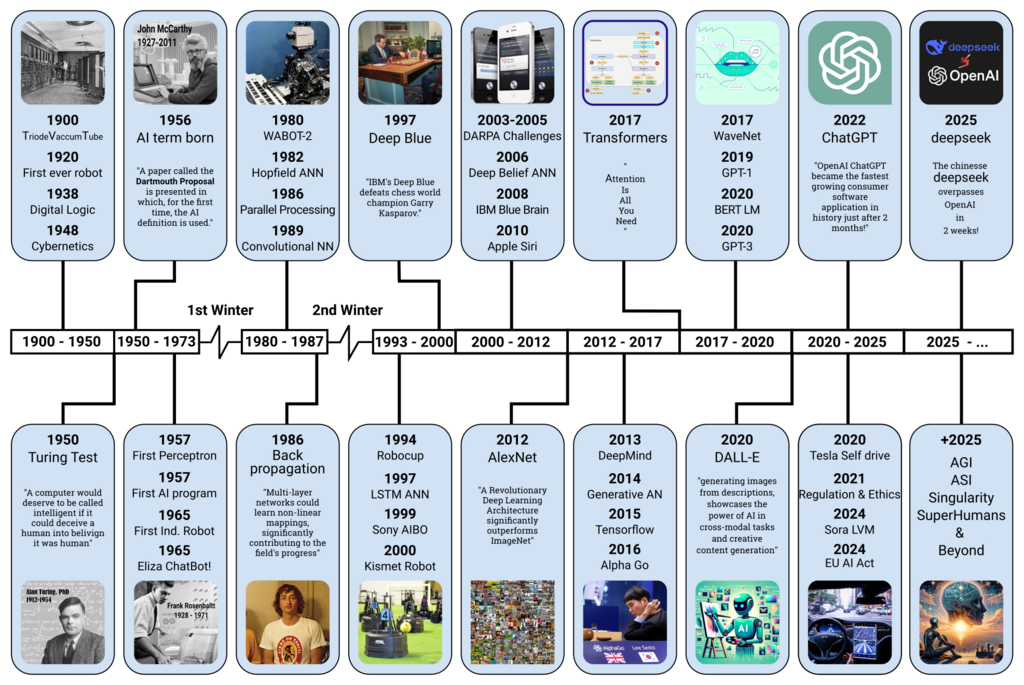
The idea of agents isn't new. It has roots in the earliest days of artificial intelligence in the 1950s, when pioneers imagined creating machines that could think and act independently. However, the modern concept of AI agents really took shape in the 1980s and 1990s.
During this time, researchers moved away from trying to build single, all-knowing AI systems. Instead, they focused on creating communities of smaller, specialized agents that could work together to solve complex problems. This is known as a multi-agent system.
The rise of the internet provided the perfect playground for these agents. Early examples included web crawlers that indexed the web for search engines and simple bots used in online auctions. Today, with the power of large language models (LLMs), agents are becoming vastly more capable, able to understand natural language and perform intricate, multi-step tasks.
Agents are a cornerstone of AI because they provide a framework for creating intelligent systems that can act purposefully in the world. By breaking down complex problems and delegating tasks to autonomous agents, we can build more powerful, flexible, and robust AI applications.
What is the fundamental operational cycle of an AI agent?
A shopping agent notices a laptop has gone out of stock and immediately searches for a similar model from a different vendor. This demonstrates which key characteristic?