AI Agents Explained
Introduction to AI Agents
What Is an AI Agent?
An AI agent is a system that can observe its surroundings and take actions to achieve a specific goal. Think of it as an autonomous entity that can make decisions on its own. The term "agent" simply refers to something that perceives and acts.
At its core, an AI agent senses, thinks, and does.
To be considered an agent, a system typically has a few key characteristics:
- Autonomy: It operates without direct human control. It can make its own choices to meet its objectives.
- Reactivity: It perceives its environment and responds to changes in a timely manner. If the situation changes, the agent adapts.
- Pro-activeness: It doesn't just react to the environment. It can take initiative to achieve its goals. For example, a personal assistant agent might proactively remind you of an upcoming appointment without being asked.
A simple household robot vacuum is a great example. It senses the layout of a room and the location of dirt (perception), decides on a cleaning path (reasoning), and moves around to vacuum (action). It does all of this autonomously.
A Brief History
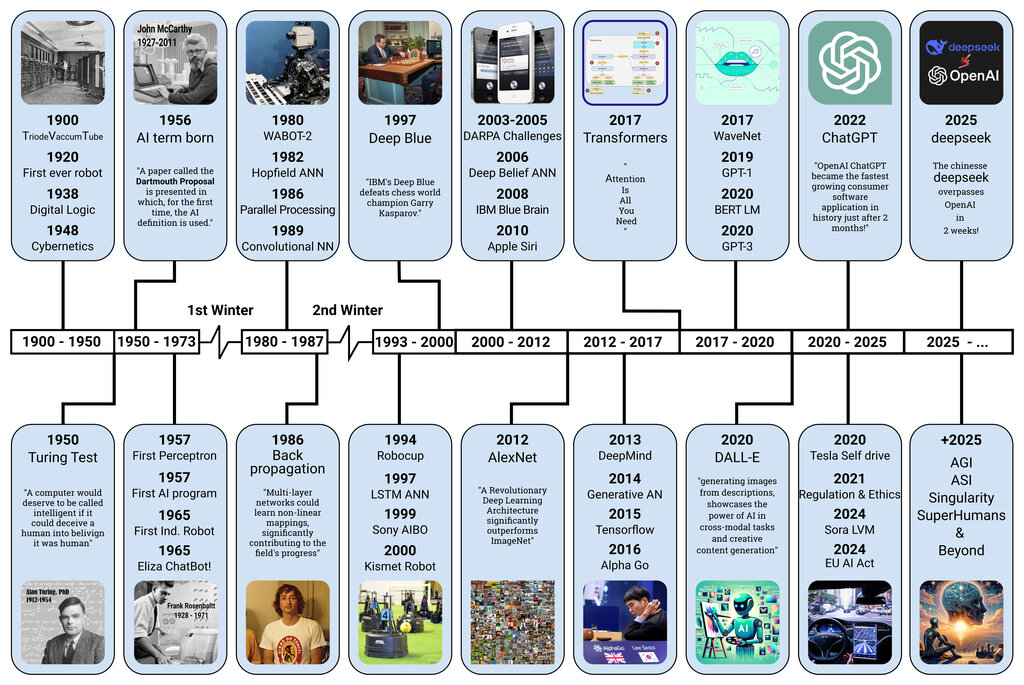
The idea of autonomous agents has been a part of artificial intelligence since the very beginning. The concept of creating machines that can think and act on their own dates back to the 1950s, with pioneers like Alan Turing questioning if machines could think.
The first real agents were simple, rule-based systems that emerged in the 1970s and 80s. These "expert systems" could make decisions in narrow domains, like medical diagnosis, by following a complex set of "if-then" rules programmed by humans.
As machine learning advanced, agents became more sophisticated. They could learn from data instead of relying solely on pre-programmed rules. This allowed them to handle more complex and unpredictable environments. The rise of deep learning and, more recently, large language models (LLMs) has supercharged agent capabilities, enabling them to understand natural language, reason about complex problems, and interact with a wide range of digital tools.
The Core Components
Every AI agent, regardless of its complexity, is built on a few fundamental components that work together in a continuous cycle.
Perception: This is how the agent gathers information about its environment. For a self-driving car, perception comes from cameras, LiDAR, and GPS. For a customer service chatbot, perception is the text a user types into a chat window. These inputs are the agent's senses.
Reasoning: This is the agent's "brain." It takes the raw data from perception and processes it to make a decision. This could be as simple as a thermostat checking if the room temperature is below the set point, or as complex as an LLM-powered agent analyzing a user's request, breaking it down into steps, and planning how to use its tools to fulfill it.
Action: Once the agent has decided what to do, it acts. An action is any way the agent affects its environment. A thermostat's action is to turn on the furnace. A chatbot's action is to generate and send a text response. A self-driving car's actions are to accelerate, brake, and turn the steering wheel.
Types of Agents
AI agents can be categorized based on how they reason and make decisions. While there are many classifications, most fall into a few main types.
Reactive Agent
noun
An agent that responds directly to its current perception of the environment without considering past events.
These are the simplest agents. They operate on a basic condition-action rule, or an "if-then" logic. They don't have any memory of past events; they only know what's happening right now. A smart light that turns on automatically when it gets dark is a reactive agent.
Deliberative Agent
noun
An agent that maintains an internal model of the world and uses it to plan its actions to achieve its goals.
Also known as goal-based or model-based agents, these are more advanced. They don't just react to the present moment. They maintain an internal representation, or "model," of the world. They use this model to think ahead, considering the consequences of different actions to find a sequence of steps that will lead them to their goal. Your phone's GPS is a good example: it knows the map, sees current traffic, and plans a route to your destination.
Finally, there are Hybrid Agents. As the name suggests, these agents combine features of both reactive and deliberative agents. They might have a reactive layer for quick responses to immediate events (like a robot stopping to avoid an obstacle) and a deliberative layer for long-term planning. This combination allows them to be both responsive and goal-oriented, which is necessary for navigating complex, dynamic environments.
Which statement best defines an AI agent?
A self-driving car swerving to avoid a sudden obstacle is primarily demonstrating which characteristic?