AI Agents Explained
Introduction to AI Agents
What Is an Agent?
At its core, an artificial intelligence agent is anything that can view its environment and act upon that environment to achieve a goal. Think of it as an autonomous entity that gets things done.
A self-driving car is an agent. Its goal is to get from point A to point B safely. A smart thermostat is a simpler agent. Its goal is to keep a room at a comfortable temperature. Even a software bot that plays chess is an agent, with the goal of winning the game.
An agent perceives its environment through sensors and acts upon that environment through actuators.
This definition is intentionally broad. The concept of an agent is a fundamental building block in AI. It gives us a framework for thinking about and building systems that can operate independently in the world, whether that world is a physical space or a digital one.
The Core Components
Every AI agent, from the simplest to the most complex, has the same basic structure. It takes in information, decides what to do, and then performs an action. This cycle is made possible by three key parts: sensors, actuators, and an agent function.
Let’s break these down using the example of a self-driving car.
Sensors are how the agent perceives its environment. For a car, this includes cameras that see traffic lights, LiDAR that senses the distance to other cars, GPS that knows the car's location, and microphones that might hear sirens. These are the agent’s eyes and ears.
Actuators are the parts the agent uses to act on its environment. The car’s actuators include the steering wheel, accelerator, and brakes. These are the agent’s hands and feet, allowing it to change its position and speed.
The Agent Function is the brain of the operation. It's the internal program or logic that connects the agent's perceptions to its actions. It receives the data from the sensors (the percepts) and decides which action to perform with the actuators. For example, if the camera (sensor) perceives a red light, the agent function decides to apply the brakes (actuator).
The agent function is essentially a map from a history of perceptions to an action.
In more formal terms, we can represent this relationship with a simple formula. The function, , maps a sequence of percepts, , to an action, .
This function is the core intelligence of the agent. It contains the rules, logic, or learned behaviors that guide the agent toward its goal.
Why Agents Are a Big Deal
The agent concept provides a powerful and unified way to think about AI. Instead of focusing on disparate algorithms, we can focus on building complete entities that sense, think, and act. This approach allows us to design systems that can tackle complex, dynamic problems in the real world.
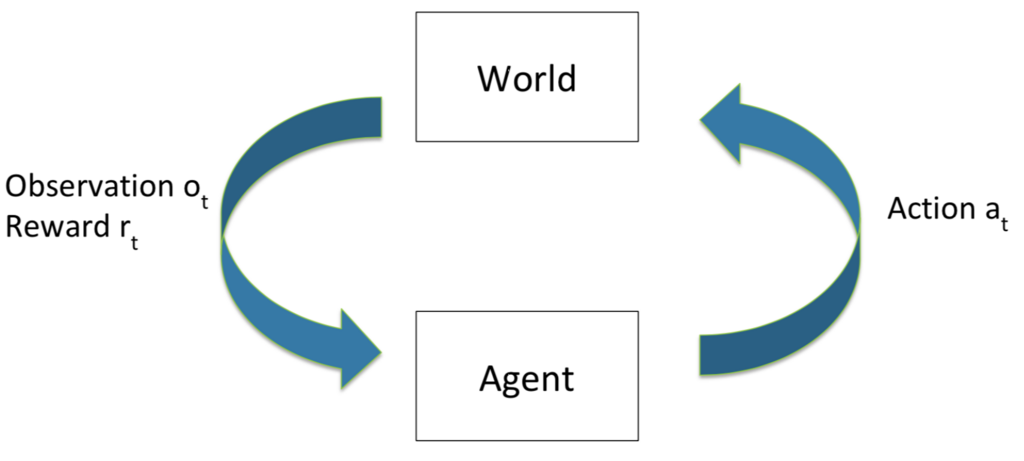
This simple loop is the foundation for everything from robotic vacuum cleaners navigating a living room to sophisticated AI systems managing power grids or trading stocks. Understanding this perceive-act cycle is the first step to understanding how modern AI systems work.
Time to test your knowledge.
What is the fundamental purpose of an AI agent?
In a smart thermostat, which component is its primary actuator?
Now that you understand what an agent is and its core components, we can explore the different types of agents and the environments they operate in.