AI Agents Explained
Introduction to AI Agents
What Is an AI Agent?
Think of an AI agent as a digital butler. It's a program that can perceive its environment, think for itself, and then take action to achieve a specific goal. Just like a real butler might notice a room is getting stuffy, decide to open a window, and then actually open it, an AI agent follows a similar loop.
An AI agent is an autonomous entity that observes its environment through sensors and acts upon that environment through actuators to achieve its goals.
The “environment” can be anything from a chessboard to the internet, or even the physical world for a robot. The key characteristics are autonomy and goal-driven behavior. An agent isn't just a passive tool; it actively works towards an objective on its own.
The Building Blocks of an Agent
Every AI agent, from a simple thermostat to a sophisticated self-driving car, operates on a fundamental cycle of three components: perception, reasoning, and action.
1. Perception: This is how the agent gathers information. For a spam filter, perception means reading the text of an email. For a robotic vacuum, it's using sensors to detect walls and dust.
2. Reasoning: This is the 'brain' of the operation. The agent processes the perceived information and decides what to do next. The spam filter analyzes words and patterns to classify the email. The vacuum's brain calculates a path to clean the room efficiently.
3. Action: This is the agent's output. After deciding on a course of action, the agent performs it. The spam filter moves the email to the junk folder. The vacuum's wheels turn and its suction motor runs.
Types of AI Agents
Agents come in several flavors, each with a different level of intelligence and complexity. They range from simple reactive machines to complex learning systems.
| Agent Type | How It Works | Simple Example |
|---|---|---|
| Simple Reflex | Acts only on the current perception. No memory of the past. | A thermostat turning on the heat when the temperature drops. |
| Model-Based | Maintains an internal model of the world to track things it can't see. | A self-driving car remembering a cyclist is in its blind spot. |
| Goal-Based | Considers future actions to find one that will achieve its goal. | A GPS app calculating the fastest route to a destination. |
| Utility-Based | Chooses the action that maximizes its 'utility' or happiness. | A trading bot that sells a stock to maximize profit, not just to make any profit. |
| Learning | Improves its performance over time by learning from experience. | A chess engine that gets better by playing games against itself. |
Early agents were mostly simple reflex or goal-based systems that followed strict rules. Today, most advanced AI systems, like the large language models behind chatbots, are learning agents. They can adapt, improve, and handle tasks far more complex than their predecessors.
A Quick Look Back
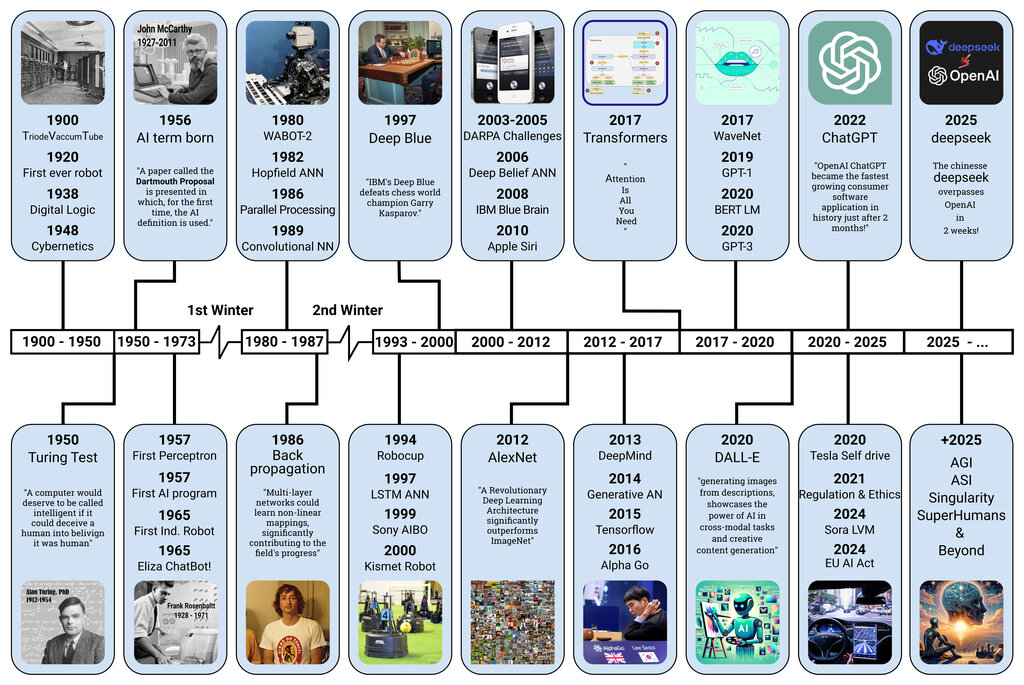
The idea of AI agents isn't new. It dates back to the earliest days of computer science. Alan Turing's concept of a machine that could think, proposed in 1950, laid the groundwork. Early AI research focused on creating systems that could solve puzzles or play games like checkers, acting as simple goal-based agents.
Over the decades, breakthroughs in computing power and algorithms allowed for more complexity. Agents evolved from following hard-coded rules to learning from data. This shift from symbolic AI (rule-based) to machine learning (data-driven) marks the most significant milestone in the history of AI agents, leading to the powerful and adaptive systems we see today.
Now that you have a grasp of what AI agents are, their components, and how they've evolved, let's test your knowledge.
Which of the following best describes the core concept of an AI agent?
A spam filter analyzes the content of an email and, based on its analysis, moves the email to the junk folder. Moving the email is an example of which component of the agent's cycle?
Understanding these core concepts is the first step to seeing how AI agents are changing everything from online shopping to scientific research.