AI Agents Explained
Introduction to AI Agents
What Is an AI Agent?
Think about a self-driving car. It uses cameras and sensors to “see” the road, pedestrians, and other vehicles. Based on that information, it steers, accelerates, or brakes. It perceives its environment and then acts upon it. At its core, this is what an AI agent does.
Agents in AI are autonomous entities that perceive their environment, process information, and take actions to achieve specific goals.
An agent isn't just a passive program waiting for direct commands. It’s a system designed to operate within an environment to accomplish a goal. The parts that gather information are its sensors (like a camera, microphone, or thermostat), and the parts it uses to take action are its actuators (like a steering wheel, a speaker, or a heating element). This perception-action loop is fundamental to how they work.
More Than Just Code
What really separates an AI agent from a standard computer program are a few key characteristics. These traits allow agents to handle complex, unpredictable situations in a way that simple, scripted software cannot.
autonomy
noun
The ability of an agent to operate without direct human intervention or control.
Autonomy is the cornerstone of an AI agent. An autonomous agent has control over its own actions and internal state. It's not just executing a pre-written list of instructions. Instead, it makes decisions based on its perceptions and its built-in knowledge or experience to achieve its goals.
Consider a smart thermostat. A simple programmable thermostat follows a strict schedule you set. An autonomous smart thermostat learns your habits, senses when you're home or away, and adjusts the temperature to save energy and keep you comfortable, all without you telling it what to do every moment.
Taking Action
Beyond just being independent, agents are defined by how they decide to act. Their behavior can be categorized as either reactive or proactive.
Reactivity is about responding to the present. A reactive agent perceives a change in its environment and acts immediately in response.
A simple example is an automatic light that turns on when it senses motion. It doesn't plan ahead; it just reacts to a direct stimulus.
Proactivity is about looking ahead. A proactive agent takes initiative to achieve its goals, rather than just waiting for something to happen.
Imagine an AI shopping agent that notices you're running low on milk and automatically adds it to your grocery list. It's not just reacting to an empty carton; it's proactively working toward its goal of keeping your kitchen stocked.
| Characteristic | Description | Example |
|---|---|---|
| Reactivity | Acts in response to the current state of the environment. | An email spam filter automatically moving a suspicious message to the junk folder. |
| Proactivity | Takes goal-directed initiative without a triggering event. | A calendar assistant scheduling a meeting to discuss a project before its deadline. |
Working with Others
Finally, many agents aren't designed to work in isolation. They have social ability, which is the capacity to interact with other agents and even humans. This doesn't mean they're friendly or have emotions. It simply means they can communicate and coordinate.
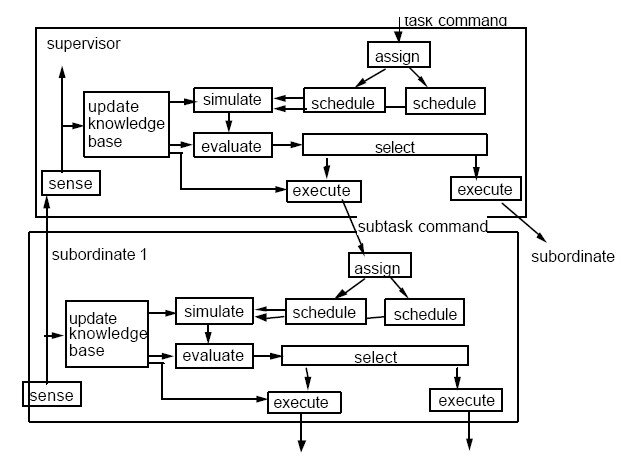
Think of a team of robots in an automated warehouse. They need to communicate to avoid collisions and to efficiently retrieve and pack items. One robot might signal to another that it has picked up an item from a shelf, so the other knows to fetch the next one on the list. This coordination is a form of social ability.
These four traits—autonomy, reactivity, proactivity, and social ability—are what make AI agents powerful tools for tackling tasks in our complex and ever-changing world.
Ready to check your understanding?
What is the fundamental cycle of an AI agent's operation?
A self-driving car's cameras are its ________, and its steering wheel is its ________.
Understanding these foundational traits is the first step toward exploring the different kinds of agents and how they are built.