AI Agents Explained
Introduction to AI Agents
What Are AI Agents?
Think of an AI agent as an autonomous program that acts like a digital employee. It's designed to perceive its environment, make decisions, and take actions to achieve specific goals, all without direct human command for every step.
Imagine you ask a smart assistant to book a flight. A simple program might just search for the cheapest option. An AI agent, however, could check your calendar for conflicts, consider your preferred airlines, notice that you usually pick a window seat, and then book the flight that best balances cost and convenience. It observes, decides, and acts on your behalf.
An AI agent is a software entity that perceives its environment, makes decisions, and takes actions to achieve a specific goal.
This perceive-decide-act loop is the fundamental operating principle of all AI agents, from a simple thermostat that adjusts room temperature to a complex robot navigating Mars.
The Four Key Traits
What truly defines an AI agent? Four key characteristics work together to make these systems powerful and distinct from other types of software.
| Characteristic | Description |
|---|---|
| Autonomy | Operates independently without constant human guidance. |
| Reactivity | Senses and responds to changes in its environment in real-time. |
| Proactivity | Takes initiative to achieve its goals, rather than simply waiting for instructions. |
| Social Ability | Can communicate and cooperate with other agents and humans. |
Autonomy is what allows an agent to function on its own. A Roomba, for example, doesn't need you to tell it where to go next; it navigates the room by itself. Reactivity is its ability to adapt. If the Roomba bumps into a chair, it immediately changes direction. Proactivity means it doesn't just sit in the corner waiting for a command; it starts cleaning on a schedule or when its dock is empty. Finally, social ability would be like multiple Roombas coordinating to divide up a large house, ensuring they don't clean the same spot twice.
A Brief History
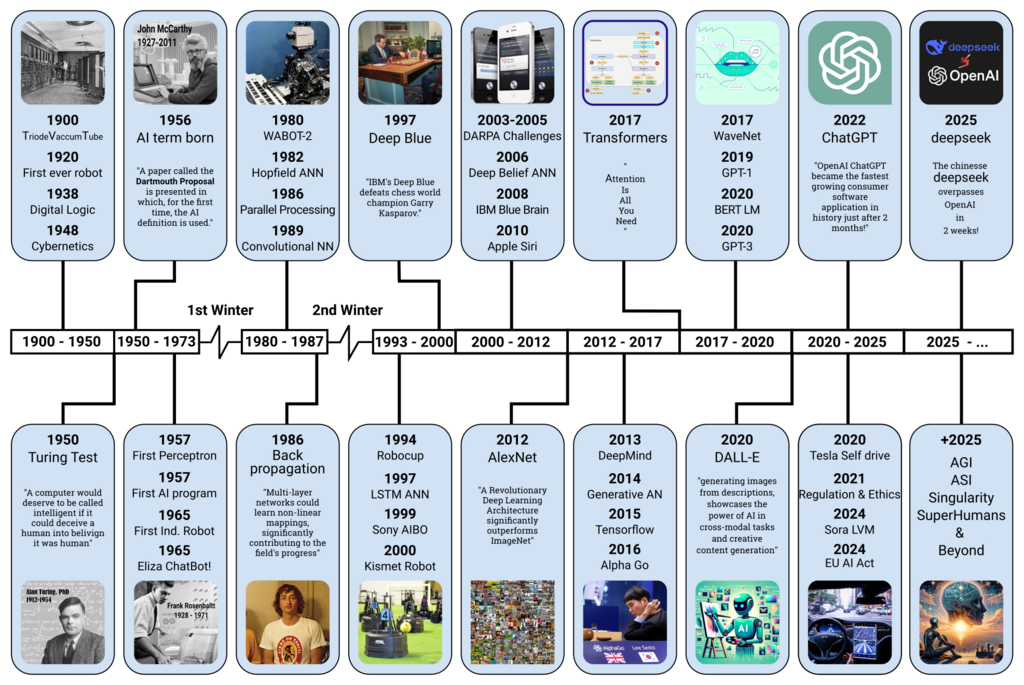
The idea of autonomous agents isn't new. It has roots in the earliest days of artificial intelligence and cybernetics in the 1940s and 50s. Early thinkers envisioned machines that could behave intelligently and purposefully, much like living organisms.
However, it wasn't until the 1980s and 90s that the concept of a software "agent" truly took shape. With the rise of the internet and more complex computer systems, researchers needed a way to create programs that could handle tasks in dynamic, unpredictable environments. The agent-based approach provided a powerful framework for building systems that could navigate this complexity.
Over the decades, agents have evolved from simple rule-based programs to sophisticated systems powered by machine learning and large language models, capable of tackling tasks that were once purely in the realm of science fiction.
Why Agents Matter
AI agents represent a major step in the evolution of artificial intelligence. Early AI focused heavily on single, isolated tasks, like classifying an image or translating a sentence. Agents, by contrast, are designed to perform complex, multi-step tasks in an ongoing, interactive way.
They are significant because they bridge the gap between pure data processing and meaningful action in the real or digital world. By creating systems that can operate autonomously and intelligently, we can automate complex processes, solve problems more efficiently, and create assistants that can help us with everything from managing our schedules to conducting scientific research. They are the 'doers' of the AI world.
What is the fundamental operating loop that all AI agents follow?
A robot vacuum cleaner encounters a newly placed chair and immediately changes its path to go around it. Which key characteristic of an AI agent is it primarily demonstrating?
Now you have a foundational understanding of what AI agents are and what makes them tick.