AI Agents and Workflow Automation
Introduction to AI Agents
What Are AI Agents?
At its core, an AI agent is a program that can make its own decisions. Think of it like a highly specialised assistant. You give it a goal, and it works autonomously to achieve it. To do this, it needs to perceive its environment, think about its options, and then act.
Agent
noun
An entity that perceives its environment through sensors and acts upon that environment through actuators to achieve a goal.
The “environment” can be anything from a room for a robot vacuum to the internet for a shopping bot. The agent's job is to make the best choice it can based on the information it has. This ability to sense, think, and act is what separates an agent from a simple script that just follows a list of pre-written instructions.
The Building Blocks
Every AI agent, no matter how simple or complex, has a basic structure. It takes in information using sensors and performs actions using actuators. The part in the middle, the brain, is where the decision-making happens. This is often called the agent function.
Let’s break this down:
-
Sensors are the agent's inputs. For a self-driving car, this includes cameras, GPS, and radar. For a chatbot, it's the text a user types into a chat window.
-
The Agent Function is the internal logic. It maps any given perception from the sensors to an action. This is the core intelligence of the agent.
-
Actuators are how the agent affects its environment. The car's actuators are the steering wheel, accelerator, and brakes. The chatbot's actuator is the ability to generate and display text.
Essentially, an agent is a continuous loop: it perceives, it thinks, it acts, and then it perceives the results of its action.
Types of Agents
Not all agents are created equal. They range from very simple to incredibly complex, based on how they make decisions. We can group them into a few key types.
| Agent Type | How It Works | Simple Example |
|---|---|---|
| Simple Reflex | Acts only on the current perception. No memory of the past. | A smart thermostat turning on the heat when the room is cold. |
| Model-Based | Maintains an internal state (a “model”) of how the world works. | A self-driving car that remembers a pedestrian is hidden behind a bus. |
| Goal-Based | Has a specific goal and chooses actions to achieve it. | A GPS app calculating the fastest route to your destination. |
| Utility-Based | Aims to maximise its own “happiness” or utility. Chooses the best outcome. | A flight booking agent that finds a flight balancing price, comfort, and speed. |
| Learning | Can improve its performance over time by learning from its experiences. | A game-playing AI that gets better at chess the more it plays. |
A simple reflex agent is purely reactive, following simple if-then rules. A model-based agent is a step up, as it can handle situations where it can't see everything at once. Goal-based and utility-based agents are more proactive, as they think about the future consequences of their actions. Finally, a learning agent is the most adaptive, able to fine-tune its logic as it gathers more data.
A Brief History
The idea of artificial agents has been around for decades, starting with early work in symbolic AI. These first agents were based on logical rules meticulously programmed by humans. They were good at tasks in controlled environments, like playing chess, but struggled with the messiness of the real world.
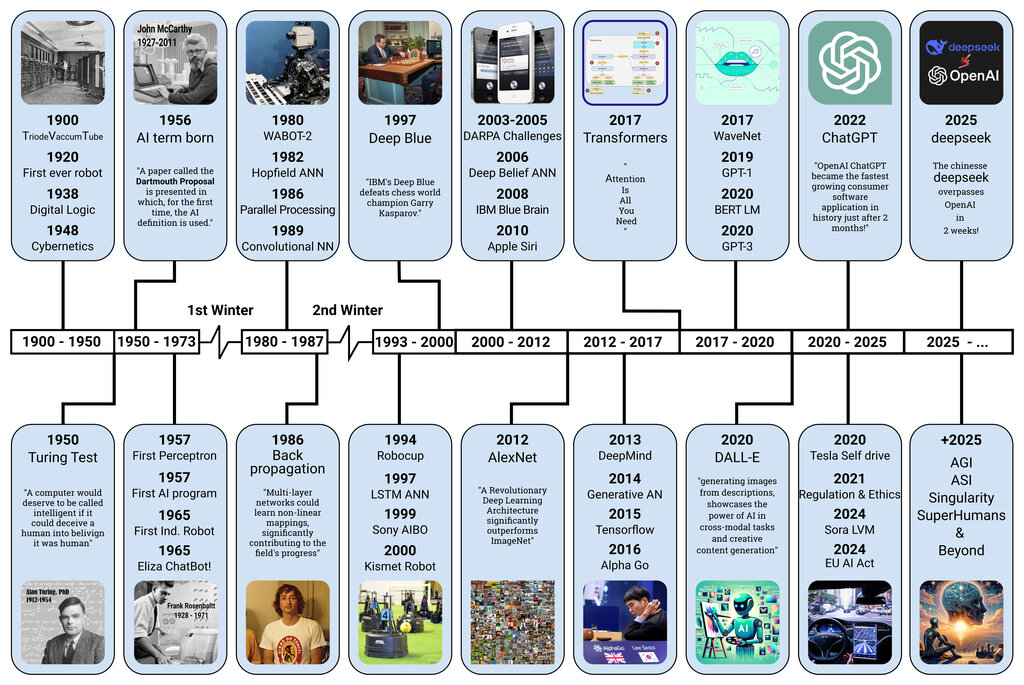
The big shift came with machine learning. Instead of being explicitly programmed, agents could now learn from vast amounts of data. This made them more flexible and powerful. Today, with the rise of Large Language Models (LLMs), we are seeing a new generation of agents that can understand and use human language to perform complex tasks, like booking appointments, planning trips, or even writing code.
Agents are now used everywhere. They power the recommendation algorithms on streaming services, manage logistics in warehouses, assist traders in financial markets, and control characters in video games to make them seem more realistic. They are the invisible engines behind much of modern technology.
Ready to check your understanding?
What are the three core, sequential capabilities that define an AI agent?
For a self-driving car, the system that applies the brakes is considered an actuator.
AI agents are the bridge between raw computational power and meaningful action. By sensing, thinking, and acting, they allow us to automate complex decision-making in almost any field.