AI Agent Fundamentals
Introduction to AI Agents
What is an AI Agent?
An AI agent is a system that observes its environment and takes actions to achieve a specific goal. Think of a simple thermostat. It perceives the room's temperature (the environment) and acts by turning the heat on or off to reach its goal temperature. It's an agent, just a very basic one.
At its core, every AI agent follows a simple loop: Perceive, Think, Act.
More complex agents, like a self-driving car, do the same thing on a much grander scale. They perceive the road with cameras and sensors, process that information to make decisions, and then act by steering, accelerating, or braking. The goal is to navigate safely to a destination.
agent
noun
Anything that can be viewed as perceiving its environment through sensors and acting upon that environment through actuators.
The key characteristic is autonomy. An agent operates on its own, without direct human control, to pursue its objectives.
An Agent's World
Agents don't exist in a void. They operate within an environment, which is just a formal way of saying the world or system they interact with. The nature of this environment dramatically affects how an agent needs to be designed.
We can categorize environments along a few key dimensions. Is the world standing still, or is it constantly changing? Are the possible actions finite, or are they infinite?
| Environment Type | Description | Example |
|---|---|---|
| Static | The environment doesn't change while the agent is deciding on an action. | A crossword puzzle. |
| Dynamic | The environment can change on its own, independent of the agent's actions. | A self-driving car in traffic. |
| Discrete | There are a finite number of distinct states and actions. | A game of chess. |
| Continuous | States and actions flow from one to the next in a continuous range. | Controlling the speed and steering of a car. |
An agent designed for a static, discrete environment like chess will be very different from one designed for a dynamic, continuous environment like the real world. The latter requires the ability to react to unpredictable events in real time.
Simple vs. Intelligent
Not all agents are created equal. The simplest agents are reflex agents. They operate on a simple "if-then" logic. If you see condition X, then perform action Y. Our thermostat is a perfect example: if the temperature is below 68 degrees, turn on the heat. It doesn't remember past temperatures or predict future changes; it only reacts to the present moment.
Intelligent agents are more sophisticated. They maintain an internal state, meaning they have a memory of past events. They can use this knowledge to make better decisions. For example, a travel-booking agent might remember your preference for aisle seats or know that flight prices tend to rise on Fridays. It uses this information, along with its current goal (book a flight), to take action.
These agents don't just react; they reason and plan.
Sensing and Acting
So how does an agent actually perceive and act? It uses sensors and actuators.
Sensors are the tools an agent uses to gather information about its environment. For a software agent, this could be API calls or reading files. For a robot, it's cameras, microphones, and touch sensors.
Actuators are the tools an agent uses to perform actions. For a software agent, this might be displaying a message on screen or sending an email. For a robot, it's motors, wheels, and speakers.
Let's look at an email spam filter. Its sensors
Let's look at an email spam filter. Its sensors 'read' the content of an incoming email: the sender, the subject line, and the body text. This is its perception. Based on this data, its internal logic decides if the email is spam. Its actuator then performs the action: moving the email to the spam folder or leaving it in the inbox.
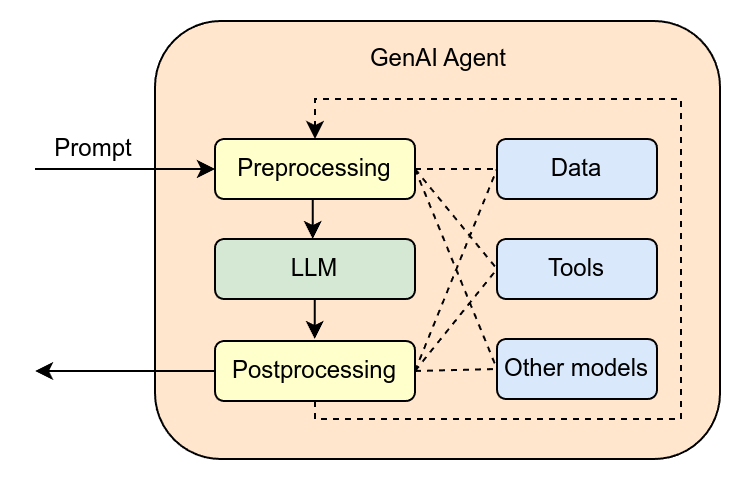
This fundamental cycle of perceiving the environment through sensors and acting upon it with actuators is the basis for all AI agents, from the simplest thermostat to the most advanced autonomous systems.
What is the fundamental cycle that all AI agents follow?
In the context of an email spam filter, which of the following is an example of an actuator?