AI Agent Development
Introduction to AI Agents
What Are AI Agents?
You've likely interacted with AI, maybe through a chatbot or a voice assistant. But an AI agent is a step beyond that. Think of it less like a simple tool and more like an autonomous assistant. It's a system designed to perceive its environment, make decisions, and take actions to achieve specific goals on its own.
An AI Agent is a software entity characterized by its autonomy, reactivity, pro-activeness, and social ability.
Let's break down those four key characteristics:
- Autonomy: An agent can operate without direct human control. It manages its own actions and internal state.
- Reactivity: It perceives its environment (which could be the digital world of the internet or a physical space via sensors) and responds to changes in a timely fashion.
- Proactivity: Agents don't just react; they take initiative. They can exhibit goal-directed behavior by taking actions to pursue their objectives.
- Social Ability: They can interact with other agents and humans, often using some form of communication language.
Imagine hiring a personal assistant to book a trip. You wouldn't tell them every single click to make. You'd just say, "Find me a flight to Honolulu next Tuesday, under 💲500." The assistant then perceives the goal, reacts to flight availability, and proactively books the best option. AI agents work in a similar, goal-oriented way.
A Quick Look Back
The idea of AI agents isn't new. It has roots in the early days of artificial intelligence, dating back to the 1950s. Early concepts were often limited by computational power and focused on simple, rule-based systems in controlled environments. For decades, agents were more theoretical than practical for complex, real-world tasks.
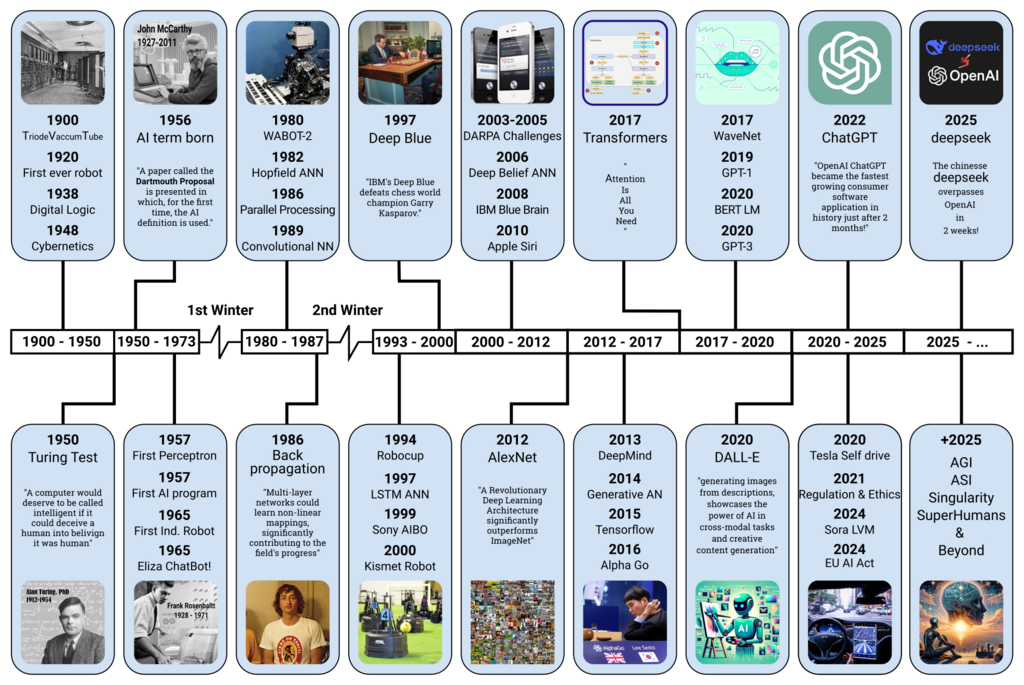
The recent explosion in large language models (LLMs) has changed everything. Modern AI agents can now understand nuanced human language, reason through complex problems, and use various digital tools to execute tasks. This leap has transformed them from academic curiosities into powerful tools capable of automating sophisticated workflows.
Types of Agents
Not all agents are created equal. They can be categorized based on their intelligence and capabilities. Here are a few common types, from the simplest to the most complex.
As you move down the list, each type of agent generally incorporates the abilities of the ones before it while adding new layers of sophistication. A learning agent might also be goal-based and have a model of the world, all while continuously improving its strategies.
Agents in the Wild
AI agents are already at work across many industries, often behind the scenes. Their ability to automate complex, multi-step tasks makes them incredibly valuable.
In e-commerce, they power recommendation engines that analyze your browsing history to suggest products you might like. In finance, they monitor transactions in real-time to detect and flag potential fraud, saving consumers and banks millions.
Customer service chatbots are evolving into true agents that can access order histories, process returns, and solve complex problems without escalating to a human. In scientific research, agents can even design and run experiments, sift through massive datasets for patterns, and help accelerate new discoveries.
These applications highlight the core purpose of AI agents: to take on complex, goal-oriented tasks, freeing up human intellect for problems that require creativity, strategy, and empathy.
Now that you have a foundational understanding of what AI agents are, let's test your knowledge.
Which of the following best describes the fundamental cycle of an AI agent's operation?
An AI agent that exhibits goal-directed behavior by taking initiative rather than just responding to its environment is demonstrating which key characteristic?
Understanding these basic concepts is the first step toward appreciating the power and potential of AI agents.