AI Agent Creation Mastery
Introduction to AI Agents
What Are AI Agents?
An AI agent is a program that can operate on its own to get things done. Think of it like a personal assistant, but one that lives inside a computer. Its main job is to perceive its digital or physical environment, make a decision, and then take an action to achieve a specific goal.
An AI agent is an autonomous system that perceives its environment and acts upon it to achieve goals.
This could be as simple as a spam filter scanning your emails. It perceives an incoming message, decides if it's junk, and acts by moving it to the spam folder. Or it could be as complex as a self-driving car navigating a busy street. It perceives traffic, decides when to turn, and acts by steering the wheel. The core idea is the same: sense, think, act.
agent
noun
Something that perceives and acts in an environment.
This continuous loop of interaction is what makes agents useful. They aren't just passive programs waiting for commands. They actively engage with their surroundings to complete tasks.
Types of Agents
Not all agents are created equal. They can be categorized based on how they make decisions. While there are many complex types, most fall into a few basic categories.
Reactive agents are the simplest. They operate purely on the current situation, like a reflex. They see something, and they react. A smoke detector is a reactive agent: it senses smoke and immediately sounds an alarm. It doesn't think about past events or future consequences.
Proactive agents are more forward-thinking. They don't just react to their environment; they take initiative to achieve their goals. A calendar app that proactively suggests a time for a meeting based on everyone's availability is a proactive agent. It's working towards the goal of scheduling the event.
Rational agents aim to do the best possible thing. Given what they perceive, they act to achieve the best expected outcome. A chess-playing AI is a rational agent. It doesn't just make a legal move (reactive) or work towards checkmate in general (proactive); it analyzes the board to make the optimal move that maximizes its chances of winning.
| Agent Type | Key Characteristic | Example |
|---|---|---|
| Reactive | Acts based only on current perception | A thermostat turning on the heat when it's cold |
| Proactive | Takes initiative to achieve goals | A robot vacuum cleaning a room on a schedule |
| Rational | Acts to achieve the best possible outcome | An investment algorithm buying and selling stocks |
The Core Components
Every AI agent, regardless of its type, is built from three fundamental parts that enable the sense-think-act cycle.
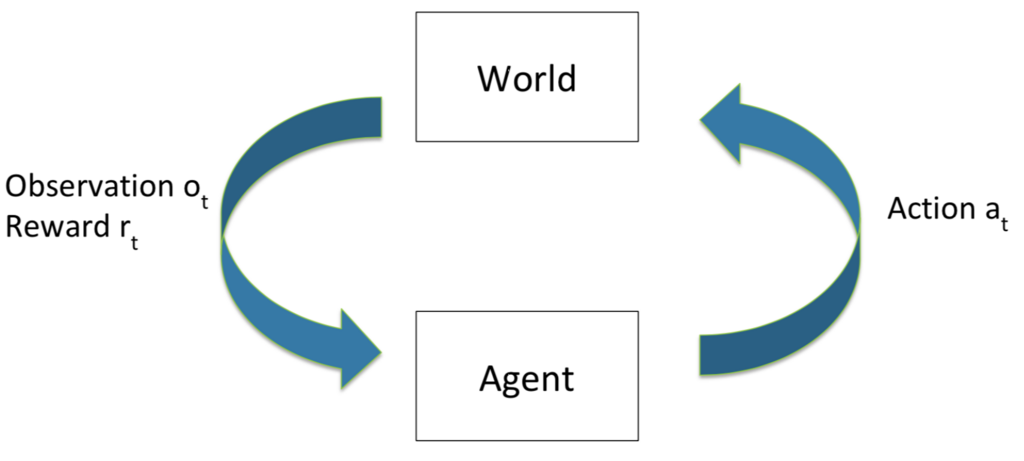
1. Perception This is how the agent gathers information about its environment. For a software agent, this isn't about eyes and ears. It's about data. Perception could involve reading sensor data, processing user input from a keyboard, or receiving information from an API. It's the agent's window to its world.
2. Decision-Making
This is the agent's 'brain.' After perceiving the environment, the agent uses its internal logic or model to decide what to do next. For a reactive agent, this might be a simple if-then rule. For a rational agent, it could be a complex algorithm that weighs probabilities and potential outcomes.
3. Action Execution Once a decision is made, the agent needs to carry it out. This is the action. An action could be anything from sending an email, calling another program's function, or moving a robot's arm. This is how the agent affects its environment, which closes the loop and leads to a new perception.
Understanding these basic building blocks is the first step toward creating and working with these powerful AI systems. Now, let's review what you've learned.
What are the three fundamental components that enable an AI agent's 'sense, think, act' cycle?
A spam filter that automatically moves an email to the junk folder based on a set of predefined rules is best described as what type of agent?
These concepts of perception, decision-making, and action are the foundation for all types of AI agents, from the simplest to the most advanced.