AI Adoption Explained
Introduction to AI
What is Artificial Intelligence?
At its core, artificial intelligence is about making machines smart. Think about all the things you do without much thought: recognizing a friend's face, understanding a sentence, or deciding which route to take to work. These tasks feel simple to us, but they involve complex processing in our brains. The goal of AI is to enable computers to perform these kinds of tasks.
It’s not about creating a walking, talking robot like in the movies. It’s about building systems that can learn from data, identify patterns, and make decisions with minimal human intervention. Essentially, AI is a broad field of computer science dedicated to simulating intelligent behavior in computers.
Artificial Intelligence
noun
The theory and development of computer systems able to perform tasks that normally require human intelligence, such as visual perception, speech recognition, decision-making, and translation between languages.
This idea of intelligent machines isn't new. For centuries, humans have imagined creating artificial beings. But it wasn't until the advent of modern computers that this dream started to become a reality.
A Quick Trip Through Time
The term "Artificial Intelligence" was first coined in 1956 at a workshop at Dartmouth College. This event brought together a small group of mathematicians and scientists who believed that a machine could be made to think. This kicked off decades of research, filled with exciting breakthroughs and periods of slow progress known as "AI winters," when funding and interest dried up.
Early AI focused on solving puzzles and playing games like chess. In 1997, IBM's Deep Blue computer famously beat the world chess champion, Garry Kasparov. This was a huge milestone, showing that a machine could out-strategize the best human mind in a highly complex game.
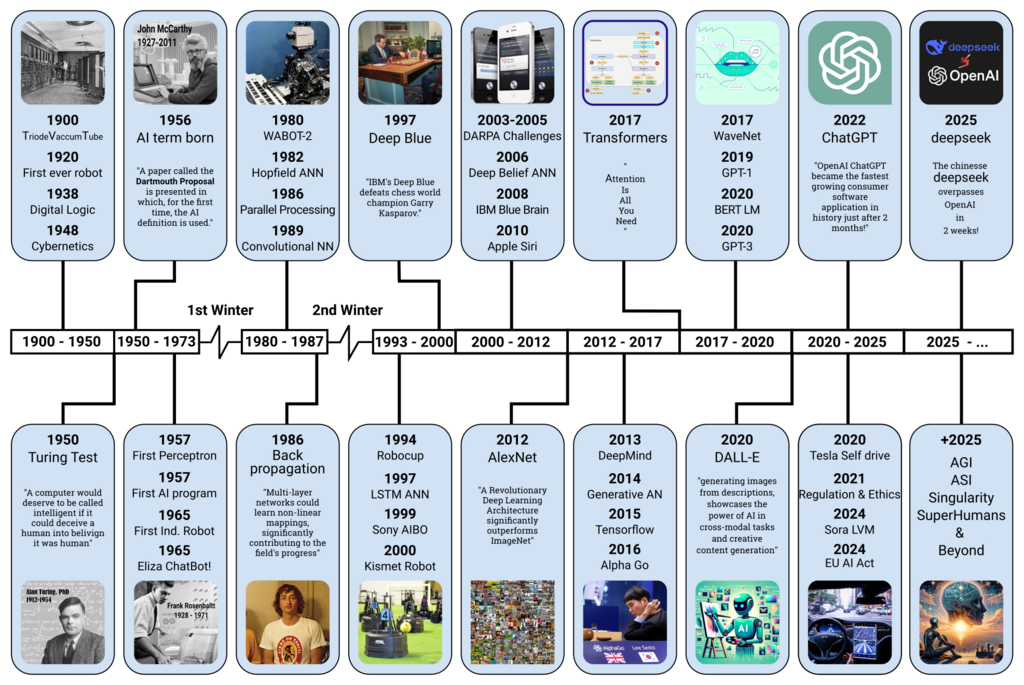
In recent years, AI has exploded. This is thanks to two main ingredients: massive amounts of data and powerful computers. We now generate more data than ever before, and modern processors are capable of crunching that data at incredible speeds. This combination has fueled the rise of machine learning and deep learning, subfields of AI that have led to the powerful tools we see today.
The Two Main Types of AI
When people talk about AI, they are usually referring to one of two concepts: Artificial Narrow Intelligence (ANI) or Artificial General Intelligence (AGI). It's important to know the difference.
| Feature | Artificial Narrow Intelligence (ANI) | Artificial General Intelligence (AGI) |
|---|---|---|
| Scope | Performs a single, specific task | Can understand & perform any intellectual task a human can |
| Examples | Spam filters, voice assistants, self-driving cars | None yet exist; remains theoretical |
| Learning | Learns from data relevant to its specific task | Can learn and transfer knowledge across different domains |
| Current Status | All current AI is ANI | A long-term goal for many researchers |
Artificial Narrow Intelligence (ANI), sometimes called Weak AI, is what we have right now. It's an AI that is trained to perform one specific task very well. A spam filter is a great example. It's incredibly good at identifying junk email, but it can't write a poem or diagnose a disease. Siri, Alexa, and Google Assistant are also forms of ANI. They can answer questions and perform commands, but their abilities are limited to what they were programmed and trained to do.
Artificial General Intelligence (AGI), or Strong AI, is the kind of AI you often see in science fiction. This is a machine with the ability to understand, learn, and apply its intelligence to solve any problem, much like a human being. An AGI could seamlessly switch from translating languages to composing music to conducting scientific research. We are still a long way from achieving AGI.
AI in Your Daily Life
You might not realize it, but you probably interact with AI every single day. It's the silent engine behind many of the technologies we take for granted.
When Netflix or YouTube recommends a show or video you might like, that's AI at work. It analyzes your viewing habits and compares them to millions of other users to predict what you'll enjoy next.
When you use Google Maps to find the fastest route, AI is analyzing real-time traffic data to guide you around congestion. Even simple things, like your phone's camera automatically focusing on a face or the spam filter in your email, are powered by narrow AI systems.
From entertainment recommendations to navigation, AI is already woven into the fabric of our digital lives, making things more personalized and efficient.
So, while the idea of a thinking machine might seem futuristic, the reality is that a simpler, more specialized form of AI is already here, working behind the scenes to make our technology smarter and more helpful.