AI Accelerating Science
Introduction to the Scientific Method
A Framework for Discovery
Science is a way of asking questions about the natural world and getting reliable answers. For a long time, people relied on authority or pure reason to explain things. But during the Scientific Revolution, thinkers developed a more rigorous approach. They decided that ideas should be tested against evidence from the real world. This process became known as the scientific method.
It isn't a rigid checklist that every scientist follows in exactly the same order. Instead, it’s a systematic way of thinking that guides inquiry. It provides a logical, repeatable framework for exploring observations and answering questions, ensuring that discoveries are based on evidence.
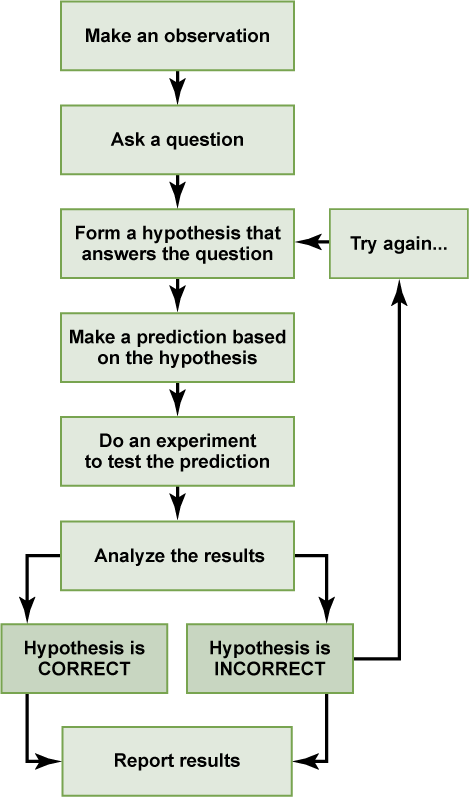
The process begins with a simple act: noticing something. An observation is the starting point for all scientific inquiry. It’s a spark of curiosity about the world. You might observe that your plants grow taller in one window than another, or that a dropped ball always falls to the ground. This leads to a question: why?
Once you have a question, you formulate a hypothesis. This is a proposed explanation for your observation. Crucially, a hypothesis isn't just a guess; it's a testable statement. It makes a prediction that can be supported or refuted through investigation.
Hypothesis
noun
A proposed explanation for a phenomenon made as a starting point for further investigation.
A good hypothesis must be falsifiable. This means there must be a way to prove it wrong. For example, the hypothesis "All swans are white" is falsifiable because finding just one black swan would disprove it. An untestable claim isn't a scientific hypothesis.
Putting Ideas to the Test
The next step is experimentation. This is where you design a fair test to see if your hypothesis holds up. A key part of experimentation is controlling variables. You want to change only one thing at a time (the independent variable) to see what effect it has on your outcome (the dependent variable). Everything else must be kept the same; these are the controlled variables.
For the plant hypothesis, you would set up an experiment. You could take two identical plants, place one in a sunny window and the other in a dim corner. You would give them the same amount of water, the same soil, and the same pot. The only variable you change is the amount of light. The plant's growth is what you measure.
After the experiment is complete, you move on to analysis. You collect your measurements (the data) and look for patterns. Did the plant in the sun grow taller? If so, by how much? You might use charts or graphs to visualize the results.
Finally, you draw a conclusion. You decide whether the evidence supports or rejects your hypothesis. If the plant in the sun grew significantly taller, your conclusion would be that the results support the hypothesis that more light leads to more growth. If there was no difference, or the shaded plant grew taller, you would reject the hypothesis. This doesn't mean you failed; it means you've learned something and can now form a new hypothesis to test.
The scientific method is iterative. The conclusion of one experiment often becomes the observation that sparks the next.
The Method in Practice
A classic example of the scientific method comes from the 19th-century physician Ignaz Semmelweis.
Observation: Semmelweis noticed that women giving birth in a hospital ward attended by doctors had a much higher death rate from a sickness called childbed fever than women in a ward attended by midwives.
Hypothesis: He proposed that the doctors were carrying “cadaverous particles” on their hands from the autopsy room to the maternity ward.
Experiment: He required doctors to wash their hands with a chlorine solution before examining patients. This was his independent variable.
Analysis: Semmelweis collected data on the death rates before and after the handwashing rule was implemented. He saw a dramatic drop in deaths in the doctors' ward.
Conclusion: The evidence strongly supported his hypothesis. Handwashing reduced the transmission of the deadly illness.
Semmelweis’s work demonstrates the power of this systematic approach. By carefully observing, forming a testable hypothesis, and gathering evidence, he uncovered a truth that has since saved countless lives.
Ready to test your understanding?
The scientific method is best described as:
A key characteristic of a scientific hypothesis is that it must be 'falsifiable'. What does this mean?