Agile Principles Explained
Introduction to Agile
What Is Agile?
Agile isn't a strict set of rules or a specific method. It’s a way of thinking about projects. Think of it as a philosophy for building things, whether it's software, a marketing campaign, or a new product.
Imagine building a custom car. A traditional approach would be to spend months creating a perfect, detailed blueprint for the entire car before anyone picks up a wrench. Every single detail, from the engine specs to the color of the stitching on the seats, is decided upfront. Nothing can change once the plan is set.
An Agile approach is different. You'd start by building a basic, drivable chassis. Then, you'd work with the customer in short cycles. First, you add the engine and see how it runs. Next, you work on the body, getting feedback. Then the interior. At each step, the customer can see progress, offer input, and make changes. The final car might be different from the initial idea, but it’s exactly what the customer wants.
Unlike traditional project management, Agile is not a methodology but a mindset and approach to delivering value incrementally and iteratively.
Agile vs. Traditional Methods
The traditional method described above is often called the "Waterfall" model. It’s a sequential process where each phase must be fully completed before the next one begins. First you gather all the requirements, then you design the entire system, then you build it, then you test it, and finally, you release it. The project flows in one direction, like a waterfall.
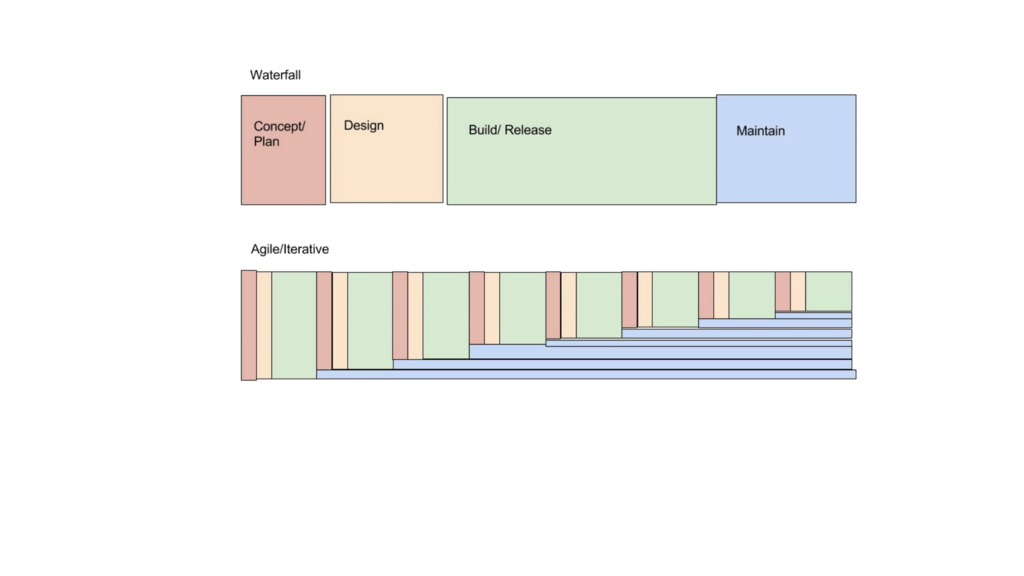
This approach can work for projects where the requirements are simple, well-understood, and unlikely to change. But what if you’re halfway through building and the customer realizes they need something different? Or what if the market changes? With Waterfall, making changes late in the process is difficult and expensive. You might end up delivering a product that is perfectly built to the original plan, but no longer useful.
Agile was created to solve this problem. It breaks the project into small, manageable pieces. Teams work in short cycles, often called "sprints" or "iterations," to deliver a small part of the final product. After each cycle, they review their work with the customer and adjust their plan for the next cycle. This allows for flexibility and continuous feedback, ensuring the final product meets the customer's actual needs.
The Agile Manifesto
In 2001, a group of software developers met to discuss how they could improve their development processes. They were frustrated with the rigid, documentation-heavy methods of the time. The result of their meeting was the "Manifesto for Agile Software Development."
This manifesto outlines four core values that are the foundation of the Agile mindset.
- Individuals and interactions over processes and tools.
Agile prioritizes people and communication. While tools and processes are useful, the best ideas and solutions come from team members talking to each other.
- Working software over comprehensive documentation.
Documentation is important, but the primary measure of success is a product that actually works and delivers value to the customer. Agile teams focus on creating functional software rather than getting bogged down in writing extensive documents that may never be read.
- Customer collaboration over contract negotiation.
Instead of defining every detail in a rigid contract at the beginning, Agile encourages ongoing collaboration with the customer throughout the project. This ensures the final product is what the customer truly wants, not just what was written down months earlier.
- Responding to change over following a plan.
In today's fast-paced world, change is inevitable. Agile embraces change. It recognizes that being able to adapt to new requirements or market conditions is more valuable than stubbornly sticking to an outdated plan.
Notice the wording: "over." This doesn't mean that things on the right side of the statement have no value. Processes, documentation, contracts, and plans are all important. However, Agile values the items on the left more. The Manifesto is also supported by 12 principles that expand on these values, all centered on delivering value to the customer quickly and efficiently.
Time to check what you've learned.
What is the core idea behind the Agile approach?
The traditional "Waterfall" model is most suitable for which type of project?
Understanding these core ideas—flexibility, collaboration, and customer value—is the first step to understanding why Agile has become so popular in project management.