Agentic RAG Systems Explained
Introduction to RAG
Giving AI an Open Book
Large Language Models (LLMs) are powerful, but they have a fundamental limitation: their knowledge is frozen in time. An LLM only knows what it learned during its training, and it can't access live information. This can lead to outdated or even invented answers, a problem often called "hallucination."
What if we could give an LLM a library of up-to-date, factual documents to reference before it answers a question? That's the core idea behind Retrieval-Augmented Generation, or RAG.
Retrieval-Augmented Generation (RAG) is an AI framework that connects a language model to an external knowledge repository, allowing the model to fetch and include relevant information when generating an answer.
Think of it like an open-book exam. Instead of relying purely on memory, the AI first looks up relevant information (the retrieval step) and then uses that information to craft a well-informed answer (the generation step). This simple but powerful approach makes AI responses more accurate, relevant, and trustworthy.
How RAG Works
A RAG system is built from a few key components working together. It all starts with a knowledge base, which is simply a collection of data you want the AI to use. This could be anything from internal company wikis and product manuals to a vast database of scientific research papers.
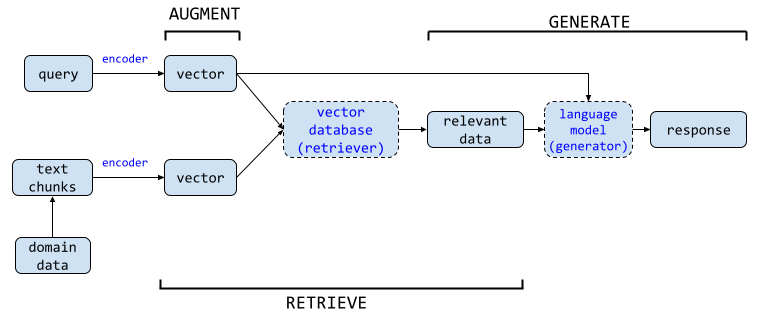
When you ask a question, two main things happen:
-
Retrieval: A component called a retriever searches the knowledge base for snippets of text that are most relevant to your query. It acts like a highly specialized search engine, pinpointing the exact paragraphs or documents that contain the information needed to form an answer.
-
Generation: The original query and the retrieved text snippets are then handed over to the generative model (the LLM). With this extra context, the LLM can generate a comprehensive and factually grounded answer, often citing the sources it used.
Benefits and Applications
Integrating retrieval with generation unlocks several key advantages. The most obvious is access to current and specific information. You can connect an LLM to a constantly updated database, ensuring its answers are always timely.
By grounding your generative content on your organization’s trusted knowledge base, a process also known as retrieval-augmented generation (RAG), you ensure that your generative content is accurate and specific to your organization’s processes.
This dramatically reduces the chances of hallucination, as the model's responses are anchored to real data. It also provides transparency. Because the system can point to the specific documents it used, users can verify the information for themselves.
This makes RAG systems incredibly useful for a variety of applications:
- Customer Support: Chatbots can provide accurate answers based on the latest product documentation and help articles.
- Enterprise Search: Employees can ask complex questions and get synthesized answers from internal reports, emails, and presentations.
- Research and Analysis: A researcher could use a RAG system to get a summary of the latest findings on a specific topic from thousands of academic papers.
What is the primary problem that Retrieval-Augmented Generation (RAG) is designed to solve for Large Language Models (LLMs)?
In the RAG process, the "retriever" component acts most like a: