Agentic Prompting for Business Discovery
Agentic Reasoning Frameworks
Beyond Simple Prompts
We've moved past the era of treating large language models like simple Q&A bots. The real power in business intelligence comes from building AI agents that can think, plan, and execute complex tasks on their own. Instead of just answering a question, these agents become partners in discovery, capable of tackling vague goals and returning structured, actionable insights.
This shift is powered by agentic workflows, which turn a single, static prompt into a dynamic, multi-step process. An agent doesn't just respond; it reasons about the problem, interacts with tools, and refines its approach based on what it finds. It's the difference between asking for a fish and giving an AI a fishing rod, a map, and instructions on what kind of fish to catch.
First, Think Step-by-Step
You can't solve a complex problem without a plan. The same is true for AI. If you give an agent a vague goal like "Find opportunities in AI for healthcare," it will likely return a generic, unhelpful list. To get better results, we need to force the agent to break the problem down first.
This is where Chain-of-Thought (CoT) prompting comes in. It's a technique that instructs the model to outline its reasoning process before delivering a final answer. For our healthcare example, a CoT-driven agent would first decompose the broad topic into logical sub-sectors.
Okay, 'AI in healthcare' is too broad. First, I'll break it into categories: 1. Diagnostics (e.g., medical imaging analysis), 2. Operations (e.g., hospital management, patient scheduling), 3. Drug Discovery (e.g., protein folding, clinical trial simulation), and 4. Personalized Medicine (e.g., genomic analysis).
This decomposition turns one massive, ambiguous task into several smaller, concrete research queries. The agent now has a clear plan of attack instead of just jumping to a conclusion.
The Reason-Act Loop
Once an agent has a plan, it needs to execute it. This is where the framework comes into play. ReAct stands for "Reason + Act," and it creates an iterative loop that allows the agent to interact with its environment (like a database, an API, or the web) and learn from the results.
The loop is simple but powerful: Think, Act, Observe.
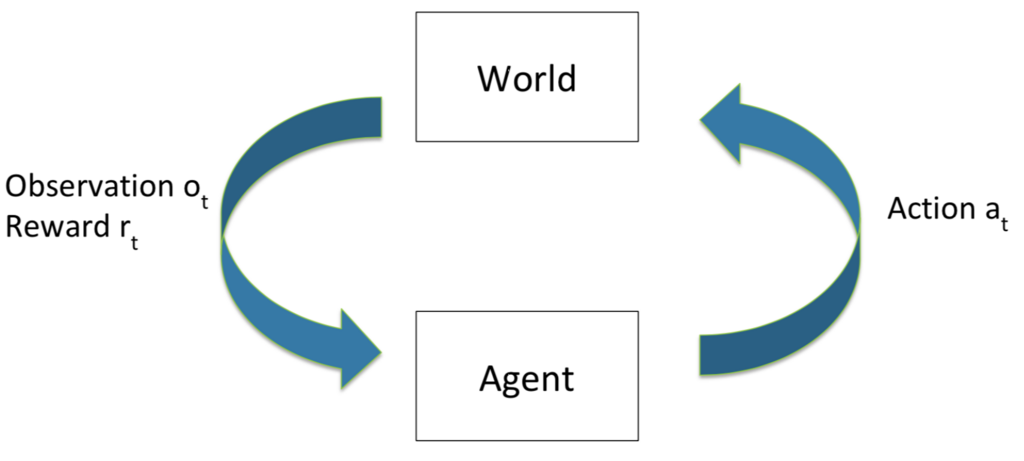
Let's apply this to our market discovery task. The agent, having identified "medical imaging analysis" as a sub-sector, enters the ReAct loop:
- Think: My goal is to find an underserved niche in AI for medical imaging. I should search for recent startups in this space and see what areas are crowded.
- Act: The agent executes a command, like
search_startup_db(query="AI medical imaging", funding_stage="Seed"). - Observe: It gets a list of 20 recent startups, most of which focus on cancer detection in MRIs and CT scans. It notes that lung and breast cancer are particularly crowded fields.
Now the loop repeats, but with new information.
- Think: Okay, cancer detection is saturated. What about other modalities or diseases? I'll check for AI applications in ultrasound or for neurological disorders like Alzheimer's.
- Act:
search_startup_db(query="AI ultrasound neurology") - Observe: The agent finds only two early-stage companies. This looks like a potential gap.
This iterative process allows the agent to navigate a problem space autonomously, zeroing in on promising opportunities instead of just scraping the surface.
Structuring the Conversation
For an agent's output to be useful in a business context, it can't just be a wall of text. We need structured data. By adding instructions to the system prompt, we can require the agent to return its findings in a specific format, like JSON. This makes the output predictable and machine-readable, allowing it to be fed into other systems, databases, or dashboards automatically.
Furthermore, we can define our business constraints directly in the prompt. This guides the agent's evaluation process, ensuring its suggestions are aligned with our strategic goals.
{
  "role": "system",
  "content": "You are a market analysis agent. Your goal is to identify underserved market niches. When you identify a potential niche, respond ONLY with a JSON object using the following schema:\n\n{\n  'market_niche': 'A specific, underserved area',
  'business_case': 'A 1-2 sentence rationale for why this is an opportunity',
  'estimated_tam': 'Estimated Total Addressable Market in 💲',
  'competition_level': 'Low, Medium, or High',
  'alignment_score': 'A score from 1-10 on how well this aligns with our focus on preventative care.'
}\n\nConstraint: Do not suggest any market with a competition_level of 'High'."
}
By combining Chain-of-Thought for planning, ReAct for execution, and structured outputs for usability, we transform a language model into a purpose-built agent. It can now autonomously scan markets, evaluate opportunities against our specific criteria, and deliver insights ready for a human decision-maker to act upon.
What is the primary advantage of using an AI agent with an agentic workflow over a traditional Q&A model for business intelligence?
In the context of AI agents, what is the main purpose of the Chain-of-Thought (CoT) prompting technique?