Agentic AI vs RPA in ERP
Architectural Logic
From Scripts to Strategy
In enterprise automation, we often start with scripts. Think of Robotic Process Automation, or , as a highly sophisticated digital macro. You record a sequence of actions—click this button, copy that field, paste it here—and the bot repeats it perfectly. It operates at the user interface (UI) or API layer, following a fixed, deterministic path. If you tell it to click a button located at coordinate (150, 300), it will always click there.
This approach is powerful for stable, predictable workflows. But what happens when your ERP provider updates the interface and that button moves to (150, 450)? The script breaks. The bot, lacking any understanding of its goal, can't adapt. It only knows the steps, not the destination. This architectural fragility is the core limitation of script-based automation.
The diagram above shows the difference. The RPA bot follows a straight line. If a step is broken, the process halts. The Agentic AI, however, operates in a loop, constantly assessing its options to reach a predefined goal.
The Agentic Leap
Agentic AI introduces a fundamental shift from executing scripts to achieving goals. Instead of a rigid, step-by-step procedure, you give the agent a high-level objective, like "Generate a quarterly sales report for the European region." The agent, often powered by a Large Language Model (LLM), is responsible for figuring out the how.
Unlike traditional automation that follows predetermined rules, agentic AI systems make autonomous decisions, pursue specific goals, and adapt their behavior to manage complex workflows independently.
This is possible because an AI agent operates on a continuous Perception-Reasoning-Action loop. It perceives its environment (what's on the screen, what data is in the API response), reasons about the best course of action to get closer to its goal, and then acts by using a tool. If an action fails—say, an API endpoint is temporarily down—it perceives the failure, reasons about an alternative, and acts again, perhaps by trying a different endpoint or falling back to a UI-based method. This is a probabilistic, not deterministic, approach. It's not about following one guaranteed path, but about navigating possibilities.
Architecture for Resilience
The architectural difference comes down to layers. RPA operates directly on the UI and API layers. Its logic is intertwined with the presentation of the application. An agent, however, introduces a 'cognitive layer' between the goal and the execution. This layer is where the planning and resilience live. The agent doesn't just have a script; it has a toolbox. An RPA bot might be one of the tools in that box, alongside tools for direct database queries, API calls, or even sending an email to a human for help.
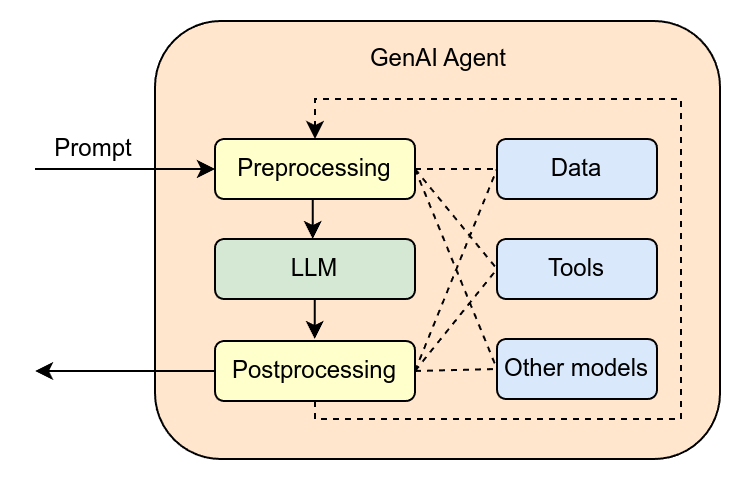
When an ERP interface changes, an RPA bot fails. An AI agent, on the other hand, perceives the change. Its reasoning faculties recognize that the previous path is blocked. It then consults its available tools and plans a new path to the same goal. The system is resilient because the goal is decoupled from the execution method.
So, while RPA excels at automating high-volume, static tasks, Agentic AI provides a framework for automating dynamic, complex processes that require adaptation and problem-solving. It's the difference between a player piano and a jazz musician.
What is the primary limitation of traditional Robotic Process Automation (RPA) as described in the text?
According to the text, an AI Agent operates on a continuous loop. What are the three phases of this loop?