Agentic AI Systems
Introduction to Agentic AI
What is Agentic AI?
Most AI we interact with today is reactive. You give a chatbot a prompt, and it gives you a response. You ask a smart speaker to play a song, and it plays the song. It waits for your command and then executes a specific task.
Agentic AI is different. It doesn't just react; it acts. The core idea is to create AI systems, or "agents," that can pursue goals on their own with minimal human guidance.
Agentic AI is a type of artificial intelligence that can work on its own instead of waiting for step-by-step instructions.
Think of it like hiring a personal assistant versus using a calculator. You tell a calculator exactly what to do: $5 * 8$. You tell a personal assistant a high-level goal: "Please book my travel to a conference next month." The assistant then figures out all the necessary steps: finding flights, booking a hotel, arranging ground transport, and managing your calendar. They make decisions and take actions to achieve the goal.
That's the essence of agentic AI. It's about building systems with agency.
agency
noun
The capacity of an actor to act independently and to make their own free choices.
These systems are characterized by their autonomy, adaptability, and goal-oriented behavior. They perceive their environment, make decisions, and take actions to get closer to their objectives.
Autonomous Decision-Making
How does an agentic system decide what to do? It follows a continuous loop of sensing, thinking, and acting. It's not just a one-off command and response. Instead, it's a dynamic process.
- Perceive: The agent gathers information about its environment. This could be data from the internet, input from sensors, or information from other AI agents.
- Plan: Based on its goal and the information it has, the agent breaks the goal down into smaller, manageable steps. It formulates a plan of action.
- Act: The agent executes the steps in its plan. This might involve using software tools, accessing a database, or communicating with another system.
- Observe: After acting, the agent observes the outcome. Did its action move it closer to its goal? Did the environment change? It uses this feedback to update its understanding and adjust its next plan.
This loop allows the agent to navigate complex situations and adapt to new information without a human needing to intervene at every step.
Working Together
Often, a single agent isn't enough to solve a complex problem. That's where multi-agent systems (MAS) come in. A multi-agent system is a collection of autonomous agents that interact with each other.
These agents can collaborate to achieve a common goal, compete for resources, or negotiate to find a compromise. By working together, they can tackle problems that would be too difficult or inefficient for a single agent to handle. For example, one agent might be specialized in gathering data, another in analyzing it, and a third in presenting the findings. They communicate and coordinate their actions to produce a result.
Multi-agent systems allow for a divide-and-conquer approach to problem-solving, where tasks are broken down and distributed among specialized agents.
This structure makes the system more robust. If one agent fails, others can potentially adapt and take over its tasks, preventing the entire system from collapsing.
The Unpredictable Outcome
One of the most fascinating aspects of multi-agent systems is emergent behavior. This is when complex, system-wide patterns arise from the simple, local interactions of individual agents. The overall behavior is not explicitly programmed into any single agent; it emerges from their collective actions.
A classic example from nature is a flock of birds. Each bird follows a few simple rules, like matching the speed of its neighbors, staying close but not too close, and avoiding predators. No single bird is in charge, and there's no master plan. Yet, from these simple individual rules, the intricate and coordinated dance of the flock emerges.
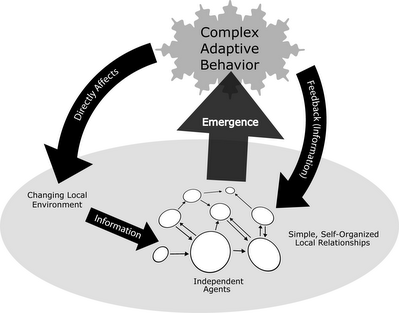
In AI, emergent behavior can lead to powerful and unexpected solutions to problems. By designing simple agents and allowing them to interact, developers can create systems that exhibit sophisticated, intelligent behavior that wasn't designed top-down. This is a powerful concept, suggesting that complex intelligence doesn't always require a complex design.
Understanding these core ideas—autonomy, multi-agent collaboration, and emergence—is the first step toward grasping the power and potential of agentic AI.