Agentic AI Projects with n8n
Agentic AI Fundamentals
Beyond Prompts
Most AI tools you might have used are reactive. You give them a prompt, they give you a response. Ask a question, get an answer. It's a simple, one-step exchange.
Agentic AI is different. It’s a shift from a simple tool to an autonomous worker. Instead of just responding, an agent can take a goal, break it down into steps, make a plan, and execute it. It can use tools, adapt to new information, and work on a problem until it's solved, all with minimal human oversight.
Think of it like hiring a personal assistant versus using a calculator. A calculator only does what you tell it, one calculation at a time. An assistant understands your goal, like "plan my trip to Tokyo," and then handles all the steps: booking flights, finding a hotel, and creating an itinerary.
The Agent's Architecture
At its core, every AI agent operates on a simple but powerful loop. It perceives the world around it, decides what to do next, and then takes action. This cycle repeats until the agent achieves its objective.
Let's break down these components:
- Perception: This is how the agent gathers information. It could be reading a user's request, analyzing data from a spreadsheet, or even processing information from the internet via an API. The agent needs to understand its current situation and the resources available.
- Decision-Making: This is the agent's brain. After perceiving its environment, it needs to reason about what to do next. It formulates a plan, breaks the goal into smaller tasks, and decides which tools to use. This is where the magic of modern AI comes into play.
- Action: Once a decision is made, the agent acts. This could involve writing code, sending an email, querying a database, or calling another AI model. The outcome of the action then feeds back into the perception phase, starting the loop over again.
LLMs as the Engine
The reasoning and planning capabilities of agentic AI are largely powered by Large Language Models (LLMs). An LLM acts as the core cognitive engine, allowing the agent to understand complex goals, reason through problems, and generate step-by-step plans. The LLM processes the information from the perception stage and outputs a logical plan for the action stage.
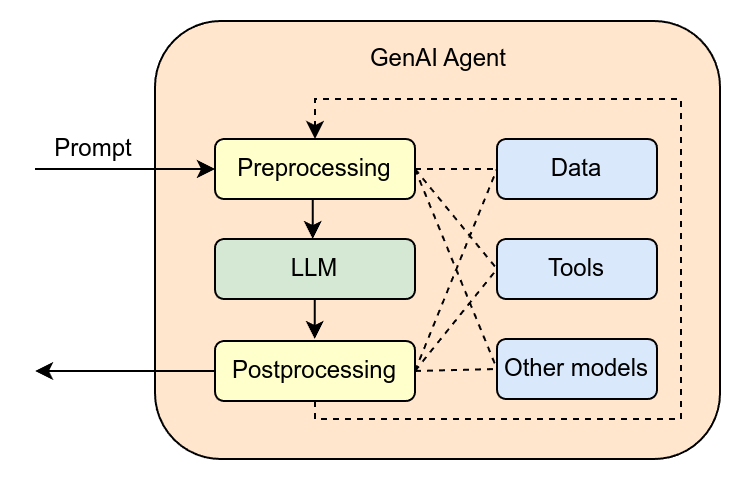
But an LLM on its own isn't an agent. It's like a powerful engine without a car. To be truly effective, an agent needs more. It requires a framework that allows it to interact with tools and, most importantly, to remember.
The Power of Memory
Imagine trying to complete a task if you forgot everything you just did a second ago. That's an AI agent without memory. Memory, or context, is what allows an agent to function coherently. It provides the continuity needed to execute multi-step plans.
There are two key types of memory for an agent:
- Short-term memory: This holds information about the current task. It tracks the steps already taken, the results of those steps, and what needs to be done next. It's the agent's working scratchpad.
- Long-term memory: This allows an agent to learn from past experiences. By storing information from previous tasks, an agent can recall successful strategies or avoid past failures, becoming more efficient and effective over time.
By combining perception, a powerful decision-making engine like an LLM, the ability to take action, and a persistent memory, we create a system that can autonomously work toward complex goals. This is the foundation of agentic AI.