Agentic AI In Depth
Agent Characteristics
What Makes an Agent 'Intelligent'?
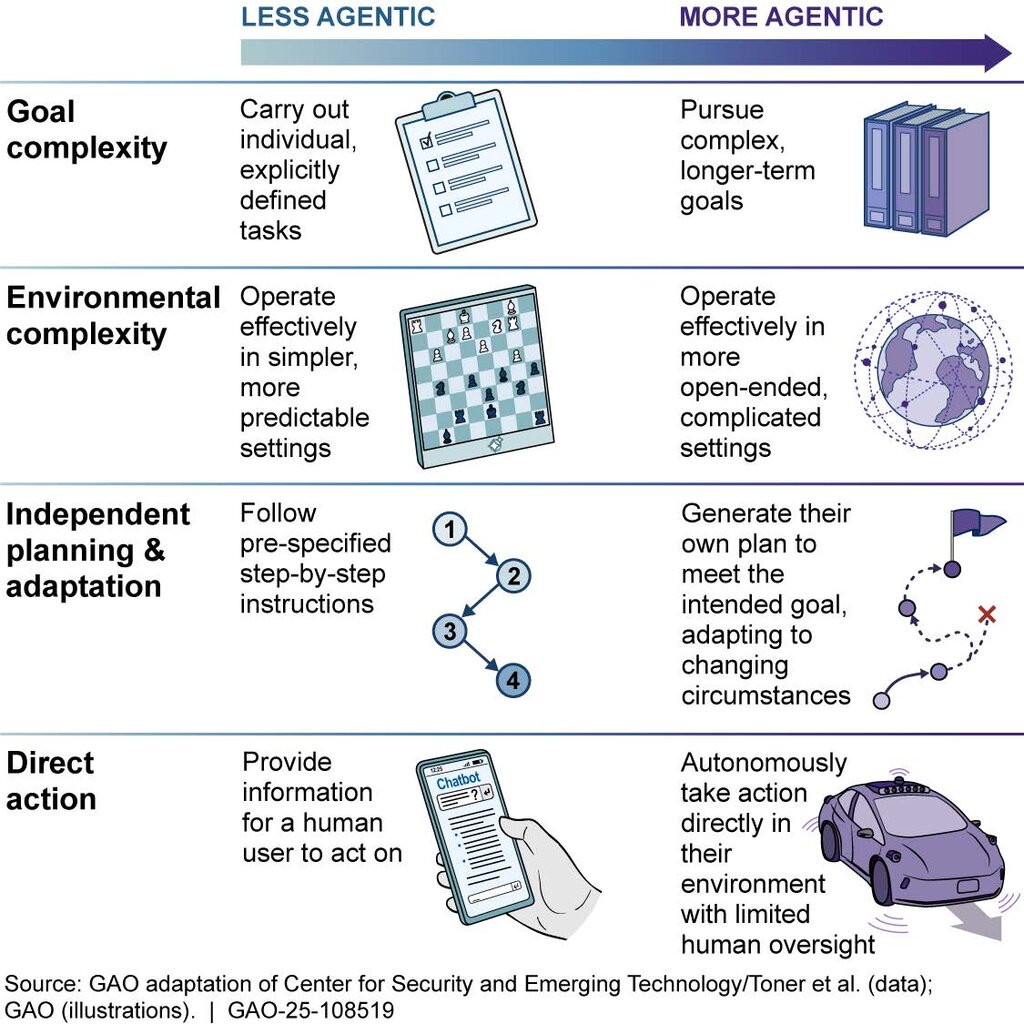
An AI agent is more than just a program that follows instructions. To be considered 'agentic,' a system needs to exhibit specific behaviors. Think of it as the difference between a simple calculator and a self-driving car. Both compute, but one perceives its environment and acts on it to achieve a goal. The core idea is that an agent links what it senses (percepts) to the actions it takes.
Learn what makes an AI system an 'agent' and why agentic design is crucial
Four key characteristics define an intelligent agent: autonomy, reactivity, pro-activity, and social ability. Not every agent has all four traits in equal measure, but they provide a framework for understanding and building more sophisticated AI systems. The more an AI exhibits these traits, the more 'agentic' it becomes.
Core Characteristics
Autonomy
noun
The ability of an agent to operate without direct human intervention or control. It can make its own decisions based on its perceptions and internal state.
Autonomy is the cornerstone of agentic AI. An autonomous agent isn’t just following a rigid script. It has a degree of freedom to choose its actions to achieve its objectives. For example, a Roomba doesn't need you to tell it where to go. It uses its sensors to navigate a room, avoid obstacles, and return to its dock, all on its own.
Next is reactivity. An agent must perceive its environment and respond to changes in a timely fashion. If the world changes, the agent’s behavior should change with it. A smart thermostat turning on the heat when the temperature drops is a simple example. A more complex one is a trading bot that executes a trade the instant market conditions meet its predefined criteria.
Pro-activity means an agent doesn't just wait for something to happen; it takes initiative. Instead of only reacting, it pursues goals. A proactive agent might notice your calendar has a meeting in 30 minutes and suggest the best route to take based on current traffic. It's goal-driven, not merely event-driven. This behavior is guided by the agent's internal objectives, allowing it to exhibit rather than simply responding to its immediate surroundings.
Finally, social ability is the capacity to interact with other agents, including humans. This can be as simple as a pop-up chatbot asking if you need help or as complex as a fleet of delivery drones coordinating their routes to avoid collisions and optimize delivery times. In multi-agent systems, this collaborative or competitive interaction is essential for achieving larger, more complex goals that a single agent could not manage alone.
Simple Agent Architectures
To see these characteristics in action, we can look at a couple of basic agent designs. The simplest is the simple reflex agents. These agents react directly to their perceptions without considering any history or context. Their behavior is based on a set of condition-action rules: if this happens, do that.
Think of an automated light that turns on when it detects motion. It perceives motion (the condition) and flips the switch (the action). It has no memory of whether the light was just on or how long it's been dark.
A step up in complexity is the model-based reflex agent. This agent maintains an internal state, which is its own model of how the world works. It keeps track of the parts of the world it can't see right now. This internal model helps it handle situations where its sensors don't provide the full picture.
For example, a self-driving car needs to know about other cars that might be in its blind spot. It uses its past perceptions to build a model of where other vehicles are likely to be, allowing it to make safer decisions than a simple reflex agent could. This internal is crucial for operating in partially observable environments.
These are just the first steps. By building on these concepts, adding goals (goal-based agents) and measures of success (utility-based agents), we can create increasingly sophisticated systems. Understanding these foundational agent types is key to grasping how more advanced AI, like the large language models of today, can perform complex, multi-step tasks.
What is the core function that defines an AI system as an 'agent'?
A virtual assistant analyzes your calendar, checks current traffic conditions, and then alerts you to leave 15 minutes early for an appointment. This behavior is a prime example of which agent characteristic?
Now you have a solid grasp of what makes an agent, well, an agent. Next, we'll explore how these agents actually decide what to do through planning and search.