Agentic AI for Strategic Executive Leadership
Agentic vs Static Architectures
Beyond the Chatbox
Most interactions with generative AI feel like a simple conversation. You ask a question, and a large language model (LLM) provides an answer. This is a static, reactive process. The AI waits for your input, generates a response based on that single prompt, and then waits again. It's a powerful tool for drafting an email or summarizing a report, but its ability to act is limited to the text it produces.
Agentic AI represents a fundamental shift from this model. Instead of just responding, an agent acts. It is a system designed to pursue a goal with a degree of autonomy. You don't give it a step-by-step list of commands; you give it an objective, and it figures out the steps itself. This is the difference between an analyst who can write a market summary and a project manager who can execute a multi-stage plan.
While a chatbot is a responder, an agent is an actor. It possesses a form of executive agency, allowing it to plan, make decisions, and take actions to achieve a goal.
The Anatomy of an Agent
What gives an AI agent its ability to act independently? It's not a single, monolithic model but an architecture that combines several key capabilities. These components work together to transform a passive language model into a proactive system.
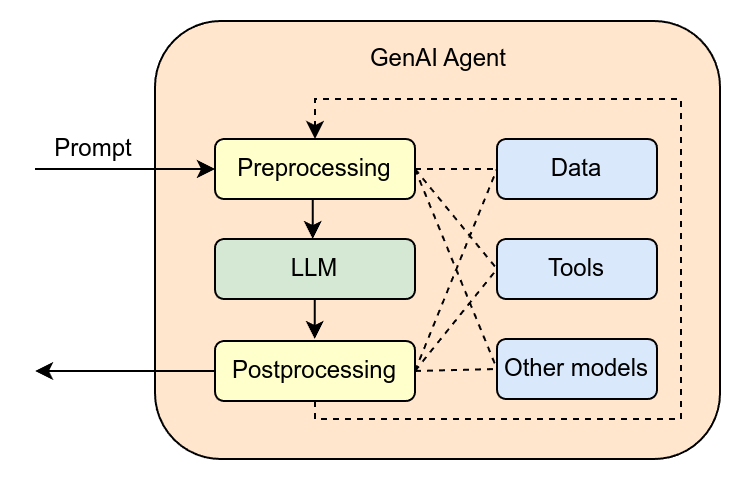
At the heart of this is the ability to reason. Agents use techniques like to create an internal monologue. Before producing a final answer, the AI breaks down the problem, explores potential paths, and lays out its logic step by step. This structured thinking process dramatically improves its ability to handle complex, multi-part requests.
This reasoning ability is then paired with action. The most common framework for this is the ReAct pattern (Reason + Act). The agent operates in a continuous loop: it assesses the situation, reasons about the next best step, takes an action, and then observes the outcome. This cycle repeats until the overall goal is achieved.
For this loop to be effective, an agent needs memory. A standard chatbot has a very limited memory, often just the current conversation. An agentic system, however, uses more sophisticated memory management. It can have short-term "working" memory for the task at hand, and access to long-term memory, often a database, to recall past actions, user preferences, and learned information. This prevents the agent from starting from scratch every time it acts.
Finally, agents connect their reasoning to the real world through tools and function calling. An agent's "Act" step isn't just generating text; it's often making an API call. This allows it to check a database, send an email, update a project management board, or order materials from a supplier. The LLM acts as a reasoning engine that decides which tool to use and with what inputs, effectively orchestrating other software to get the job done.
From Assistant to Partner
Understanding this architectural shift is crucial for strategic planning. A static generative AI is an assistant that can help with discrete tasks. It can draft a response to a request for information (RFI) for a construction bid or write a first draft of a new patient intake policy for a hospital. The human executive remains firmly in the driver's seat, prompting the AI at every stage.
Unlike traditional generative AI, which responds reactively to prompts, agentic AI proactively orchestrates processes, such as autonomously managing complex tasks or making real-time decisions.
An agentic system, by contrast, can function as a strategic partner. For a construction firm, an agent could be tasked with monitoring supply chain data for a specific project. If it detects a delay in a steel shipment (Observe), it could reason that this will impact the framing schedule (Reason), then automatically check alternative suppliers and notify the project manager with a proposed solution (Act). This goes far beyond simple text generation.
Similarly, a hospital executive could deploy an agent to manage operating room scheduling. The agent's goal would be to maximize utilization while accommodating surgeon preferences and emergency cases. It would use tools to access electronic health records, staff schedules, and inventory systems, reasoning through the complex interplay of variables to create and adjust the schedule dynamically, a task that would otherwise require significant human coordination.
The transition from static to agentic AI is not just a technical upgrade. It's a shift from using AI as a tool for communication to deploying it as a system for execution.
What is the primary difference between a standard generative AI model and an agentic AI system?
An AI agent operates in a continuous loop: it assesses the situation, reasons about the next best step, takes an action, and observes the outcome. What is this framework commonly called?