Agentic AI for Product Managers
Introduction to Agentic AI
Beyond Answering Questions
Think about the difference between a calculator and a personal assistant. A calculator does exactly what you tell it. You type in “2+2,” and it gives you “4.” It's incredibly useful, but it waits for your specific instructions.
A personal assistant, on the other hand, operates differently. You can give them a high-level goal, like “plan a business trip to Tokyo for next week.” They don’t wait for you to specify every single step. They figure out what needs to be done: find flights, book a hotel near the conference center, check your calendar for conflicts, and maybe even reserve a table at a restaurant for a client dinner. They take the goal and run with it.
This is the core idea behind agentic AI. It’s a shift from AI systems that simply react to prompts to systems that can autonomously pursue goals. They can plan, execute a series of actions, and adapt along the way with minimal human intervention.
Agentic AI doesn't just perform a task. It understands an objective and independently works to achieve it.
The Core Principles
Several key characteristics make agentic AI different from other forms of artificial intelligence. Understanding them is crucial to grasping its potential.
Autonomy This is the ability to operate without constant human supervision. A traditional AI, like a grammar checker, flags a potential error and waits for you to accept or reject the suggestion. An agentic AI is more like a self-driving car that navigates traffic, changes lanes, and reaches a destination on its own. It makes decisions and takes action independently to move closer to its goal.
Goal-Directed Behavior Agentic systems are defined by their objectives. Instead of being given a specific command like “search for flights from SFO to LAX on Tuesday,” you give it a goal: “find the most efficient way for me to get to my Los Angeles meeting on Tuesday afternoon.” The AI then determines the best steps. That might involve booking a flight, or it might mean checking train schedules or traffic conditions for driving. It focuses on the outcome, not just the command.
Adaptability What happens when things go wrong? A simple automated script will fail if it hits an unexpected error. Agentic AI is designed to be more resilient. If a website is down or a flight is suddenly unavailable, it can adapt its strategy. It might try a different airline, look for flights on a different day, or notify you with alternative options. It learns from its environment and adjusts its plan accordingly.
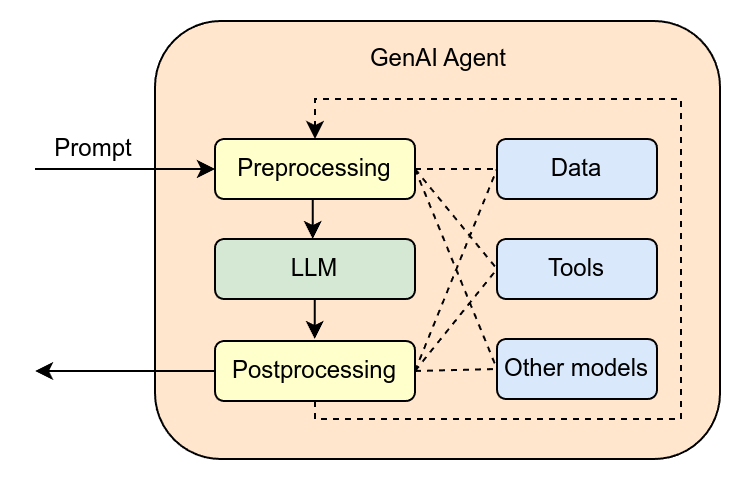
Modularity Think of an agentic AI as a project manager with a team of specialists. It can access different tools or modules to accomplish its goal. One module might be a web browser for research, another could be an API for booking travel, and a third might be a code interpreter for data analysis. The AI acts as the central coordinator, deciding which tool to use and when.
Transparency For an autonomous system to be trustworthy, we need to understand its decision-making process. Transparency means the AI can explain why it took certain actions. Why did it choose this flight over another? What information led it to that conclusion? This “chain of thought” is vital for debugging, refining the AI’s performance, and building user confidence.
Agentic vs. Traditional AI
The distinction between agentic and traditional AI becomes clearer when you see them side-by-side. Traditional AI systems, including many generative AI models like basic chatbots, are primarily reactive. They excel at single-turn tasks: you ask a question, they provide an answer. You give a command, they execute it.
Agentic AI is proactive. It can handle multi-step, complex tasks that unfold over time. It's less of a tool you wield and more of a partner you delegate to.
In short, the differences between agentic AI and traditional AI are about control and capability: agentic systems are more autonomous, goal-driven, and capable of operating independently across multiple steps, while traditional AI executes within narrower, predefined boundaries.
Here’s a simple breakdown of the key differences.
| Feature | Traditional AI | Agentic AI |
|---|---|---|
| Initiative | Reactive (waits for prompts) | Proactive (pursues goals) |
| Task Complexity | Best for single, discrete tasks | Handles multi-step, complex workflows |
| Autonomy | Low (requires human guidance) | High (operates independently) |
| Interaction Model | Conversational (one-off exchange) | Delegative (ongoing process) |
| Adaptability | Limited (often fails on errors) | High (can adjust to new information) |
By understanding these fundamentals, you can begin to see how agentic AI represents a significant evolution, moving from systems that answer to systems that achieve.