Agentic AI Explained
Introduction to Agentic AI
What Is Agentic AI?
Most of us think of AI as something that responds to us. We type a question into a chatbot, and it gives us an answer. We ask a smart speaker to play a song, and it plays. This is a reactive relationship. We provide a prompt, and the AI gives a direct, one-off response.
Agentic AI is different. It represents a shift from reactive tools to proactive partners. Instead of just responding to a command, an agentic system can take a goal, create a plan, and execute a series of actions to achieve it, all with minimal human oversight. It's the difference between a calculator that waits for you to input numbers and a financial assistant that you can ask to "find the best savings account for my goals and start the application process."
Agentic AI is a branch of artificial intelligence focused on building autonomous, intelligent agents capable of making decisions, interacting with other agents and completing complex tasks with minimal human intervention.
At the heart of this concept is the idea of agency. An AI with agency can act independently on behalf of a user to achieve a desired outcome.
From Reactive to Proactive
Traditional AI models, including many powerful generative AI tools, are fundamentally passive. They excel at tasks like summarizing text, generating images, or translating languages, but they wait for a specific instruction before they do anything. The user is always in the driver's seat, guiding each step.
Agentic AI flips this dynamic. You give it a high-level goal, and it takes the initiative. It can reason about what needs to be done, break the goal down into smaller sub-tasks, and then execute those tasks in a logical sequence. This proactive nature is its defining feature.
| Feature | Traditional AI | Agentic AI |
|---|---|---|
| Initiative | Reactive (waits for prompts) | Proactive (initiates actions) |
| Task Scope | Single, well-defined tasks | Complex, multi-step workflows |
| Human Role | Constant director | Goal-setter and supervisor |
| Operation | Executes one step | Plans and executes a sequence |
The Core Traits of an Agent
Several key characteristics distinguish agentic AI systems. Understanding them helps clarify what makes this technology so powerful.
Autonomy This is the ability to operate without constant human intervention. An agent can be given a goal and trusted to work towards it independently, making its own decisions along the way.
Goal-Oriented Behavior Agents don't just perform random actions. Their behavior is driven by a specific objective. Whether it's booking a flight, managing a calendar, or monitoring a system for errors, every action is a step toward fulfilling its primary goal.
Multi-Step Planning & Reasoning Achieving a goal often requires more than one step. Agentic AI can analyze a goal, reason about the necessary sequence of actions, and create a coherent plan. If it hits a roadblock, it can reassess and adapt its plan.
Cross-System Integration To get things done in the real world, agents need to interact with various tools and software. A key feature is the ability to use different applications, like sending emails, accessing databases, or interacting with websites. It can orchestrate these tools to complete its workflow.
Contextual Understanding An agent needs to perceive and understand its environment to act effectively. It processes real-time data and context to make informed decisions. For example, a travel agent AI would need to know your budget, preferred dates, and current flight prices to book a suitable trip.
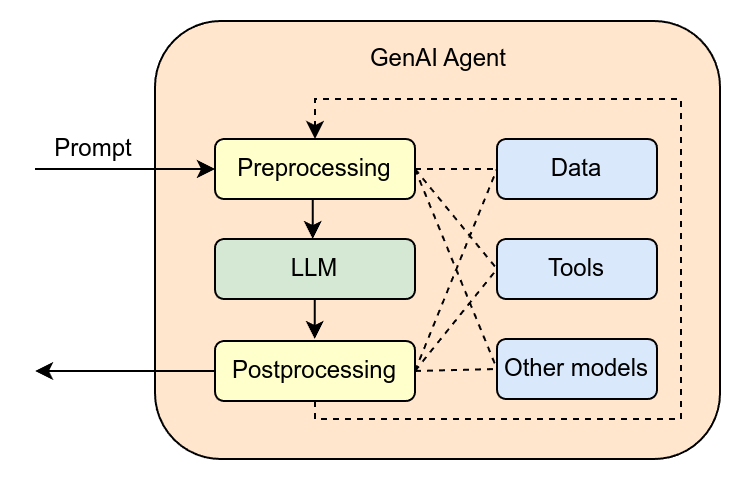
These traits combine to create systems that are much more than simple information retrievers. They are becoming capable doers. This ability to autonomously plan and execute complex workflows is why agentic AI is poised to change how we interact with technology, automating not just single tasks, but entire processes.
What is the primary characteristic that distinguishes agentic AI from traditional reactive AI?
Which of the following scenarios best illustrates an agentic AI system?