Agentforce Advanced Implementation and Strategy
Architectural Logic Frameworks
From Blueprints to Brains
In traditional systems, logic follows a blueprint. Think of a Salesforce Flow: it’s a deterministic process where A always leads to B. If a certain condition is met, a specific action is triggered, every single time. It’s predictable and rigid, like a train on a track.
AI agents operate on a different principle. Instead of following a strict, pre-defined path, they work within a framework of autonomous reasoning. We don't program every step. Instead, we architect a system that allows the agent to think, decide, and act on its own to achieve a goal. This is a fundamental shift from building a rigid process to guiding an intelligent system.
Your role changes from a process builder to a logic architect, shaping the agent's decision-making environment rather than dictating its every move.
The ReAct Framework
At the heart of many modern agents, including those in Agentforce, is a pattern called ReAct, which stands for Reason and Act. It’s a simple but powerful idea that transforms a language model from a mere text generator into a problem-solver that interacts with its environment.
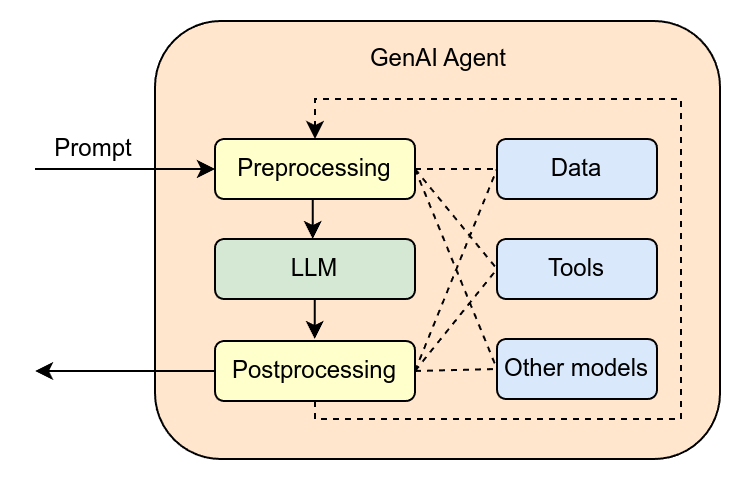
The ReAct pattern works in a continuous loop. The agent first reasons about the task, forming a thought about what it needs to do next. Then, it takes an action based on that thought, like querying a database or accessing a tool. Finally, it makes an observation of the result. This new information feeds back into the loop, informing the next cycle of reasoning and action.
This cycle continues until the agent determines the final goal has been met. The Salesforce is the core component that drives this loop. It's responsible for parsing the user's initial request and the subsequent observations into coherent thoughts. Based on this internal monologue, it decides which specific tool to call or what action to perform next to move closer to the objective.
Guiding the Agent's Logic
Because the agent is autonomous, we can't force its decisions. However, we can heavily influence them through strategic instruction design. Your instructions act as the agent's constitution, defining its goals, constraints, and available tools. This is where you can apply principles from game theory to build a more robust and reliable agent.
Think of it as defining the rules of a game. By clearly stating what a 'win' looks like (the goal) and the valid moves (the tools and constraints), you can drastically reduce the chances of undesirable behavior like hallucination and guide the agent toward the optimal path for goal attainment.
For example, you can model constraints logically within the instructions. Instead of saying "Don't do X," you might frame it as "To achieve the highest score, prioritize actions Y and Z, and only use action X if conditions A and B are met." This approach guides the agent's reasoning process by framing the task as a strategy problem, not just a to-do list.
Within Agentforce instructions, you also manage the trade-offs between different prompting strategies:
| Strategy | Description | Use Case in Agentforce |
|---|---|---|
| Zero-Shot | You give the agent a task it has never seen before, without any examples. | Good for simple, ad-hoc tasks where the goal is straightforward and the agent can rely on its general knowledge. |
| Few-Shot | You provide a few examples of how to perform similar tasks within the instructions. | Essential for complex or nuanced tasks. This teaches the agent the desired pattern of reasoning and action. |
Using a few-shot approach is a powerful way to implement logic-based constraint modeling. By showing the agent examples of correct reasoning and tool usage, you are implicitly teaching it the rules and steering its autonomous behavior toward proven, effective patterns.
Now, let's test your understanding of these architectural concepts.
What is the primary difference between how a traditional system like a Salesforce Flow and an AI agent operate?
The ReAct pattern works in a continuous loop of Reasoning, Acting, and which other crucial step?
Mastering these frameworks allows you to build agents that are not only powerful but also predictable and aligned with business goals.