Agent-Based Systems Fundamentals and Applications
Introduction to Agent-Based Systems
The World from the Ground Up
Imagine a traffic jam. No single driver is in charge, and there's no central rulebook that says “create a bottleneck at 5 PM.” Instead, each driver follows a few simple rules: stay in your lane, keep a safe distance, and slow down when the car ahead does. The traffic jam is an emergent outcome of all these individual decisions happening at once. This is the core idea behind Agent-Based Systems.
Agent
noun
An autonomous, decision-making entity within a model. An agent has its own set of rules and behaviors and can interact with its environment and other agents.
Agent-Based Systems, or ABS, are a way of modeling complex systems by simulating the actions and interactions of individual agents. Instead of looking at a system from the top down, ABS builds it from the ground up. Each agent is given a set of rules, and the modeler simply lets them loose to see what happens. The key characteristics of agents are their autonomy (they make their own choices), heterogeneity (they can be different from one another), and their ability to interact and adapt.
In an Agent-Based System, complex global behavior arises from simple local rules.
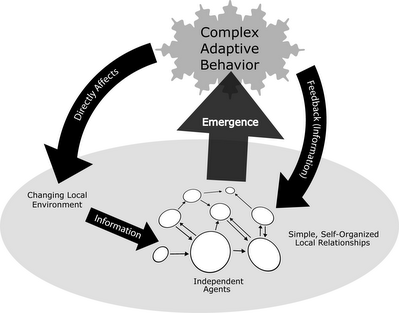
A Different Kind of Model
ABS isn't the only way to model the world. Other approaches, like System Dynamics, look at systems from a high level, focusing on aggregate data and feedback loops. Think of modeling a national economy by looking at overall inflation and unemployment rates. ABS, in contrast, would model the individual households and firms making buying and selling decisions.
| Feature | Agent-Based Systems (ABS) | System Dynamics |
|---|---|---|
| Level of Detail | Bottom-up (individual agents) | Top-down (system aggregates) |
| Focus | Interactions and emergent behavior | Feedback loops and system flows |
| Key Question | How do individual actions create patterns? | How do system stocks and flows change? |
| Example | Simulating individual commuters to understand traffic jams. | Modeling total traffic flow on a highway system. |
The power of ABS lies in its ability to capture behaviors that top-down models miss. When the actions of diverse individuals matter, ABS provides a much richer and more realistic picture.
From Segregation to Supply Chains
The roots of ABS go back to the 1940s with thinkers like John von Neumann, who explored self-replicating automata. But one of the most influential early models came in the late 1960s from economist Thomas Schelling. He wanted to understand how neighborhoods become segregated, even when individuals are not strongly prejudiced.
Schelling's model showed that severe segregation could emerge from just a mild preference for one's neighbors to be of the same type. This was a groundbreaking insight. It demonstrated that large-scale patterns don't always reflect the intentions of the individuals creating them.
Today, ABS is used in countless fields:
- Economics: Modeling stock markets by simulating individual traders.
- Public Health: Simulating the spread of a disease through a population.
- Business: Optimizing supply chains by modeling factories, trucks, and stores as agents.
- Urban Planning: Understanding pedestrian flow in a new city square.
By focusing on the individual, agent-based systems give us a powerful lens for understanding how complexity arises in the world around us. It's a way to see the forest and the trees.
What is the fundamental approach of an Agent-Based System (ABS)?
In the context of Agent-Based Systems, the traffic jam example illustrates a phenomenon known as: