Agent-Based Modeling Fundamentals
Introduction to Agent-Based Modeling
Modeling from the Ground Up
Imagine trying to understand a traffic jam. You could look at overall traffic flow, speed averages, and congestion data. That’s a top-down view. Or, you could focus on each individual driver. What simple rules do they follow? Keep a safe distance, change lanes when possible, slow down for the car ahead. If you simulate a thousand cars all following these simple rules, you might see a traffic jam form all on its own. You're not programming a traffic jam; you're programming drivers. The jam just happens.
This is the core idea behind Agent-Based Modeling, or ABM. It’s a way to understand complex systems by simulating the actions and interactions of its individual components, or “agents.”
Agent-based modeling is a simulation technique that focuses on the behavior of individual agents and their interactions with each other and with their environment.
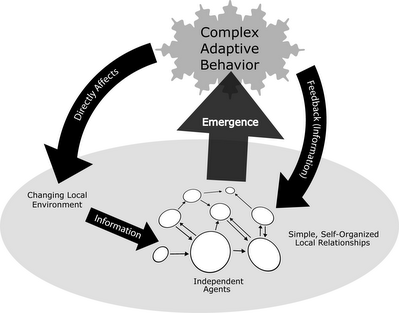
An agent can be a person, a car, a company, an animal, or even a cell. Each agent is given a set of simple rules that govern its behavior. The model then lets these agents loose in a simulated environment to interact with each other. By watching these interactions play out, we can often see complex, large-scale patterns emerge from the simple, small-scale behaviors.
The Core Ideas
ABM is a “bottom-up” approach. Instead of creating equations that describe the system as a whole (a “top-down” method), we define the behavior of the individual parts. Three key components make this possible:
- Agents: These are the autonomous individuals in the model. The key is that they can make their own decisions based on their rules and their perception of the environment and other agents.
- Environment: This is the world the agents live in. It can be a simple grid, a realistic map, or an abstract network.
- Rules of Interaction: These are the simple instructions that govern agent behavior. An agent’s rules might tell it how to move, what to eat, or how to interact with another agent it meets.
The magic happens when you press “run.” The agents, all following their own simple rules, start interacting. From these local interactions, a global pattern can emerge—a pattern you didn't explicitly program. This is called emergent behavior.
A flock of birds is a classic example of emergence. No single bird is the leader, and no bird can see the whole flock. Each bird follows just three simple rules: steer away from neighbors to avoid collision, align with the average direction of neighbors, and move toward the average position of neighbors. The result is the beautiful, coordinated dance of the flock.
Where is ABM Used?
Because it’s so flexible, ABM is used in many different fields. In ecology, scientists model predator-prey populations or the spread of forest fires by simulating the behavior of individual animals or trees. In social science, researchers can study the spread of opinions or fads by modeling people in a social network.
In economics, analysts use ABM to create artificial stock markets where trading agents, each with different strategies, buy and sell assets. These models can create market bubbles and crashes that look surprisingly similar to the real world, helping us understand phenomena that are difficult to predict with traditional equations.
Even city planners use ABM to simulate traffic flow or pedestrian movement to design more efficient public spaces.
Why Not Just Use an Equation?
Other modeling approaches, like equation-based modeling, look at a system from the top down. They use differential equations or statistical analysis to describe the behavior of the system as a whole. This is powerful for systems where the components are uniform and their interactions are well understood, like gas particles in a box.
But what about systems where the individuals are diverse and their interactions create complex, unpredictable feedback loops? A city isn't just an aggregation of the “average” citizen. Everyone is different, and their interactions are what make the city dynamic. ABM shines here because it embraces this complexity and heterogeneity.
| Feature | Agent-Based Modeling (ABM) | Equation-Based Modeling |
|---|---|---|
| Approach | Bottom-up | Top-down |
| Focus | Individual agents & interactions | System-level aggregates |
| Key Element | Heterogeneous agents | Homogeneous components |
| Best For | Complex, adaptive systems | Stable, predictable systems |
| Example | Simulating a city's growth | Calculating planetary orbits |
ABM doesn’t replace other methods; it complements them. It provides a new lens for looking at the world, one that starts with the individual and builds up to the whole. It’s a powerful tool for exploring, understanding, and experimenting with the complex systems that surround us.
Agent-Based Modeling (ABM) is best described as which type of approach to understanding complex systems?
When complex, large-scale patterns (like a traffic jam or a market crash) arise from the simple, local interactions of individual agents in a simulation, this phenomenon is known as: