Aeroplane Flight Fundamentals
Introduction to Aerodynamics
The Four Forces of Flight
An airplane in flight is in a constant tug-of-war with four invisible forces. These forces push and pull on the aircraft, determining whether it climbs, descends, or cruises smoothly through the sky. Mastering flight means managing the balance between them.
Four primary forces influence flight: lift, weight, thrust, and drag.
Let's break them down one by one.
Weight and Lift
Weight is the simplest force. It's the force of gravity pulling the airplane down toward the center of the Earth. Everything has weight, from the plane's body and engines to the passengers and cargo inside.
Lift is the force that opposes weight. It's the upward push that gets the plane off the ground and keeps it in the air. Lift isn't magic; it's generated by the wings. As the plane moves forward, air flows over and under the wings. The wings, also known as airfoils, are specially shaped to make the air travel faster over the top surface than the bottom. This difference in speed creates a pressure difference: lower pressure on top and higher pressure on the bottom. The higher pressure below pushes the wing up, creating lift.
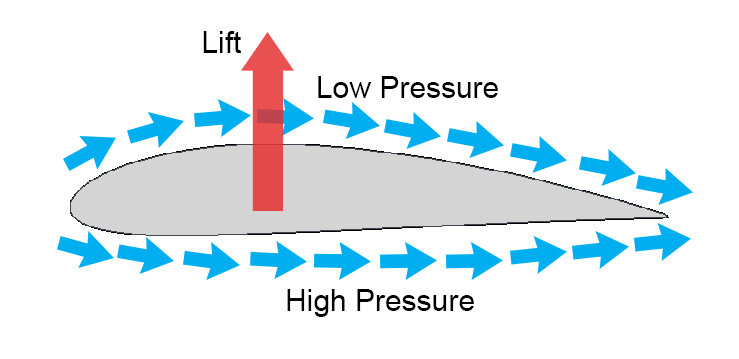
For an airplane to stay at a constant altitude, lift must be equal to its weight.
Thrust and Drag
Thrust is the force that pushes the airplane forward. It’s generated by the engines, which might be propellers spinning or jet engines blasting hot gas out the back. Thrust is what overcomes the resistance of the air and gives the plane the speed it needs to generate lift.
Drag is the force that opposes thrust. Think of it as air friction. It's the resistance the air puts up as the airplane tries to move through it. If you've ever stuck your hand out of a moving car's window, you've felt drag pushing against it. The plane's shape is designed to be as streamlined as possible to minimize this resistance.
The Balancing Act
Flying is all about managing the balance between these four forces. The pilot and the plane's systems constantly make adjustments to control them. The relationship between the forces determines what the airplane is doing.
| Phase of Flight | Force Relationship |
|---|---|
| Straight & Level Cruise | Lift = Weight, Thrust = Drag |
| Climbing | Lift > Weight, Thrust > Drag |
| Descending | Lift < Weight, Thrust < Drag |
| Accelerating | Thrust > Drag |
| Decelerating | Thrust < Drag |
In a steady, level cruise, the forces are in equilibrium. Lift perfectly balances weight, and thrust perfectly balances drag. To climb, the pilot increases thrust and adjusts the wings to generate more lift than the plane's weight. To descend, they do the opposite. It's a continuous, dynamic dance of physics that makes modern air travel possible.
Which force directly opposes the forward motion of an airplane?
When an airplane is flying at a constant altitude and constant speed (in a steady cruise), which of the following is true?