Adventures in Elementary Science
Scientific Inquiry
The Spark of Curiosity
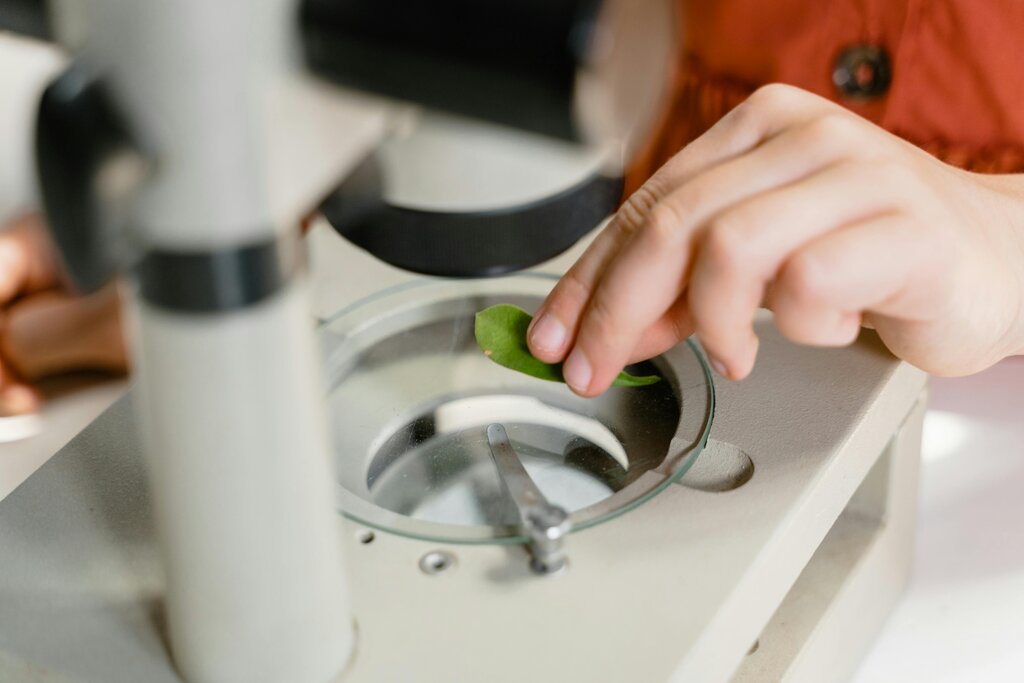
Scientific inquiry starts with a simple act: observation. This isn't just a passive glance. It's an active process of noticing the world, recognizing patterns, and questioning what you see. An observation might be noting that your houseplants near a sunny window seem to grow faster than those in a shadier corner of the room. This initial moment of curiosity is the seed of every scientific discovery.
Observation
noun
The act of gathering information about the world through the senses or with scientific tools.
Observations can be qualitative, describing qualities like color or texture ("the leaves on the sunny plant are a vibrant green"). They can also be quantitative, involving measurements and numbers ("the plant in the window grew 5 cm in a week"). Both types are valuable. Qualitative observations can lead to new questions, while quantitative data provides the hard evidence needed to test them.
From Question to Hypothesis
An observation leads to a question. For our plants, the question is straightforward: "Does the amount of sunlight a plant receives affect its growth?" To answer this, we need to form a hypothesis. A hypothesis isn't a random guess; it's a specific, testable statement that proposes an answer to your question. It often takes the form of an "If... then..." statement.
Hypothesis
noun
A proposed explanation for a phenomenon made as a starting point for further investigation.
A good hypothesis is falsifiable, which means it's possible to design an experiment that could prove it wrong. For our plant example, a solid hypothesis would be: "If a plant receives more hours of direct sunlight, then it will grow taller than a plant that receives fewer hours." This statement is clear, measurable, and directly testable.
A weak hypothesis might be "Sunlight is good for plants." It's too vague. How much sunlight? What does "good" mean? A strong hypothesis is precise.
Designing the Test
With a hypothesis in hand, the next step is to design an experiment to test it. A well-designed experiment isolates the one factor you want to study. This factor is called the independent variable. In our case, the independent variable is the amount of sunlight. The outcome you measure is the dependent variable, which here is plant height.
To test our hypothesis, we could set up three identical plants. One gets 8 hours of direct sunlight (Group A), one gets 4 hours (Group B), and one gets only 2 hours (Group C). Every other condition—the type of plant, pot size, soil, amount of water, and room temperature—must be kept exactly the same for all three. These are our controlled variables. Keeping them constant is crucial for a fair test.
Making Sense of the Results
Once the experiment is running, you collect data. This involves making and recording systematic observations. For our plants, we would measure the height of each plant at regular intervals, perhaps every day for three weeks, and record the measurements in a log or spreadsheet. It’s important to be meticulous and consistent.
| Day | Plant A Height (cm) | Plant B Height (cm) | Plant C Height (cm) |
|---|---|---|---|
| 1 | 10.0 | 10.0 | 10.0 |
| 7 | 12.5 | 11.5 | 10.5 |
| 14 | 15.2 | 12.8 | 11.1 |
| 21 | 18.0 | 14.0 | 11.5 |
After collecting the data, you analyze it. This means looking for patterns and trends. Does the data support the hypothesis? In our example, the table shows that Plant A, which received the most sun, grew the tallest. Plant C, with the least sun, grew the shortest. This pattern suggests a clear relationship between sunlight and growth.
Scientific inquiry can be understood as a flexible process that includes various steps such as questioning, observing, hypothesizing, experimenting, and drawing conclusions.
Conclusion and What's Next
The final step is to draw a conclusion. Based on our analysis, we can conclude that the data supports our hypothesis: more sunlight leads to greater plant growth. Your conclusion should summarize your findings and explain how they relate back to your original question.
But science rarely ends with one conclusion. The process is cyclical. Your findings might lead to new questions. For instance, is there an optimal amount of sunlight? Does too much sunlight harm the plant? Each conclusion can be the starting point for a new observation and a new hypothesis.
This iterative process of questioning, testing, and refining is how scientific knowledge grows over time.
Now, let's test your understanding of the scientific inquiry process.
A scientist notes that a plant in a sunny window grew 5 cm in one week. What type of observation is this?
What is the primary purpose of a hypothesis in the scientific method?
By following these steps, you can explore the world in a structured and logical way, turning simple curiosity into real understanding.