Advancing Your Yoga Practice
Intermediate Hip Mechanics
Beyond the Basic Shape
You've likely settled into Pigeon Pose many times, feeling the stretch in your outer hip. But to move towards more advanced shapes like Eka Pada Rajakapotasana (King Pigeon), we need to shift our focus from passively mimicking a shape to actively controlling our anatomy. The goal is to create stability first, then find depth.
This involves a team of muscles working in concert. While the front leg's hip flexors and rotators are stretching, other muscles must engage to protect the joints. Three key players in this are the psoas (a deep hip flexor of the back leg), the gluteus medius on the outer hip of the front leg, and the deep core muscles of the pelvic floor. Understanding their interplay is the difference between forcing a pose and embodying it.
Gluteus Medius: Essential for pelvic stability; weakness linked to CPD.
Active vs. Passive Rotation
Imagine someone lifting your leg out to the side for you. That’s passive range of motion. Now, imagine lifting your leg out to the side using only your own muscle strength. That’s active range of motion. While passive stretching has its place, relying on it too much can lead to instability, especially in a weight-bearing joint like the hip.
In a deep hip opener, simply letting gravity pull your knee to the floor without muscular support is a passive approach. An active approach involves using the muscles around the hip, particularly the gluteus medius, to externally rotate the thigh bone in its socket. This creates the rotation from a place of strength, protecting the ligaments of the hip and knee.
By actively pressing the front shin and ankle into the mat and engaging the outer hip, you create stability. This allows the hip flexors of the back leg to release more safely and effectively. It transforms the pose from a passive stretch into an active, strengthening posture.
Stabilising for Depth
When we push for deep hip opening without proper support, we can sometimes create movement in joints that are designed for stability, not mobility. A key area of concern is the SI joint (sacroiliac joint), which connects your pelvis to your spine.
If you feel a pinching or jamming sensation in your lower back or deep in your pelvis during Pigeon, it might be a sign of instability at the SI joint. The solution is not to back off entirely, but to re-engage. By lifting the pelvic floor and activating the deep core muscles, you create a muscular corset that supports the SI joint. This allows the hip joint—a ball-and-socket joint designed for a wide range of motion—to open up without compromising the stability of the pelvis and spine.
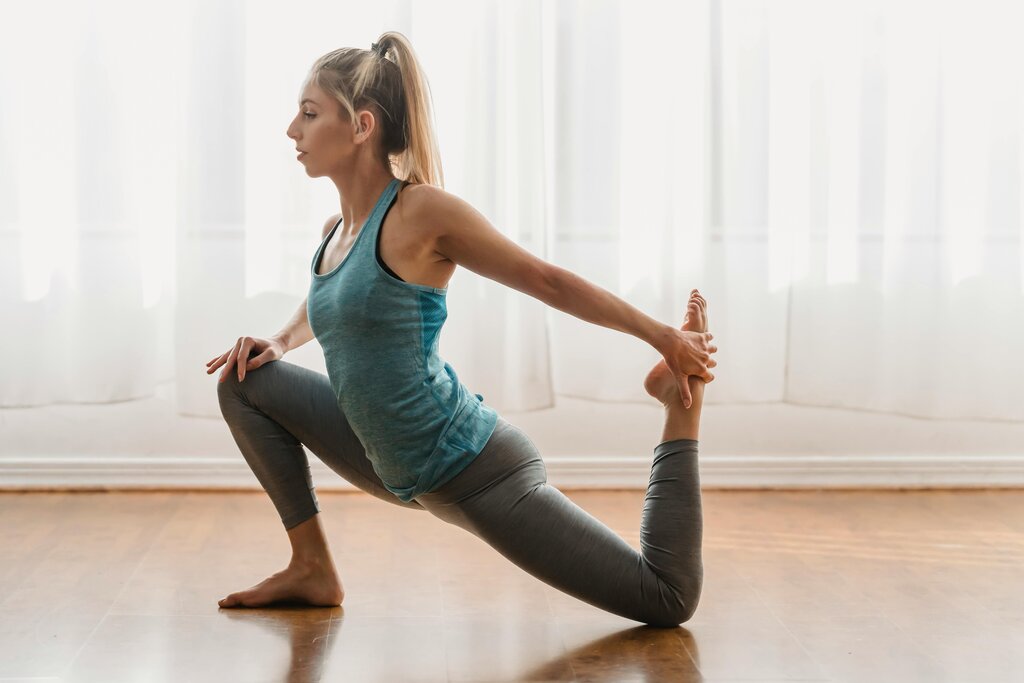
As you work towards King Pigeon, think less about forcing your hips square to the front of the mat. Instead, focus on these actions:
- Press down through the front shin and the top of the back foot to create an active foundation.
- Engage the outer hip of the front leg, as if you are trying to drag your front knee outwards without it actually moving.
- Gently lift through your pelvic floor and lower abdomen to support your lower back and SI joint.
- Extend actively through the back leg, lengthening the psoas rather than just letting it hang.
This approach builds the strength and stability needed to open the body intelligently, turning a challenging pose into an expression of controlled freedom.
Time to check your understanding of these deeper mechanics.
What is the primary principle to focus on when advancing your Pigeon Pose towards shapes like King Pigeon?
Lifting your leg out to the side using your own muscle strength is an example of active range of motion.
By integrating these principles of active engagement, you'll build a more resilient and intelligent practice.