Advancing Your Yoga Practice
Alignment and Bandhas
Beyond the Shape
You already know the basic shapes of yoga asanas. Tadasana is Mountain Pose. Adho Mukha Svanasana is Downward-Facing Dog. But moving beyond a beginner's practice means refining these shapes from the inside out. It's the difference between simply holding a pose and inhabiting it with stability and purpose.
This refinement comes from two connected principles: precise biomechanical alignment and the engagement of internal energy locks, or bandhas . Alignment isn't about creating a perfect, rigid shape. It's about stacking your joints and engaging your muscles in a way that creates stability, prevents injury, and allows energy to flow more freely. Bandhas are the engine for this process, generating core stability and a sense of lightness that can transform your practice.
The ideas of consciously stacked joints to protect all the good stuff in and around them, alignment from the crown of your neck down to the bottoms of your feet, and activation of the Bandhas — feet flexed, belly up and in, pelvic floor lifting — are the roots of your entire practice.
The Blueprint of Stability
Let's start with alignment in our most foundational standing pose: Tadasana. It seems simple, but it’s the blueprint for all other standing postures.
Begin with your feet. Press down through all four corners of each foot—the mounds of the big and little toes, and the inner and outer heels. This creates a solid foundation. Engage your quadriceps to lift your kneecaps, but avoid locking your knees. Keep a micro-bend to protect the joint.
The position of your pelvis is crucial. Most people stand with either an anterior (forward) or posterior (backward) tilt. Find a neutral pelvis by imagining your pelvic bowl holding water; you don't want to spill it forward or backward. This aligns your lower back naturally. From there, lengthen your spine, drawing your shoulder blades down your back and lifting through the crown of your head.
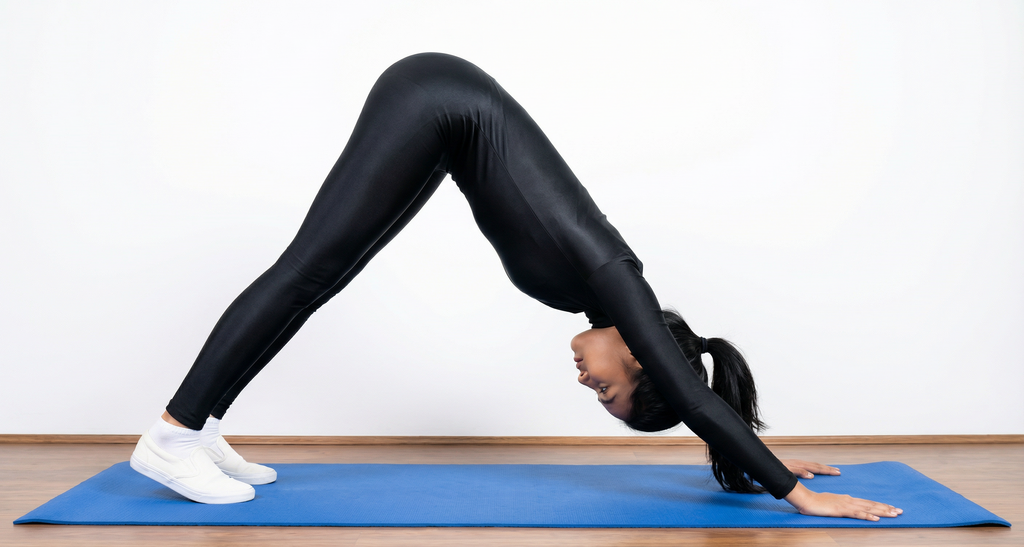
Now let's apply this focus to Adho Mukha Svanasana. Instead of just pushing back into a V-shape, think about the lines of energy. Press firmly into the mat with your entire hand, especially the base of your index finger and thumb. This protects your wrists.
Externally rotate your upper arms to broaden your collarbones and create space for your neck. Your head should hang freely. The primary goal isn't to get your heels to the floor, but to create a long, straight line from your hands to your hips. Bending your knees generously can help you achieve this spinal length. Push the floor away from you, sending your hips up and back.
Igniting the Core
Proper alignment creates the structure. provide the intelligent, internal energy to support that structure. Think of them as subtle muscular engagements that create stability from your deep core.
The two most important bandhas for asana practice are Mula Bandha and Uddiyana Bandha.
Mula Bandha is the root lock. It's a gentle contraction and lift of the muscles of the —the hammock of muscles at the base of your pelvis. The sensation is a subtle lift, not a hard clench. Engaging Mula Bandha provides a stable base for your spine and helps to draw energy upward.
Uddiyana Bandha is the abdominal lock. In asana practice, this isn't the full, intense version performed as a separate breathing exercise. Instead, it’s a gentle drawing of the lower abdomen, from the navel down to the pubic bone, in and up towards the spine. This engagement supports your lower back and creates a feeling of lightness, especially in transitions and inversions.
The key to engaging the bandhas is connecting them to your breath. As you exhale, gently engage Mula Bandha first, then Uddiyana Bandha. The end of the exhale is the moment of peak engagement. As you inhale, you can soften the engagement slightly, but don't release it completely. Maintaining this subtle core connection throughout your practice is the goal.
Revisit Tadasana. On an exhale, find Mula and Uddiyana Bandha. Feel how it creates an energetic lift from your feet all the way through the crown of your head. Now try it in Downward-Facing Dog. As you exhale and press the floor away, engage the bandhas. Notice the lightness it creates, how it helps you lift your hips higher and takes some of the weight out of your arms. You are no longer just holding a shape; you are actively creating it with internal support.
To test your understanding of these core principles, let's move on to a short quiz.
What is the primary purpose of precise biomechanical alignment in yoga asana?
In Adho Mukha Svanasana (Downward-Facing Dog), the primary goal is to create a long, straight line from your hands to your hips, even if it means bending your knees.
Mastering alignment and the bandhas is a continuous process of refinement. It shifts your practice from an external physical exercise to an internal experience of stability, energy, and awareness.