Advancing Your Understanding of ADHD
Neurobiological Mechanisms
The Brain's Executive Suite
The (PFC) acts as the brain's chief executive officer. Situated right behind your forehead, this region is responsible for complex cognitive behavior, personality expression, decision-making, and moderating social behavior. In short, it handles the executive functions: planning, prioritizing, and inhibiting impulses. In the ADHD brain, the PFC can be underdeveloped or under-activated, which helps explain the core challenges with self-regulation and impulse control.
Think of the PFC as a car's braking system. For a neurotypical person, the brakes are responsive and reliable. For someone with ADHD, the brake pedal might be softer and require more conscious effort to engage, making it harder to stop a thought or action once it has started.
The Dopamine Dial
Neurotransmitters are the chemical messengers that allow brain cells to communicate. For the PFC, the most critical messenger for executive function is . It's often misunderstood as just the "pleasure chemical," but its role is far more nuanced, especially in the context of ADHD. Dopamine signaling operates on two main levels: tonic and phasic release.
Tonic release is the slow, steady background hum of dopamine that maintains your baseline level of alertness and mood. It’s what keeps the PFC online and ready for action. Phasic release, on the other hand, is the sharp, sudden burst of dopamine that occurs in response to something new, exciting, or rewarding. It's the signal that says, "Pay attention! This is important!"
In the ADHD brain, the tonic dopamine level is often lower. This creates a state of under-arousal in the PFC, making it difficult to engage with tasks that aren't inherently stimulating. To compensate, the brain seeks out activities that trigger a strong phasic release. This explains why a person with ADHD might struggle with a mundane chore but can hyperfocus for hours on a video game or a passion project.
Signal, Noise, and Norepinephrine
Dopamine doesn't work alone. Its partner, , is another crucial neurotransmitter for attention. While dopamine helps signal what's rewarding and worth focusing on, norepinephrine helps manage the brain's "signal-to-noise ratio."
Imagine trying to listen to a quiet conversation in a loud room. The conversation is the signal, and the background chatter is the noise. Norepinephrine acts like a filter, dampening the noise so you can tune into the signal. In the ADHD brain, this filtering mechanism is less efficient. External distractions and internal thoughts (the noise) can easily overpower the intended focus (the signal), making sustained attention difficult.
Reward, Routines, and Rest
Deep inside the brain, the basal ganglia play a key role in motivation, forming habits, and processing rewards. This network of structures works closely with the PFC, using dopamine signals to select and initiate appropriate actions. When reward pathways in the basal ganglia are under-stimulated due to dopamine dysregulation, motivation for non-immediate rewards wanes. This is why long-term projects with distant payoffs can feel almost impossible for someone with ADHD, while tasks with immediate feedback are highly engaging.
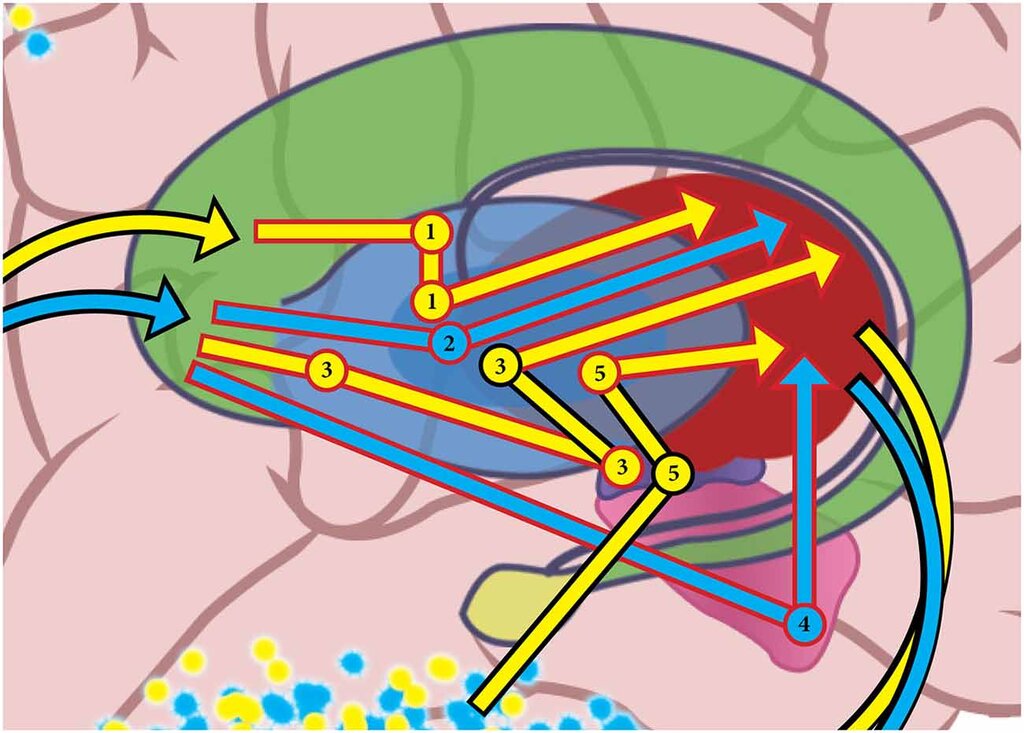
Finally, we have two competing brain networks: the Default Mode Network (DMN) and the Task-Positive Network (TPN). The TPN is active when you're focused on a task. The DMN, in contrast, is your brain's "idle" state—it's active when you're mind-wandering, daydreaming, or thinking about yourself and others.
In a neurotypical brain, these two networks have an inverse relationship. When the TPN turns on, the DMN turns off, and vice versa. In the ADHD brain, this switch is faulty. The DMN often fails to deactivate when a task requires focus, leading to intrusive thoughts and a wandering mind. It’s like trying to work with the radio playing loudly in the background, a constant source of internal distraction.
Now, let's test your understanding of these neurobiological concepts.
Which part of the brain, often referred to as the 'chief executive officer,' is primarily responsible for executive functions like planning and impulse control and is often under-activated in ADHD?
In the context of ADHD, why might a person be able to hyperfocus on a stimulating video game for hours but struggle to complete a mundane chore?
Understanding these mechanisms moves us beyond seeing ADHD as a simple deficit of attention and toward a more nuanced view of it as a complex difference in brain wiring and chemical signaling.