Advancing Your Minecraft Mastery
Redstone Logic Foundations
The Language of Redstone
You've survived, you've built a base, and you've mined some diamonds. Now it's time to make your world work for you. Redstone is Minecraft's version of electricity, allowing you to create automated farms, secret doors, and complex machines. It all starts with understanding the signal.
Think of Redstone dust as a wire. When a power source like a Redstone torch, lever, or button is activated, it sends a signal down the dust. This signal isn't just on or off; it has a signal strength that ranges from 15 down to 0. A power source emits a signal at full strength, 15. For every block of dust the signal travels, its strength decreases by one. After 15 blocks, the signal dies completely.
This 15-block limit is a fundamental rule. To send a signal further, you need to boost it.
Manipulating the Signal
Two key components allow you to control and read Redstone signals: the Repeater and the Comparator.
A Redstone Repeater does two things. First, it acts as a signal booster. It takes any signal strength from 1 to 15, and outputs a fresh, full-strength signal of 15. This allows you to create circuits that span vast distances. Second, it adds a delay. You can right-click a repeater to cycle through four delay settings, from one to four Redstone tickss. This is crucial for timing events in your contraptions, like the sequence of a piston door opening.
The Redstone Comparator is a bit more complex. Its main job is to measure things. When placed next to a container like a chest, furnace, or hopper, it emits a Redstone signal whose strength is proportional to how full that container is. An empty chest gives a signal of 0, while a completely full chest gives a signal of 15. This lets you build systems that activate only when a chest is full or a furnace has finished smelting.
Comparators also have a secondary mode, subtraction mode, which you can toggle by right-clicking. In this mode, they compare the signal from behind with the signal from the side and output the difference. It's an advanced feature, but useful for more complex calculations.
Building with Logic
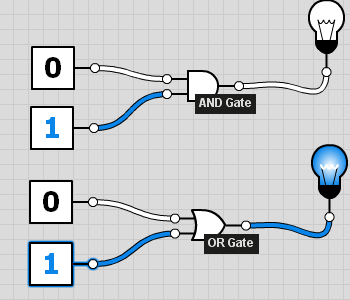
With just a few components, you can build logic gates. These are simple circuits that make decisions based on their inputs, forming the foundation of all advanced Redstone machinery. The three most fundamental gates are NOT, AND, and OR.
A NOT gate, or inverter, does exactly what its name implies: it inverts the signal. If the input is ON, the output is OFF. If the input is OFF, the output is ON. The simplest way to build this is to place a Redstone torch on the side of a block that is being powered.
An AND gate requires two inputs to be ON for the output to be ON. If either input (or both) is OFF, the output is OFF. A common design involves two levers powering blocks, with Redstone torches on the other side. The torches power a line of dust that leads to a third, inverted torch, which is the output.
An OR gate is simpler. The output is ON if at least one of its inputs is ON. It only turns OFF if all inputs are OFF. You can make one just by having two lines of Redstone dust from two different levers merge into a single line.
Powering Blocks
Finally, it's crucial to understand how power travels through blocks. There are two types of powering: hard powering and soft powering.
A block is hard-powered when a Redstone component like a repeater or comparator points directly into it, or when a lever or button on the block is activated. A hard-powered block will power all adjacent Redstone dust, including the dust on top of and below it.
A block is soft-powered (or quasi-powered) when Redstone dust on top of it is lit. A soft-powered block can activate adjacent Redstone components like repeaters or pistons, but it will not power adjacent Redstone dust. This distinction is subtle but essential for building compact and reliable circuits. Mastering it prevents your signals from interfering with each other in tight spaces.
With these fundamentals of signal strength, manipulation, logic, and power, you have all the tools you need to start building truly impressive machines in Minecraft.
Ready to test your knowledge?
What is the maximum number of blocks a standard Redstone signal can travel along a line of dust before its strength becomes 0?
You want a piston to activate only when a chest next to it is completely full. Which component should you use to read the chest's state?