Advancing Your Karate Practice
Advanced Power Mechanics
The Source of Power
True power in karate doesn't come from the arm or leg alone. It starts from the ground up, travelling through the body in a sequence called the kinetic chain. Imagine cracking a whip. The handle moves first, but the real speed and force are delivered at the very tip. Your body works the same way. The power for a punch begins with your feet pushing against the floor, a concept known as ground reaction force. This energy travels up your legs, is amplified by the rotation of your hips and torso, and finally explodes out through your fist or foot.
Each link in this chain adds to the total force. A weak link, like unstable footing or stiff hips, breaks the chain and drains your power. Mastering this sequence is the difference between a simple push and a devastating strike.
The Engine of Your Hips
If the ground is the source of your power, your hips are the engine. The explosive rotation of the hips, or Koshi no Kaiten, is what truly amplifies the force generated by your stance. It's not a gentle turn; it's a sharp, snapping motion that twists your entire torso. Think of it like wringing out a towel. The force comes from the powerful twist in the middle.
Koshi no Kaiten
noun
A Japanese term literally translating to "hip rotation." In karate, it refers to the dynamic and powerful use of the hips to generate force for techniques.
This rotation is directly linked to the pull of your non-striking hand. This is the principle of Hikite. As you punch with your right hand, you must simultaneously and forcefully pull your left hand back to your hip. This isn't just resetting for the next move; it's an integral part of the strike. The sharp pull of the retracting hand accelerates the rotation of your hips and shoulders, adding significant torque and speed to the striking fist.
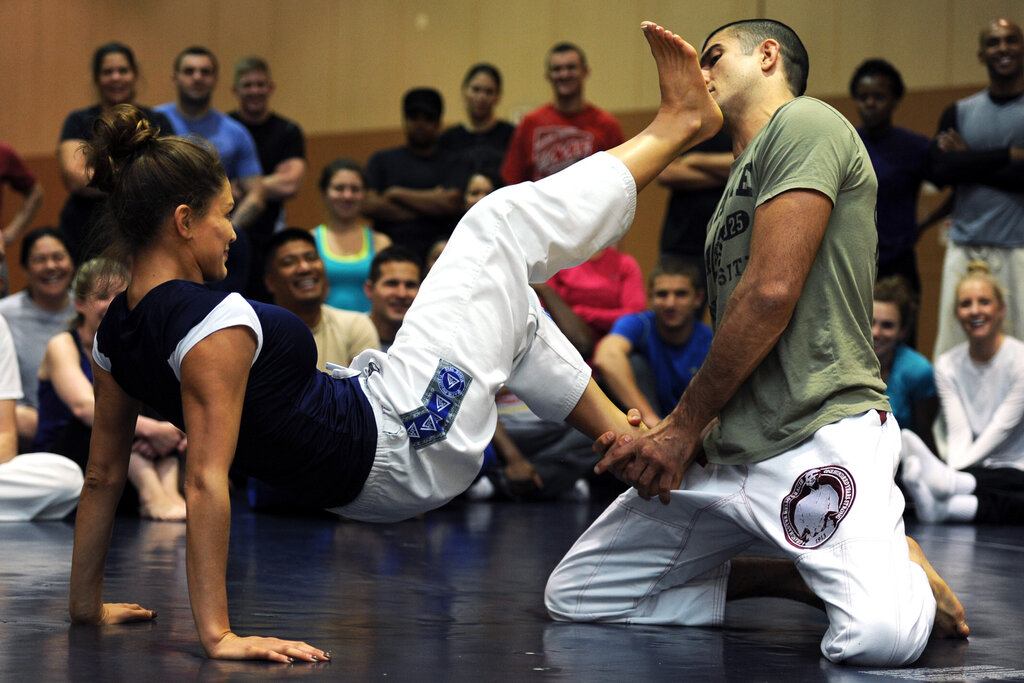
For every action, there is an equal and opposite reaction. The faster and harder you pull your Hikite, the faster and harder your strike will be.
Tension and Release
It seems counter-intuitive, but the key to immense power is relaxation. If your muscles are tense throughout a technique, you are fighting against yourself. You create drag, slow yourself down, and waste energy. Speed is a critical component of power, and tension is the enemy of speed.
The proper method is to remain fluid and relaxed during the execution of a punch or kick. Your body should be loose, allowing the kinetic chain to transfer energy smoothly. Only in the final instant, at the moment of impact, do you apply —a total-body contraction. All the muscles in your body, from your toes to your fingertips, tense for a split second. This focuses all the accumulated energy into the target.
Imagine throwing a rock. You don't hold your arm stiff the entire time. You swing it loosely and freely, and your grip only tightens at the moment of release. After impact, you immediately relax again, ready to flow into the next movement. This cycle of relaxation-tension-relaxation is the heartbeat of powerful karate.
To recap the process:
- Initiate from a solid stance, pushing off the floor.
- Amplify that energy with an explosive hip rotation (Koshi no Kaiten).
- Accelerate the rotation using a sharp, fast Hikite.
- Focus all the power at the target with a final, full-body contraction (Shime).
By mastering these mechanics, you move beyond simply executing techniques and begin to truly understand how to generate power.
According to the principles of karate, where does the power for a punch or kick truly begin?
What is the primary function of Koshi no Kaiten (explosive hip rotation) in a karate technique?
Understanding these principles is the first step. The next is countless hours of practice, turning mechanical knowledge into natural, instinctive movement.